
Disclosure: WebFin is reader-supported. If you buy hosting through links on this page, we may earn a commission at no extra cost to you. Commissions vary between providers and our ratings do not — here’s our full disclosure.
Bluehost vs HostGator is a comparison between two brands of one company. Newfold Digital has owned both since 2021, and this year it moved both onto Oracle Cloud. The benchmark project we cite now scores their hardware at the top of the field, side by side. So the machines are no longer what separates them. What does is the price shape, the refund terms, the extras at checkout, and a performance record that one brand has kept clean and the other is still repairing.
Bluehost vs HostGator: The Short Answer
Bluehost, at 4.0 against 3.2 in our reviews. It renews at $9.99 against $10.99, its measured record is complete, and it passed a load test at 41 ms after the move. HostGator costs $135.00 across 36 months against $143.64, and it refunds for 45 days rather than 30.
Head to Head
| Criterion | Bluehost Starter | HostGator Hatchling |
|---|---|---|
| Owner | Newfold Digital, since 2021 | Newfold Digital, since 2021 |
| Infrastructure | Oracle Cloud | Oracle Cloud |
| Intro rate, 36-month term | $3.99/mo | $3.75/mo |
| Renewal, 36-month term | $9.99/mo | $10.99/mo |
| 36 months | $143.64 | $135.00 |
| Response time | 411 ms, 99.99% uptime | Improving; older readings poor |
| Load test | 41 ms, no errors | 762 ms at 500 users, older run |
| Server hardware | Joint-highest in the field | Joint-highest in the field |
| Refund window | 30 days, $15.99 kept for the domain | 45 days, all plans |
| Support | Phone and chat, 24/7 | Phone, chat and tickets, 24/7 |
| Our score | 4.0 | 3.2 |
One Owner, One Cloud
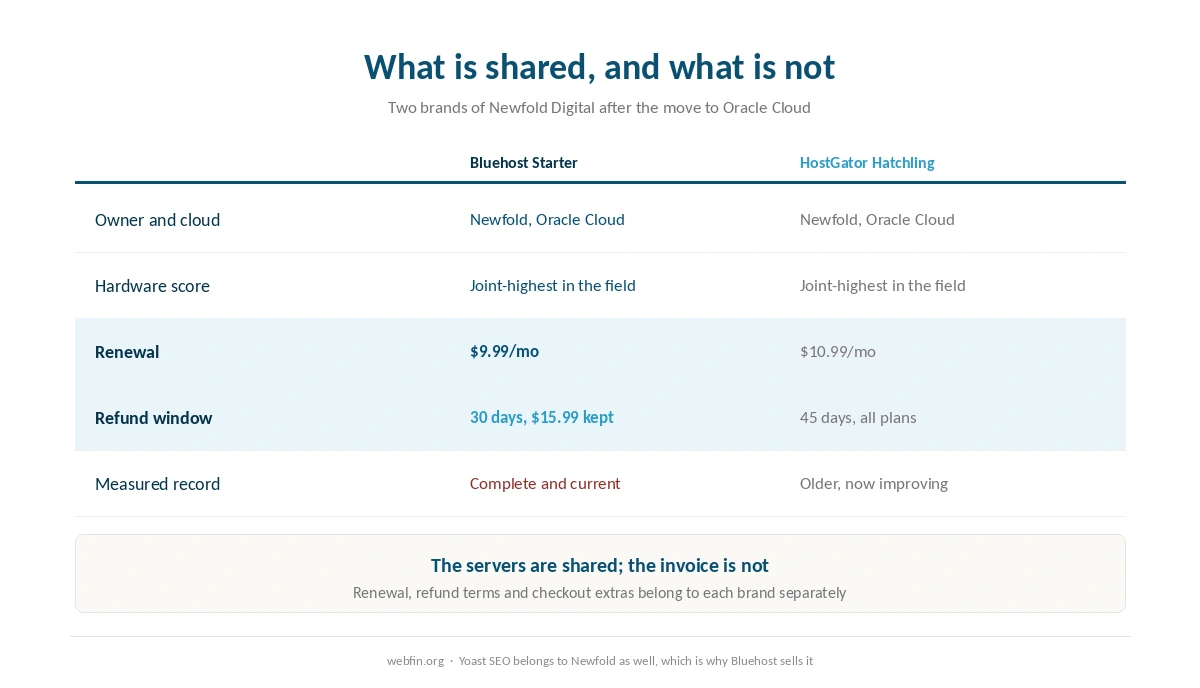
Newfold Digital took over both brands in 2021, and it also owns Yoast SEO, so all three answer to the same parent. Our page on who owns Bluehost traces the group in full. Shared ownership usually means shared infrastructure eventually, and this year it arrived.
The benchmark project we cite reports that Newfold moved HostGator’s data centers to Oracle Cloud, much like Bluehost, and saw a clear improvement afterward. In its update of 1 September 2026, HostGator climbs on the joint-highest hardware score in the field. Bluehost sits on that score too, at 9.6 of 10.
⚠️ That changes how to read this comparison. Hardware used to be a reason to pick one over the other. Now the servers are the same company’s servers, and the choice comes down to how each brand charges you for them.
Two Price Shapes From One Company
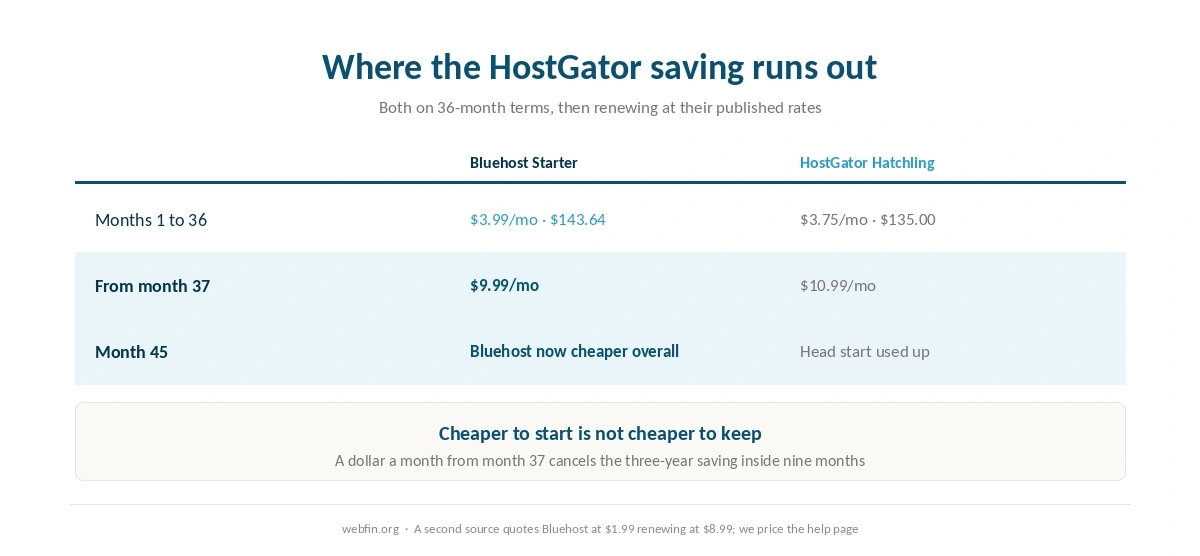
Bluehost Starter opens at $3.99 on a 36-month term and renews at $9.99, which is 2.5× over 36 months. HostGator Hatchling opens at $3.75 and renews at $10.99, which is 2.9× over 36 months. So HostGator is cheaper to start and dearer to keep. The same HostGator figures against Kinsta are in our Kinsta and HostGator comparison.
Across the first 36 months HostGator comes to $135.00 and Bluehost to $143.64. From month 37 HostGator costs a dollar a month more, so its head start runs out during month 45. For a site you plan to keep longer than that, Bluehost is the cheaper brand of the two. Our page on hosting renewal prices sets both beside the field.
⚠️ Bluehost prices are disputed between sources. Its own help page gives $3.99 renewing at $9.99 on 36 months and $11.99 on 12. The benchmark project’s July 2026 review quotes an intro of $1.99 renewing at $8.99, without stating the term. We price the help page, and the other reading would only make Bluehost cheaper.
| Host and plan | Intro → Renewal | Multiplier |
|---|---|---|
| IONOS Plus | $1.00 → $14.00 | 14.0× over 12 months |
| SiteGround StartUp | $2.99 → $17.99 | 6.0× over 12 months |
| SiteGround GrowBig | $4.99 → $29.99 | 6.0× over 12 months |
| SiteGround GoGeek | $7.99 → $44.99 | 5.6× over 12 months |
| ChemiCloud Starter | $2.49 → not published | Renewal shown at checkout only |
| Scala Hosting Mini | $2.95 → $11.95 | 4.1× over 12 months |
| DreamHost Launch, annual | $2.89 → $10.99 | 3.8× over 12 months |
| Hostinger Premium | $2.99 → $10.99 | 3.7× over 48 months |
| Bluehost Starter | $3.99 → $11.99 | 3.0× over 12 months |
| A2 Hosting Turbo Boost | $6.99 → $20.99 | 3.0× over 12 months |
| HostGator Hatchling | $3.75 → $10.99 | 2.9× over 36 months |
| GoDaddy Economy | $5.99 → $15.32 | 2.6× over 36 months |
| Bluehost Starter | $3.99 → $9.99 | 2.5× over 36 months |
| Namecheap Stellar | $1.98 → $4.88 | 2.5× over 12 or 24 months |
| Namecheap Stellar Plus | $2.98 → $6.88 | 2.3× over 12 or 24 months |
| Namecheap Stellar Business | $4.98 → $9.88 | 2.0× over 12 or 24 months |
| DreamHost Launch, 4-year | $2.89 → $7.99 | 2.8× over 48 months |
| DreamHost, eligible US nonprofits | One shared plan free for the account's life | 501(c)(3) or (c)(19); help article, checked 10 Jun 2026 by a nonprofit directory |
| Bluehost Business | $6.99 → $13.99 | 2.0× over 36 months |
| Bluehost Starter, second reading | $1.99 → $8.99 | Hostingstep, July 2026; conflicts with Bluehost's help page |
| Hostwinds Basic | $4.54 → $6.99 | 1.5× over 12 months |
| WP Engine Startup | $27.00 → $35.00 | 1.3× over 12 months |
| Rocket.net Starter | $25.00 → $30.00 | 1.2× over 12 months |
| InterServer Standard | $2.50 flat | 1.0×, price lock |
| Cloudways, from | $14.00 flat | no promotional term |
| Kinsta Starter | $35.00 flat | no promotional term |
| Liquid Web managed VPS, annual billing | $33.00, no promotional term | No increase described on annual billing |
| Liquid Web managed VPS, monthly billing | $36.00 → $72.00 reported | 2.0× over one month; one pricing guide, disputed |
| GreenGeeks Lite | $2.95 → $13.95 | 4.7× after one term; renewal was $12.95 before 2026 |
| ChemiCloud Starter, third-party figures | $9.95, $11.95 or $12.95 quoted | Sources disagree; 4.0× to 5.2× over 36 months |
| SiteGround StartUp, by term | $2.99 → $14.99, $17.99 or $24.99 | 5.0× over 24 months, 6.0× over 12, 8.4× month to month |
| ChemiCloud Kickstart, reseller | $8.99 → $29.95 | Term not stated in the source we read |
| InterServer reseller | $19.95, price locked | No increase described in sources |
| GreenGeeks reseller | $19.95 with WHMCS included | Promotional rate; renewal not published |
| Hostwinds white-label reseller | $10.00 with WHMCS included | Plain reseller plan excludes WHMCS |
| InMotion Core, 36-month term | $3.19 → $10.99 | 3.4× over 36 months; TechRadar, 2026 |
| InMotion Launch, 36-month term | $4.99 → $13.99 | 2.8× over 36 months; TechRadar and plan cards, 2026 |
| InMotion Core, by term | Renews at $10.99, $11.99 or $14.49 | Longest term lowest; one review, May 2026 |
The Record Is Where They Differ
Bluehost’s measured record is clean and current. Across November 2025 to August 2026 the benchmark project records 411 ms response time and 99.99% uptime over 9 outages, which puts it first in that project’s shared-hosting ranking. After the Oracle move it reran the load test and recorded 41 ms with no errors.
HostGator’s record is older and worse, and it is changing. The same project’s HostGator review reports 99.68% uptime, a global first byte averaging 1.23 seconds, and 762 ms under 500 concurrent visitors. Those readings largely predate the move. The September update describes a visible improvement since, without yet the full dataset that Bluehost has.
So our score of 3.2 reflects a HostGator that may no longer exist. If the next window confirms the improvement, the score moves, and we will say so on this page. Until then, our guide to reading an uptime report explains why a short improving window is weaker evidence than a long stable one.
What the Move to Oracle Changes, and What It Does Not
A shared cloud fixes the part of hosting that customers cannot see: processors, memory, disks and the network behind them. That is why both brands now share a hardware score, and why HostGator’s readings are improving from a low base. For an existing HostGator customer, it is the first good news in several years of benchmarks.
It fixes nothing a customer can see on an invoice. The renewal rates, the refund terms, the pre-selected extras and the backup policy all belong to each brand, and none of them moved with the servers. So the comparison that mattered before the migration still matters now: what each brand charges, and what it gives back when you leave.
⚠️ It also resets the evidence. Readings taken before the move describe hardware that no longer exists, and readings taken after cover a short window. Until the next full year is in, the fair summary is that Bluehost is proven on the new cloud and HostGator is promising on it.
Extras, Pre-Selected and Otherwise
HostGator pre-selects SiteLock at checkout for $23.88. It sells CodeGuard daily backups at $35.88, a dedicated IP at $59.40 and professional migration at $149.99. None of these are required, and the pre-selected one needs unticking.
Bluehost’s menu sits in the dashboard rather than the cart. A premium SSL certificate is $89.88 and optional, because the free one covers most sites. SiteLock starts at $95.88, and Yoast SEO Premium is $99.99, which keeps that money inside Newfold as well. Our page on hidden hosting fees collects these across the field.
Refunds and Backups
HostGator refunds for 45 days on every plan, excluding domains and add-ons. Bluehost refunds for 30 days and keeps $15.99 for the free domain if you leave early. On this point HostGator is plainly the better deal, and our guide to canceling hosting and getting a refund covers the order that keeps the domain safe.
Backups are weak at both. HostGator’s own terms describe its weekly copies as a courtesy rather than a guarantee. The benchmark project notes that Bluehost Starter offers weekly rather than daily backups. At either brand, keep your own copies, as our guide to backing up a WordPress site explains.
Support
HostGator publishes phone, chat and tickets around the clock. Bluehost publishes phone and chat around the clock. Neither publishes a measured response time, and no controlled test of hosting support exists in the sources we found, so the channel list is the whole comparison.
Panels and Everyday Use
Both brands run cPanel underneath their own account portals, so the day-to-day tools are familiar at either one. Bluehost puts a WordPress-focused dashboard in front, which handles installs and updates and also hosts its add-on menu. HostGator keeps closer to plain cPanel, which suits anyone who already knows the panel.
The portability point cuts in favor of both. A cPanel account exports in a standard format, so leaving either brand later is a routine move rather than a rebuild. That matters more than usual here, because the refund window is the only exit most buyers think about. Our guide to migrating web hosting covers the rest.
Limits Behind the Word Unlimited
Both brands sell shared plans as generous or unlimited, and both have ceilings. Bluehost’s own help pages describe inode limits in three different figures: 50,000 as a soft limit, 200,000 in the acceptable use policy and 1,000,000 as a terms of service violation. HostGator describes its weekly backups as a courtesy that it does not guarantee.
Neither figure touches a small site. Both matter for a large one, and neither brand makes them easy to find before you buy. Our piece on what unlimited hosting means is built around the Bluehost inode figures, because they show the gap between the word and the terms more clearly than any other example we found.
Why One Company Sells Both
Newfold runs several hosting brands at different price points, and these two sit close together. The practical effect for a buyer is that comparison shopping between them compares one company’s pricing strategies rather than two companies’ products. The support, the servers and the ownership are shared.
That is worth knowing before you treat a switch from one to the other as leaving. Moving from HostGator to Bluehost keeps you with the same parent, the same renewal policy and now the same cloud. If the reason you want to leave is the company, choose outside the group, and our comparison of Hostinger against HostGator is a place to start.
Winners by Category
Three years: HostGator, at $135.00 against $143.64. Year four onward: Bluehost, at $9.99 against $10.99. Measured record: Bluehost, complete and current. Load handling: Bluehost, at 41 ms with no errors. Hardware: a draw, on the same score and the same cloud. Refunds: HostGator, at 45 days with no domain deduction. Support channels: HostGator, which adds tickets.
When to Choose HostGator Instead
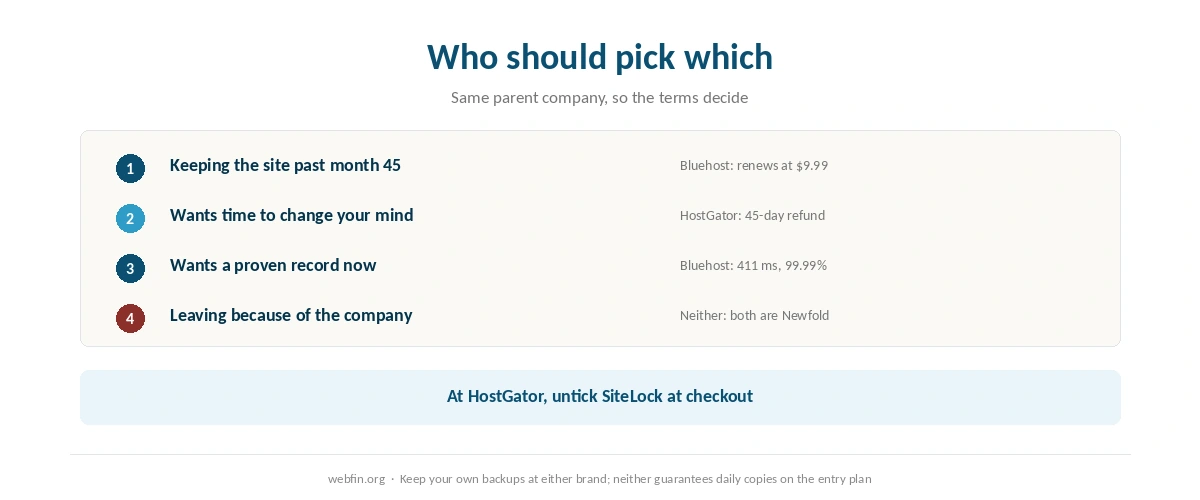
Take HostGator if the refund window matters, or if the site is a trial you might abandon within three years. It is cheaper for that stretch, and 45 days is enough to find out whether the site has a future. Just untick SiteLock at checkout.
Take Bluehost if you plan to keep the site past month 45, or if you want a measured record rather than a promising one. For the cheapest options outside Newfold, our roundup of cheap web hosting lists them.
How We Research
We run no tests. Measurements come from Hostingstep’s benchmarks, reviews and changelog, each with its window, and we mark where HostGator’s readings predate the move to Oracle Cloud. Prices, extras and refund terms come from the providers’ own pages, read on 20 September 2026.
Where sources disagree, as they do on Bluehost pricing, we print both and say which one we priced. The criteria behind our scores are on our about page, and the full workings are in our Bluehost review.
Bluehost vs HostGator FAQ
They share an owner. Newfold Digital has owned both since 2021, along with Yoast SEO, and this year it moved both onto Oracle Cloud. They remain separate brands with separate pricing, refund terms and checkout extras.
HostGator for the first 36 months, at $135.00 against $143.64. It renews at $10.99 against $9.99, so that saving runs out during month 45. For a site kept longer than that, Bluehost is the cheaper of the two.
Bluehost on the current record: 411 ms response time, 99.99% uptime and a load test at 41 ms with no errors. HostGator’s older readings were much worse, though the benchmark project reports a visible improvement since the move to Oracle Cloud.
HostGator, at 45 days on every plan, excluding domains and add-ons. Bluehost refunds for 30 days and keeps $15.99 for the free domain if you cancel early.
No. Both belong to Newfold Digital and now run on the same cloud. If the reason for leaving is the parent company, choose a host outside the group rather than another of its brands.
The Verdict
Bluehost takes this, and the reason is the record rather than the hardware. The two brands now run on the same cloud with the same hardware score, so what separates them is a cheaper renewal and a complete, current set of measurements on the Bluehost side. Our scores read 4.0 against 3.2.
HostGator deserves a second look in a few months. Its readings are improving, it refunds for longer, and it is cheaper for three years. Buy it with the refund window in mind and SiteLock unticked. Buy Bluehost if the site is meant to last. Either way you stay inside Newfold, which is what Bluehost against GoDaddy weighs against a company that sits outside it.