
Disclosure: WebFin is reader-supported. If you buy hosting through links on this page, we may earn a commission at no extra cost to you. Commissions vary between providers and our ratings do not — here’s our full disclosure.
A domain is the one thing you own in this arrangement, and the one purchase with no refund. In our table of refund windows, every host that lists exclusions excludes domains. Bluehost goes further, deducting $15.99 for its free domain if you cancel the plan. So the registrar decision is worth five minutes: where the name lives, what it renews at, whether privacy is included, and how hard it is to leave.
Best Domain Registrars: The Short Answer
Namecheap if you want a registrar rather than a host holding the name, with WHOIS privacy included for the life of the domain. DreamHost if you also host there, because privacy is included and the company is independent and employee-owned. Hostinger if the domain and the plan should sit in one cheap account. GoDaddy if you want a phone line, provided you decline its extras at checkout.
Why the Domain Should Not Be an Afterthought
It is never refunded. Every refund window in our table that lists exclusions excludes domain registration. Bluehost, a Newfold Digital brand, deducts $15.99 for a free domain when a plan is canceled. Our guide to canceling hosting and getting a refund covers the rest of that fine print.
It decides how easily you move host. A domain at a registrar makes a host change a DNS edit. A domain bundled with hosting makes it a transfer, a lock and a waiting period, as our guide to pointing a domain to a new host explains.
The first year tells you nothing. A free or one-dollar first year is a promotion. The renewal is the price you actually pay, year after year, and it is the number to read before buying.
Privacy is either included or billed. Namecheap, DreamHost and Hostinger include WHOIS privacy; several hosts charge for it annually, which our page on hidden hosting fees records.
| Host | Refund window | What's excluded |
|---|---|---|
| DreamHost | 97 days by four sources, 30 by another | Disputed; confirm at checkout |
| InMotion | 90 days on 6-month terms and longer | 30 days monthly, VPS and reseller; no monthly billing on shared |
| ChemiCloud | 45 days | Domains and add-ons |
| HostGator | 45 days, all plans | Domains and add-ons |
| Hostinger | 30 days | Domain registration |
| SiteGround | 30 days on shared, 14 on cloud; renewals within 30 days of payment | Domains and third-party services; monthly plans reported excluded |
| Bluehost | 30 days | Add-ons, domains and professional services; $15.99 deducted for the free domain |
| Scala Hosting | 30 days, then a pro-rated refund of unused term | Domains and licenses |
| Namecheap | 30 days; EasyWP adds a 30-day trial with no card | Domains |
| InterServer | 30 days | Domains |
| GreenGeeks | 30 days | Domains and add-ons |
| IONOS | 30 days | Domains |
| Rocket.net | 30 days | Domains |
| GoDaddy | 30 days | Domains and some services |
| Kinsta | 30 days | Domains |
| WP Engine | Monthly billing; cancel before the next cycle | Not a refund window in the usual sense |
| Liquid Web | Monthly billing, no contract | Not a refund window in the usual sense |
| Cloudways | Pay-as-you-go; stop and the billing stops | Not a refund window in the usual sense |
| A2 Hosting | Disputed: anytime guarantee, or standard terms | Two 2026 sources in conflict |
| Hostwinds | Disputed: 30 days by one source, 3 by two others | Confirm in writing before paying |
What the Revised ICANN Policy Changed
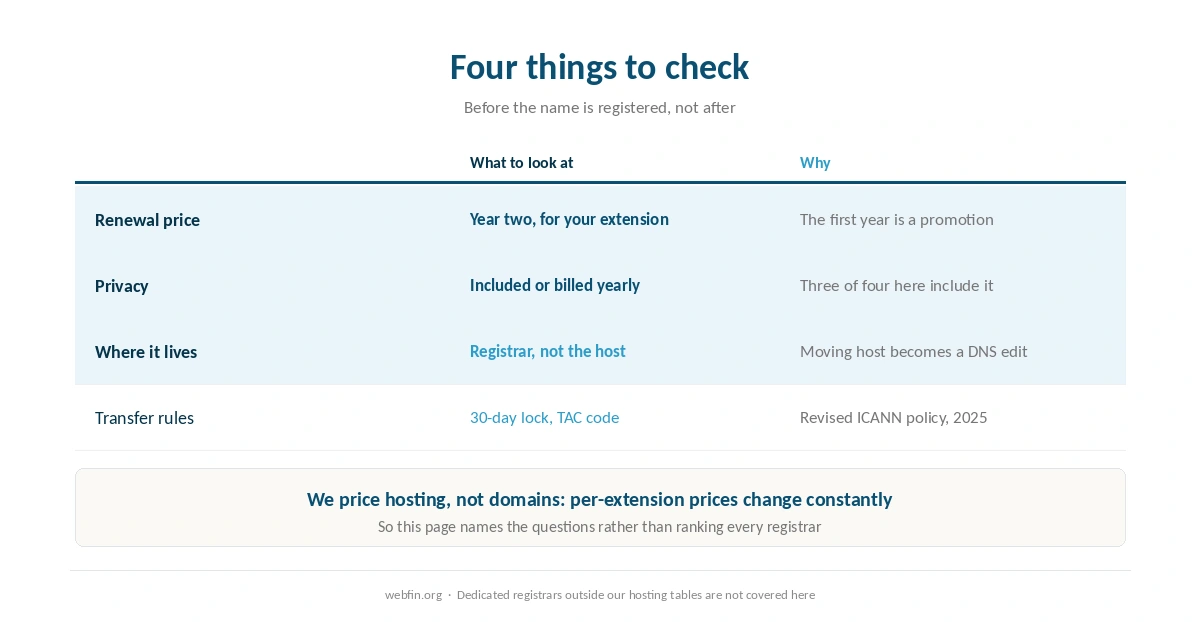
The transfer rules changed with a policy approved at ICANN82 in March 2025, which registrars have been implementing through 2026. Three parts matter to anyone moving a name.
The lock after registration or transfer is 30 days under the revised policy, where it was 60 under the long-standing one.
A change of registrant details no longer locks the name, so updating your own contact information no longer freezes a transfer.
The authorization code is now officially the TAC, the Transfer Authorization Code. Our guide to transferring a domain walks through the steps with the new terms.
Namecheap: A Registrar, Not a Host With Domains
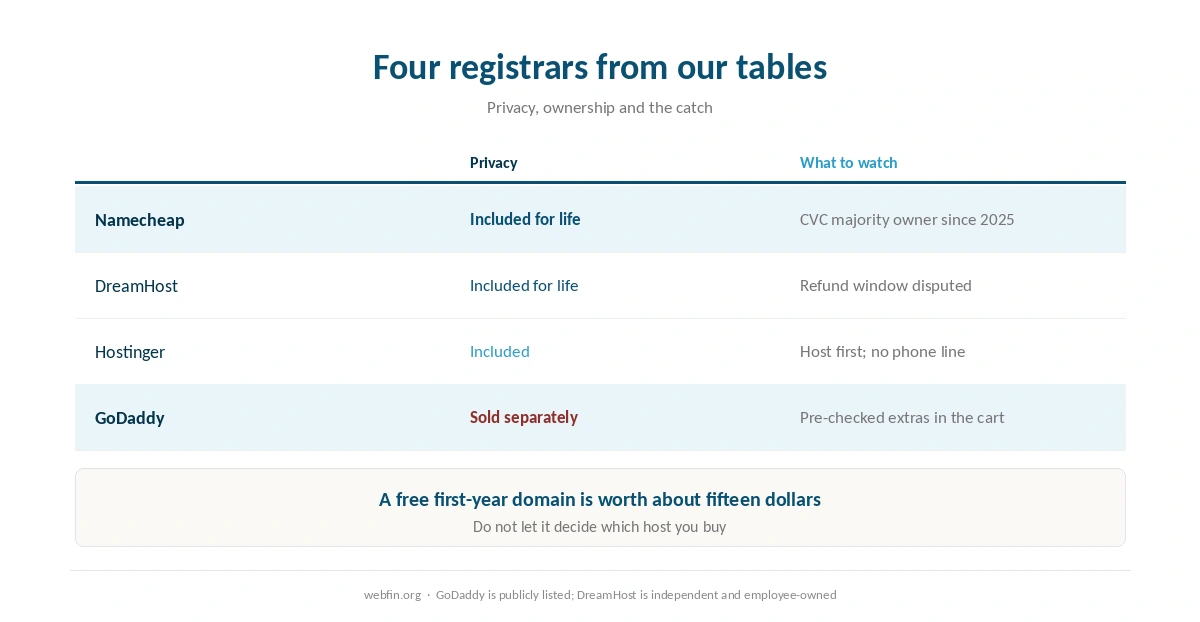
Namecheap includes WHOIS privacy for the life of the domain. That is the feature most worth having, and the one most often billed elsewhere. Keeping the name at a registrar also means your host and your domain are not the same account, so leaving a host is a DNS change rather than a project.
Watch. CVC Capital Partners took a majority stake in September 2025 and the founder stepped down as chief executive that December. Nothing has moved on price in our tables since, and our Namecheap review tracks it.
DreamHost: Privacy Included, Independent Owner
DreamHost includes domain privacy for the life of the domain and describes itself as independent and employee-owned, which is unusual in this field. If the site is already hosted there, keeping the name in the same account is defensible, because the company is not a portfolio brand likely to change hands.
Watch. Our sources dispute its refund window, 97 days by four and 30 by another, and it excludes domains either way. Our DreamHost review covers the plans.
Hostinger: One Cheap Account for Both
Hostinger includes WHOIS privacy and offers a 30-day window on domain registration. In our table its exclusion line names domain registration as the exception, where several hosts exclude domains outright.
Watch. It is a host first, so the domain lives with the hosting. That is convenient until you want to change host, and there is no phone line if something goes wrong. Our page on Hostinger for WordPress covers the hosting side.
GoDaddy: The Phone Line, and the Cart
GoDaddy is a registrar first and the largest name in the category, publicly listed, with phone support in many countries around the clock. For a non-technical owner who wants to call someone about a domain, that is a real advantage.
Watch. The cart. One review counted a large sum of pre-checked extras at checkout, which we could not verify, and its hosting side charges $119.99 a year for an SSL certificate on Economy. Our guide to avoiding checkout upsells covers the pattern, and our GoDaddy review covers the rest.
What We Cannot Tell You Here
We price hosting, not domains. Per-extension renewal prices change constantly and vary by promotion, so we do not publish a table of them, and we do not rank registrars we have no data for. Dedicated registrars outside our hosting tables are not covered on this page.
What we can do is name the questions that decide it, and they are the same at any registrar. The renewal price for your extension. Whether privacy is included. What a transfer involves, and whether support exists in a channel you will use.
Rules That Save You Money
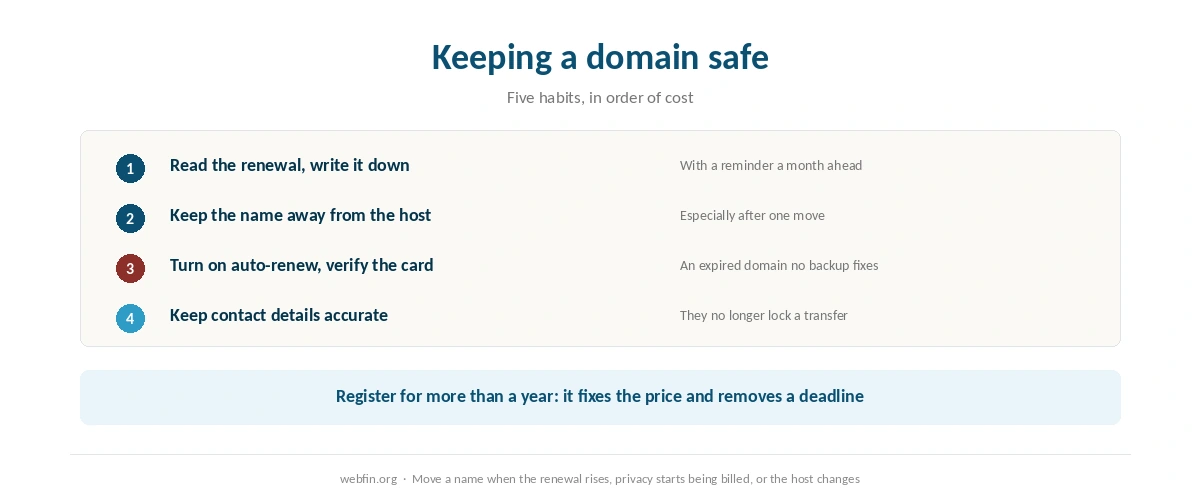
Read the renewal, not the first year. Write it down with the date, and set a calendar reminder a month before the domain renews.
Keep the name separate from the host. Especially if you have moved host once already, as our guide to migrating web hosting explains.
Do not take a free domain as the reason to pick a host. It is worth about fifteen dollars, and Bluehost deducts exactly that if you cancel.
Turn on auto-renew, then verify the card. An expired domain is the one failure that a backup cannot fix.
Keep your contact details accurate. Under the revised policy, changing them no longer locks a transfer, and an unreachable registrant is how names get lost.
When to Move a Domain
Move it when the renewal price rises without a reason you accept. Or when privacy starts being billed separately, or when the name sits with a host you are leaving anyway. Those are the three cases worth the twenty minutes.
Do not move during the 30-day lock after a registration or a previous transfer, and do not move in the week before a renewal.
Two Habits Worth Copying
Register for more than a year. Multi-year registration takes the annual renewal off your list of things to forget, and fixes the price at purchase.
Keep a note of where everything lives. Registrar, host, email provider, DNS. One page in your notes turns a crisis into a task, which our guide to fixing a website that is down assumes you have.
It is also worth knowing what each party promises, which our guide to reading a hosting agreement covers.
How We Research
We run no tests. Refund windows and their exclusions, privacy inclusions and support channels come from the providers’ own pages and from our reviews, read on 20 September 2026, and sit in our tables. The Bluehost deduction for a free domain is from its own refund terms.
The transfer policy changes come from the ICANN82 decision of March 2025 and registrar implementation notices during 2026. We do not publish per-extension domain prices, and we do not rate registrars that are not in our hosting tables. The criteria behind our scores are on our about page.
Domain Registrar FAQ
Effectively no. Every refund window in our table that lists exclusions excludes domain registration, and Bluehost deducts $15.99 for its free domain if you cancel the plan within the window.
Usually not. A domain at a registrar turns a host change into a DNS edit, while a bundled domain turns it into a transfer with a lock and a waiting period. Convenience now, friction later.
Thirty days after a registration or a previous transfer, under the policy approved at ICANN82 in March 2025, where it ran 60 days before. Changing registrant details no longer locks the name.
Namecheap, DreamHost and Hostinger include it in our tables. Several hosts bill it yearly instead, which is worth checking before you buy rather than after the first renewal.
No. It is worth about fifteen dollars, and Bluehost deducts $15.99 if you cancel. Choose the host on its renewal price and its measured record, then buy the domain wherever the renewal is cheapest.
The Verdict
Keep the domain at a registrar, choose it on the renewal price rather than the first year, and take privacy that is included over privacy that is billed. Namecheap does all three, with the caveat that its owner changed in 2025.
If you would rather have one account, DreamHost and Hostinger both include privacy and keep the name beside the hosting. GoDaddy is the one with a phone number. Whichever you pick, write down the renewal date, because a domain is the only part of this that cannot be restored from a backup. Our page on hosting renewal prices records what the hosting beside it costs.