
Disclosure: WebFin is reader-supported. If you buy hosting through links on this page, we may earn a commission at no extra cost to you. Commissions vary between providers and our ratings do not — here’s our full disclosure.
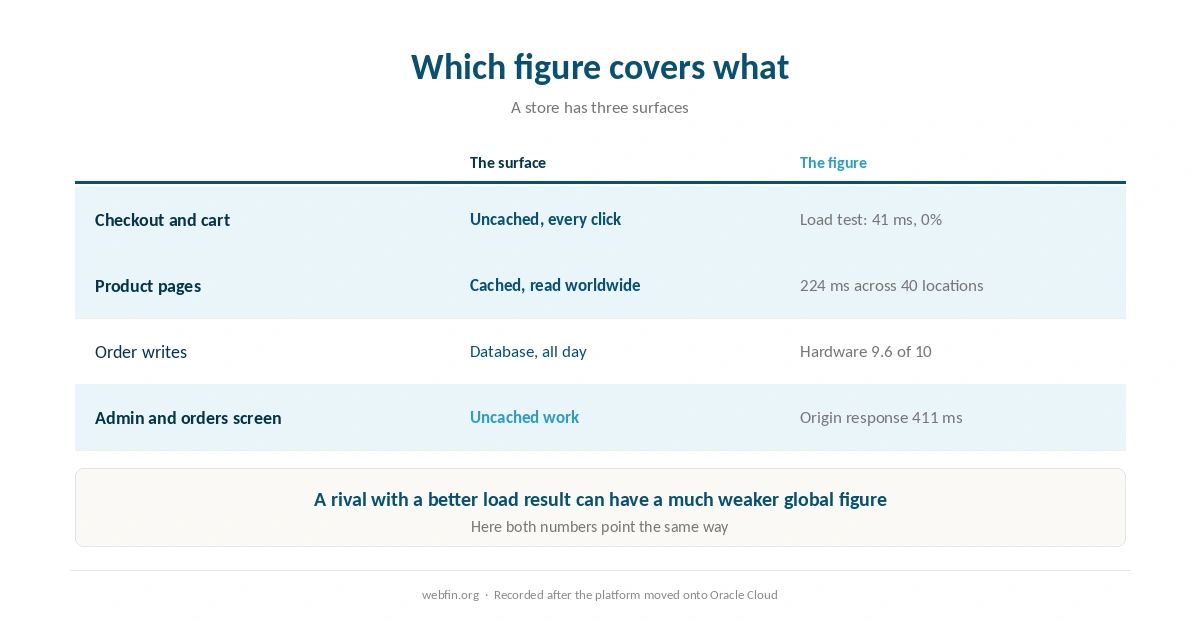
A store needs two figures, and Bluehost has both. The load test, because a checkout is never cached: 41 ms with a 0% error rate. And cached delivery for the catalog, because customers abroad see product pages before anything else: 224 ms across 40 locations. That second number is where it beats several rivals outright. What limits a store here is storage and file counts, not speed.
Is Bluehost Right for WooCommerce? The Short Answer
Yes for a small or mid-sized store, on the 36-month term, provided the catalog fits 10 GB and a moderate file count on Starter. The load result covers the checkout, and the hardware score of 9.6 of 10 covers order writes. Cached delivery of 224 ms covers customers overseas without adding a network. Decline the security and backup add-ons at checkout and buy them only if you miss them.
The Two Figures a Store Lives On
The load test, for the checkout. 41 ms with nothing dropped, recorded after the move onto Oracle Cloud. Cart, checkout and account pages reach the server on every click, so this is the measurement that decides a busy evening.
Cached delivery, for the catalog. 224 ms across 40 locations means product and category pages arrive quickly abroad without you buying a content network. Our page on SiteGround for WooCommerce covers a host with a stronger load result and a much weaker global figure, which is the trade-off in reverse.
And hardware, for the writes. 9.6 of 10 is the top of the range among shared plans in that project, which matters when every order writes rows while customers browse.
⚠️ The origin response of 411 ms is the figure to remember for the admin side. Managing orders is uncached work, and it feels different from the shopfront.
What Actually Limits a Store Here
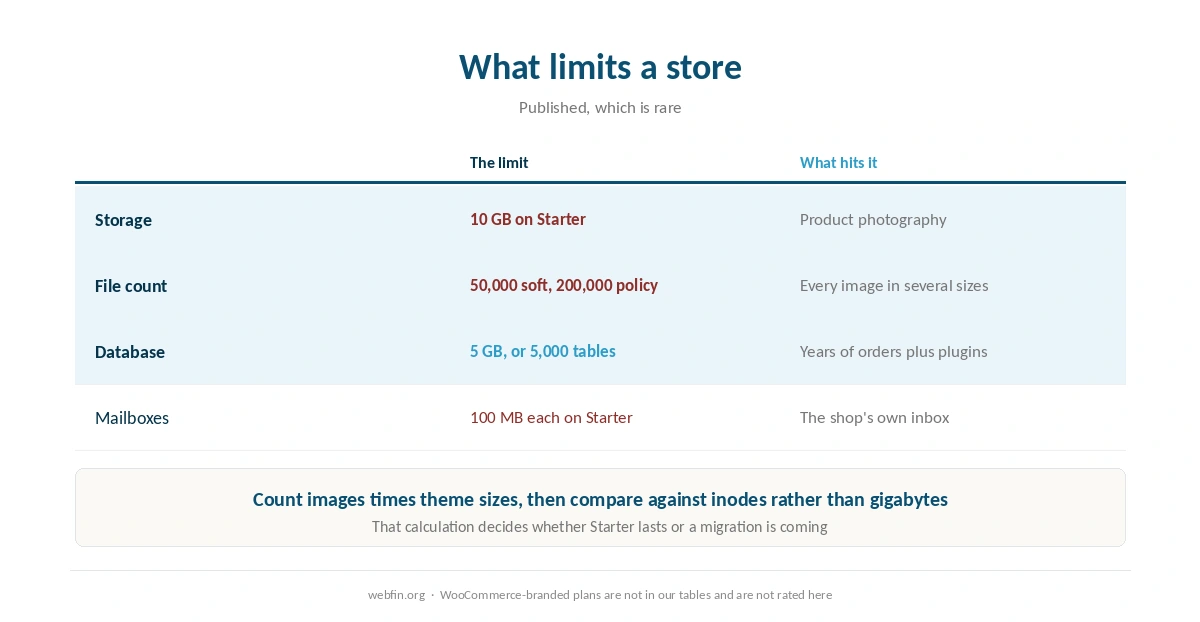
Storage on Starter is 10 GB. Product photography fills that faster than anything else on a small store.
File counts arrive before gigabytes. Bluehost publishes 50,000 inodes as a soft limit and 200,000 as an acceptable use threshold. Every product image becomes several resized files, which our piece on what unlimited hosting means explains.
The database has ceilings too. 5 GB for a single database and 5,000 tables across all of them, which a long order history plus plugins approaches over years.
Mailboxes are 100 MB each on Starter. Not a problem for order confirmations, which the store sends, but a real one for the shop’s own inbox.
| Host | Charge | Cost per year |
|---|---|---|
| Bluehost | Premium SSL, single domain | $89.88 (optional; Let's Encrypt is free) |
| Bluehost | Domain privacy | $15.00 (free year one on Business and up) |
| Bluehost | SiteLock Essentials | $95.88 |
| Bluehost | SiteLock Prevent | $239.88 |
| Bluehost | Yoast SEO Premium | $99.99 |
| Bluehost | Early cancellation, free domain | $15.99 one-off, deducted from refund |
| GoDaddy | SSL on Economy after year one | $119.99; other tiers include it for the plan's life |
| GoDaddy | Pre-checked extras at checkout | $345.39 counted by one review, unverified |
| HostGator | CodeGuard daily backups | $35.88 (weekly copies are a courtesy, not guaranteed) |
| HostGator | SiteLock, pre-selected at checkout | $23.88 |
| HostGator | Dedicated IP | $59.40 |
| HostGator | Professional migration | $149.99 one-off |
| Hostwinds | Standard SSL | $75.00 (free AutoSSL on shared via cPanel) |
| Hostwinds | Wildcard SSL | $150.00 |
| Scala Hosting | Processor core, added or removed anytime | $36.00 per core |
| Scala Hosting | Memory, added or removed anytime | $12.00 per gigabyte |
| Hostinger | WHOIS privacy | Included |
| Hostinger | Domain renewal, .com | $15–$20, no first-party figure published |
| DreamHost | WHOIS privacy | Included for the life of the domain |
| Namecheap | Domain privacy | Included for the life of the domain |
| InterServer | Everything on the one plan | Included; no tiers to upgrade to |
The Cart Deserves a Paragraph
A store owner is the easiest person to sell security to. Our table of recurring charges records SiteLock Essentials at $95.88 a year and SiteLock Prevent at $239.88. A premium certificate costs $89.88 a year, while the free automated one encrypts identically, as our page on SSL certificates explains.
Yoast SEO Premium appears at $99.99 and domain privacy at $15.00. Decline all of it at checkout. Then add only what you find yourself needing, which our guide to avoiding checkout upsells covers.
⚠️ One charge is not optional: $15.99 comes off any refund for the free domain, inside the 30-day window.
About the WooCommerce-Branded Plans
Bluehost sells plans marketed for WooCommerce. They are not in our tables, so we do not price or rate them here, and we say that rather than guess at what they add.
If you are considering one, ask support two questions in writing: what resources differ from the shared plan, and what the renewal is. Our page on hosting renewal prices records the shared figures for comparison.
Which Stores Fit
A small store with a tidy catalog. The strongest case, and the cheapest at $3.99 a month for three years.
A store selling internationally. 224 ms cached delivery is the reason, and few shared plans we price match it.
A store whose owner wants a phone line. Bluehost publishes phone and chat around the clock.
A store with occasional promotions. The load result suggests it holds, though our guide to handling a traffic spike is still worth reading before the first big day.
Which Should Look Elsewhere
A store with thousands of product photos. Storage and file counts decide this, not performance.
A store that needs staging. Testing plugin updates before a live checkout matters, and hosts that include it are worth the difference.
Flash-sale stores. Better served by a server billed by the hour, which sizes to the day.
A business whose inbox is the business. The 100 MB mailbox cap is the reason, and our guide to setting up email on your domain covers moving mail elsewhere.
The First Month, for a Store
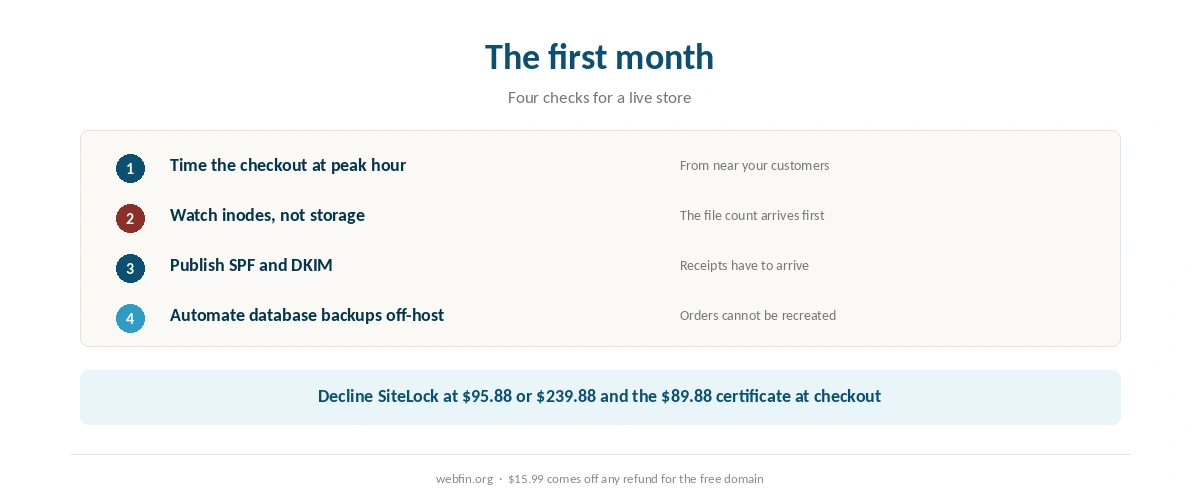
Time the checkout, not the home page. From near your customers, at your busiest hour, as our guide to testing your site speed properly describes.
Watch inodes rather than storage. The file count is the limit that arrives first on an image-heavy shop.
Publish SPF and DKIM. Receipts and password resets have to arrive, whoever sends them.
Automate database backups off the host. Orders cannot be recreated, which our guide to setting up automatic backups covers.
One Number to Settle Before Launch
How many product images will the catalog hold in a year? Multiply by the number of sizes your theme generates, then compare against the published inode figures rather than the storage figure.
That single calculation decides whether Starter is the right plan or an eventual migration. Our guide to checking whether your host is throttling you covers watching the account, and our list of hosting for ecommerce ranks the alternatives by the same load test.
How We Research
We run no tests. The load result comes from Hostingstep’s July 2026 changelog, hardware and response from its 2026 benchmarks, uptime from November 2025 to August 2026, and cached delivery from its Bluehost review of July 2026.
Storage, inode, database and mailbox limits come from Bluehost’s own pages and support articles, read on 20 September 2026, along with the add-on prices in our table. The WooCommerce-branded plans are not in our tables and are not rated here. Bluehost belongs to Newfold Digital. The criteria behind our scores are on our about page, and our page on Bluehost for WordPress covers the non-store case.
Bluehost for WooCommerce FAQ
For a small or mid-sized store, yes. It finished the 2026 load test at 41 ms with no errors, scores 9.6 of 10 on hardware, and delivers cached pages at 224 ms across 40 locations.
Storage and file counts rather than speed. Starter includes 10 GB, and Bluehost publishes 50,000 inodes as a soft limit. Product photography reaches both sooner than owners expect.
Less than on several rivals. Cached delivery is 224 ms across 40 locations, so the catalog arrives quickly abroad. The checkout stays uncached wherever the customer is.
Not at checkout. SiteLock Essentials is $95.88 a year and Prevent $239.88, and a premium certificate is $89.88 while the free one encrypts identically. Decline, then add what you miss.
They are not in our tables, so we do not rate them. Ask support in writing what resources differ from the shared plan and what the renewal is, then compare against the shared figures.
The Verdict
For a store, this is a stronger case than Bluehost’s reputation suggests. The checkout figure is clean, the hardware score is the highest among shared plans in that project, and 224 ms cached delivery means overseas customers see the catalog quickly without extra spending.
Buy it on the 36-month term and keep the catalog inside 10 GB and a sane file count. Decline the cart, and move email off Starter if the shop runs on its inbox. If you need staging or sell through flash sales, look at the alternatives instead. Our page on what web hosting costs prices them across three years.