Disclosure: WebFin is reader-supported. If you buy hosting through links on this page, we may earn a commission at no extra cost to you. Commissions vary between providers and our ratings do not — here’s our full disclosure.
This is a shopping page that mostly tells you not to shop. A free automated certificate does the same cryptographic job as a paid one, and browsers treat them identically. Our own table of add-on charges records $89.88 a year for a premium single-domain certificate at Bluehost, a Newfold Digital brand. GoDaddy Economy charges $119.99 a year from year two, and Hostwinds $75.00, each beside a free automated option. There are three cases where paying makes sense, and they are narrow.
Best SSL Certificates: The Short Answer
Use the free automated certificate your host issues, which almost every plan we price includes. Pay only in three cases: a procurement process that demands organization or extended validation, a wildcard your host will not automate, or a certificate your host cannot issue at all. Before buying anything, check whether your plan already covers it: sell what they also give away.
What a Certificate Actually Does
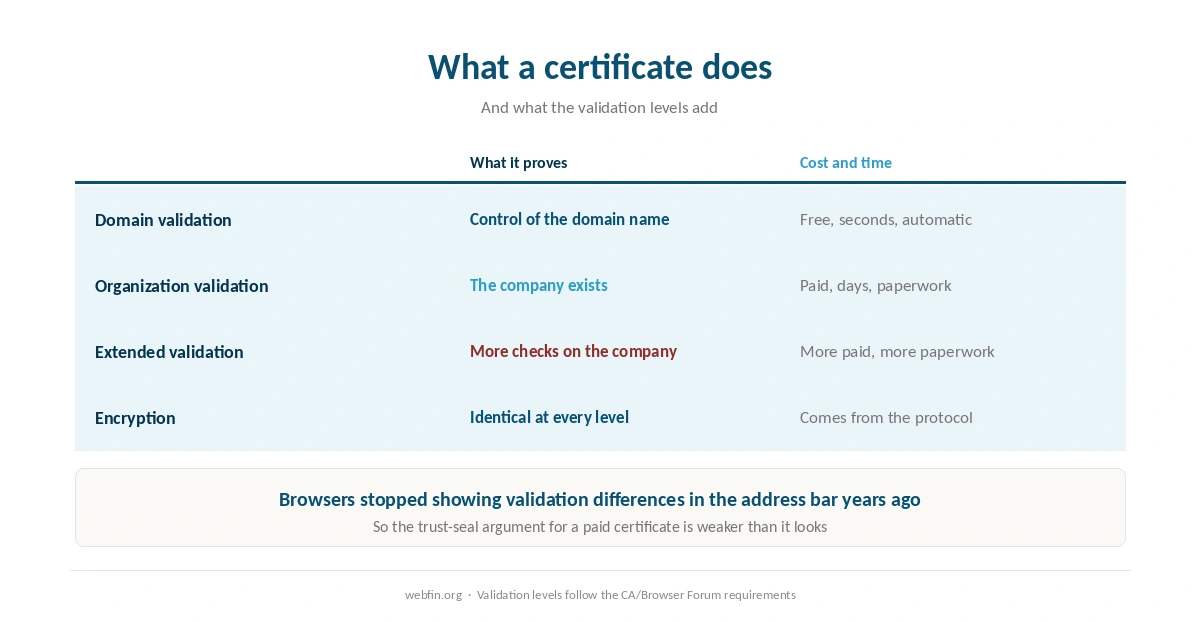
It encrypts the connection. That part is identical whether the certificate cost nothing or three figures. The encryption comes from the protocol, not from the price.
It proves control of the domain. Domain validation checks that whoever asked for the certificate controls the name, which is what an automated issuer verifies in seconds.
It does not vouch for the business. Organization and extended validation add checks on the company, and browsers stopped showing those differences in the address bar years ago.
⚠️ So the “trust seal” argument for a paid certificate is weaker than it looks. A visitor sees the same padlock either way.
| Host | Charge | Cost per year |
|---|---|---|
| Bluehost | Premium SSL, single domain | $89.88 (optional; Let's Encrypt is free) |
| Bluehost | Domain privacy | $15.00 (free year one on Business and up) |
| Bluehost | SiteLock Essentials | $95.88 |
| Bluehost | SiteLock Prevent | $239.88 |
| Bluehost | Yoast SEO Premium | $99.99 |
| Bluehost | Early cancellation, free domain | $15.99 one-off, deducted from refund |
| GoDaddy | SSL on Economy after year one | $119.99; other tiers include it for the plan's life |
| GoDaddy | Pre-checked extras at checkout | $345.39 counted by one review, unverified |
| HostGator | CodeGuard daily backups | $35.88 (weekly copies are a courtesy, not guaranteed) |
| HostGator | SiteLock, pre-selected at checkout | $23.88 |
| HostGator | Dedicated IP | $59.40 |
| HostGator | Professional migration | $149.99 one-off |
| Hostwinds | Standard SSL | $75.00 (free AutoSSL on shared via cPanel) |
| Hostwinds | Wildcard SSL | $150.00 |
| Scala Hosting | Processor core, added or removed anytime | $36.00 per core |
| Scala Hosting | Memory, added or removed anytime | $12.00 per gigabyte |
| Hostinger | WHOIS privacy | Included |
| Hostinger | Domain renewal, .com | $15–$20, no first-party figure published |
| DreamHost | WHOIS privacy | Included for the life of the domain |
| Namecheap | Domain privacy | Included for the life of the domain |
| InterServer | Everything on the one plan | Included; no tiers to upgrade to |
| AWS Lightsail | Transfer overage | $0.09 a GB in most regions (Toolradar, Sep 2026) |
| AWS Lightsail | CDN | 50 GB of CDN distribution free for one year (AWS pricing page) |
| Bluehost | .com renewal after the free year | $12.99 (DomainOffer guide to free domains, 2026) |
| Bluehost | Managed VPS cPanel license at checkout | $540 per instance, though the plan page lists cPanel as included; 36-month renewal about $83.99 vs $98.99 listed (HostAdvice 2026) |
| Cloudflare Registrar | .com at cost, registration = renewal | $10.11 (PriceWorld, Feb 2026) to $10.44 ($10.26 Verisign + $0.18 ICANN; DevToolPicks, StartupOwl 2026); transfer $10.46 (user report, Feb 2026) |
| Cloudways | Rackspace email add-on | $1.50 a mailbox a month from Sep 1, 2026 (was $1.00); 25 GB; up to 10,000 emails a day; aliases and forwarding free; email migration $10 a mailbox (Cloudways blog and support) |
| Cloudways | Titan email add-on | Three plans; Titan Pro $1.99 a mailbox a month, up to 100 GB; $1.50 for Rackspace customers (Cloudways blog, Aug 2026) |
| Contabo | Setup fee and Windows | Setup fee on Cloud VPS 10 at times (LearnWithHasan) vs none (Toolradar, Sep 2026); Windows license about €4.99 a month |
| Dedicated servers | Extra IPv4 | Often $2–$5 a month each (Valebyte 2026) |
| DigitalOcean | Droplet backups | 20% of the Droplet's monthly price (Kuberns, 2026) |
| DigitalOcean | New-customer credit | $200 for 60 days in most 2026 sources; $5 per DigitalOcean's pricing-page FAQ read 19 Aug 2026 (Findstack) |
| DigitalOcean | Transfer overage | $0.01 a GiB (Kuberns, 2026) |
| Domain name, typical yearly cost | $10 to $20 a year | Hostinger's own guide to domain costs, Mar 2026 |
| Domains at hosts, .com renewal | DreamHost $9.95; Hostinger about $16.99 | 2026 domain-offer guide (domainoffer.net); conflicts with Hostinger's $15–$20 range |
| DreamHost | .com domain (tracker) | $9.99 registration (since Jan 2, 2026; $4.99 before), $19.99 renewal, $9.99 transfer (DomainOffer, May 2026); conflicts with DomainOffer guide ($9.95 renewal) |
| Dynadot | .com domain | $8.99 registration, $10.88 renewal, 39% below a $14.64 market average; .net $12.52 flat; .llc $10.92 → $35.20 (DomainOffer, May 2026) |
| GoDaddy | .com domain | $11.99 first year, $21.99 renewal; five years $96.95 (Findstack, Oct 2026, from published 2026 comparisons) |
| GoDaddy | WHOIS privacy | $9.99 a domain a year (Findstack, Oct 2026) |
| GoDaddy | Website Builder Commerce payments | 2.7% + $0.30 a card transaction (Website Builder Expert, 2026) |
| GoDaddy Reseller | Wholesale rates, Basic / Pro | Domain .com $13.19 / $11.59; Professional Email $2.01 / $1.61 a month; Managed WordPress $8.01 / $7.01 a month; SSL from $36.73 / $31.73 (GoDaddy help center, official) |
| GoDaddy vs Namecheap | Cheap new extensions (.site, .online, .website) | $0.99 first year; renew $39.99–$54.99 at GoDaddy vs $20.98–$34.98 at Namecheap (DomainOffer, 2026) |
| Hetzner | Traffic, IPv4 and backups | 20 TB EU, 1 TB US, 0.5 TB Singapore; overage €1/TB (€7.40 Singapore); IPv4 +€0.50; backups 20% (LearnWithHasan, BetterStack 2026) |
| HostGator | cPanel email (paid add-on) | Free 0–2 mailboxes; Basic $2.99 a month ($35.88 a year) 3–10; Plus $5.99 ($71.88) 11–20; Premium $8.99 ($107.88) unlimited; tied to the hosting plan (HostGator help center) |
| HostGator | Professional Email (Titan) | One-month trial, then $2.99 a month (CloudsPress 2026) |
| HostGator | .com domain | $12.99 first year, $23.99 renewal, $12.99 transfer (ProfileTree; whtop); privacy an optional paid extra; free domain year one on 12/24/36-month Shared, WordPress or Cloud plans; non-refundable domain fee may apply on first-year cancellation (CloudsPress) |
| Hostinger | SSL | Free Let's Encrypt certificates, unlimited, installed and renewed automatically (Hostinger compare page; Bitcatcha; Truehost) |
| Hostinger | Business Email | Starter $0.99 → $1.59 a mailbox a month (10 GB); Premium $2.99 → $3.99 (50 GB), 48-month terms (TechRadar); hosting plans include a free trial that auto-renews as paid Starter (Hostinger support) |
| Hostinger | .com domain (tracker) | $9.99 registration, $19.99 renewal, $9.99 transfer (DomainOffer, May 2026) |
| Hover | .com domain | $18.99 registration and renewal, 30% above a $14.64 market average (DomainOffer, May 2026); .tech $4.99 → $63.99 |
| IONOS | Extra IPv4 address on VPS | $5.00 a month; one IPv4 included per server (IONOS VPS page) |
| IONOS | .com domain | $10.00 registration, $20.00 renewal, $9.50 transfer (DomainOffer, May 2026); $1 first year for new customers (StartupOwl; Thewearify citing IONOS); .website $1.00 → $40.00 |
| IONOS | DNSSEC via Domain Guard | $1 first year, then $15 a year (StartupOwl 2026) |
| IONOS | Email plans | Basic Email $1.10 → $2.00 (1 mailbox, 2 GB); Business/Professional Email $2.00 → $4.00 (25 mailboxes, 2 GB each); Exchange 50 GB about $6 a user at renewal (TrekMail citing IONOS; Toolradar, Sep 2026); extra 10 GB storage purchasable (IONOS help) |
| Linode | Backups and egress overage | Backups 20% (Kuberns) or 25% (LearnWithHasan) of plan; overage $0.005/GB |
| Namecheap | .com domain | $8.88 first year, $13.98 renewal; five years $65.91 (same source) |
| Namecheap | Incoming .com transfer | $10.98 to $33.98, including a year (Findstack, Oct 2026) |
| Namecheap | SSL on shared hosting | Free PositiveSSL for one year per domain or subdomain, up to 50 per cPanel account; then a paid renewal ($7.88 per Vendr or $8.88 per NateShivar a year); no AutoSSL on shared, manual Let's Encrypt install allowed (Namecheap knowledge base and blog) |
| Namecheap | Private Email | $0.99 a mailbox a month first year, $1.99 renewal (Vendr 2026) |
| Namecheap VPS | cPanel license | Charged separately, monthly, tiered; prices rose Jan 13, 2026 (Namecheap blog); $10.88 in an older review (Tom's Hardware), $17.88 after Jan 2026 per a competitor's blog (InMotion) |
| Namecheap VPS | Complete management with cPanel | About $50 to $55 a month in total (TechRadar); management only on Quasar and Magnetar (Namecheap VPS page) |
| Network Solutions | .com domain | $9.59 registration, $32.99 renewal, $10.99 transfer, +$0.20 ICANN fee (DomainOffer, May 2026); about $25 first year, $37.99 renewal (BestGuide 2026); .online $0.99 first year, renews $52.99 (DomainOffer, Jul 2026) |
| Porkbun | .com domain | $10.08 registration, $11.08 renewal, $10.08 transfer (DomainOffer, May 2026); later 2026 pages list $11.52 / $12.52 / $11.52 — verify |
| Porkbun | Cheap extensions | .website $1.96 first year, renews $21.11; .pw $3.43, renews $18.33 (DomainOffer, 2026) |
| Pressable | Visit overage | $1.20 per 1,000 visits; $1.00 per GB storage (FrontDesk Review, Sep 2026) |
| Porkbun | Email inbox | $24 a year per inbox (knowledge base); $36 in a developer documentation example; 10 GB; 15-day free trial with new domains |
| Liquid Web | Mailboxes | $2.25 a mailbox a month, 25 GB, plus a $10 monthly base charge for unlimited domains; requires active hosting (whtop, 2026) |
| SiteGround | Domains | $15.95 a year for .com, $17.95 .net, $19.95 .co.uk (Tooltester, 2026); WHOIS privacy free in year one only (whtop) |
| OVHcloud | Domains | .ovh $2.15 year one, $3.49 renewal, $53.99 reactivation; .com renewal $12.59 (European Alternatives); 15 GB mailbox and DNSSEC included |
| Cloudways | Offsite backup storage | $0.033 per GB per server; incremental; charges rounded up in $0.50 steps, so $3.85 becomes $4 and $1.22 becomes $1.50 (Cloudways support center) |
| DigitalOcean | Snapshots | $0.06 per GB a month (DIYAI, 2026) |
The Three Validation Levels
Domain validation. Automatic, free on most plans we price, issued in seconds and renewed without you noticing. Right for essentially every site, including stores.
Organization validation. The issuer checks the company exists, which takes days and paperwork. Occasionally required by a partner or a procurement checklist.
Extended validation. More paperwork, more money, and no visible difference in a modern browser. Bought almost exclusively because a policy document names it.
Where the Money Actually Goes at Hosts
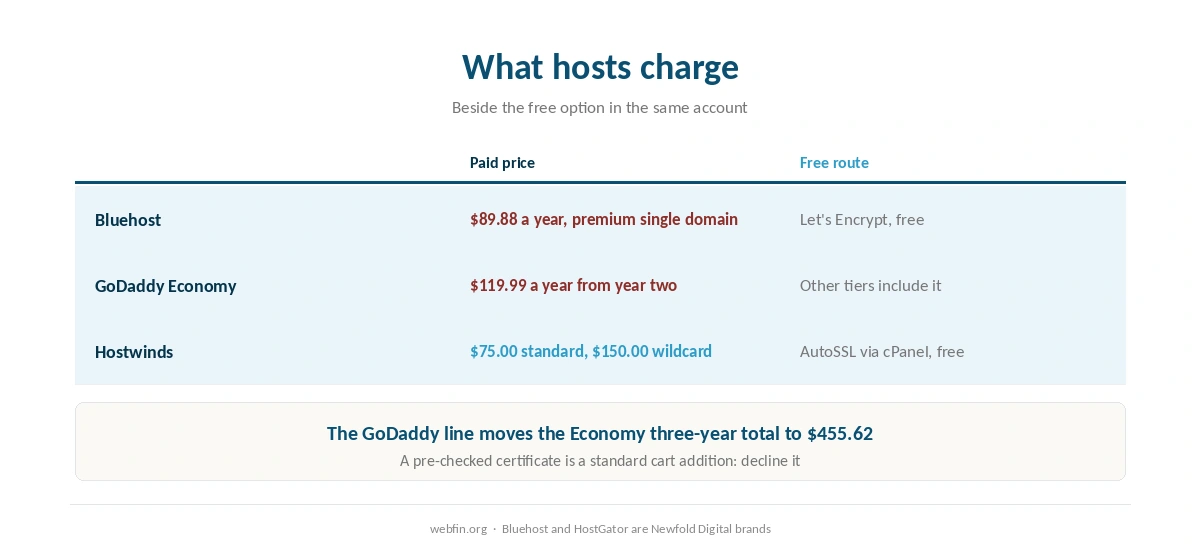
Our table of add-on charges records the pattern rather than the marketing. Bluehost sells a premium single-domain certificate at $89.88 a year and notes that Let’s Encrypt is free. Hostwinds prices a standard certificate at $75.00 and a wildcard at $150.00, with free AutoSSL available on shared plans through cPanel.
GoDaddy is the sharpest case: on Economy the certificate costs $119.99 a year from year two, while other tiers include it for the life of the plan. That single line moves the three-year total for Economy to $455.62 in our pricing table, which our page on hidden hosting fees covers alongside the rest.
⚠️ Read those rows as a warning about carts rather than about cryptography. A pre-checked certificate is a standard cart addition. Our guide to avoiding checkout upsells covers declining it.
When Paying Is the Right Call
A procurement requirement. If a client, a partner or an insurer names organization or extended validation, buy what the document says and move on.
A wildcard your host will not automate. Free authorities issue wildcards, but automation varies, and a subdomain network needs one. Our guide to setting up WordPress Multisite covers that case.
A certificate your host cannot issue. Rare on shared hosting, more common on a server you configure yourself.
A warranty that somebody insists on. Paid certificates carry warranties, which procurement departments care about and few site owners ever use.
What to Do Instead, Step by Step
Check the panel first. Look for a free or automated certificate section before looking at a price list, which our guide to understanding cPanel helps with on cPanel hosts.
Confirm renewal is automatic. Free certificates are short-lived by design, so the automation is the feature. A certificate that expires quietly is worse than none.
Force HTTPS everywhere. Redirect plain connections, and fix mixed content so the padlock stays clean, as our guide to configuring caching touches on for cached pages.
Then check the expiry date once a quarter. Automation fails silently more often than it fails loudly.
Certificates on a Server You Run Yourself
On a VPS or a cloud server the free automated route still applies, but you configure it yourself: an ACME client, a renewal timer and a reload hook for the web server. Managed hosts do all three silently.
That is one more line in the maintenance column when pricing a server. Our list of hosting for SaaS startups covers. Our guide to moving from shared to VPS covers the step before it.
The Failure Mode Nobody Plans For
A certificate that stopped renewing. Visitors get a full-page browser warning, which costs more traffic than any slow page ever will, and search engines notice.
It follows a DNS change, a host move or a domain transfer, when the validation path breaks and nobody is watching. Our guide to pointing a domain to a new host covers the order that avoids it. Our guide to fixing a website that is down covers the morning it happens anyway.
Which Sites Need What
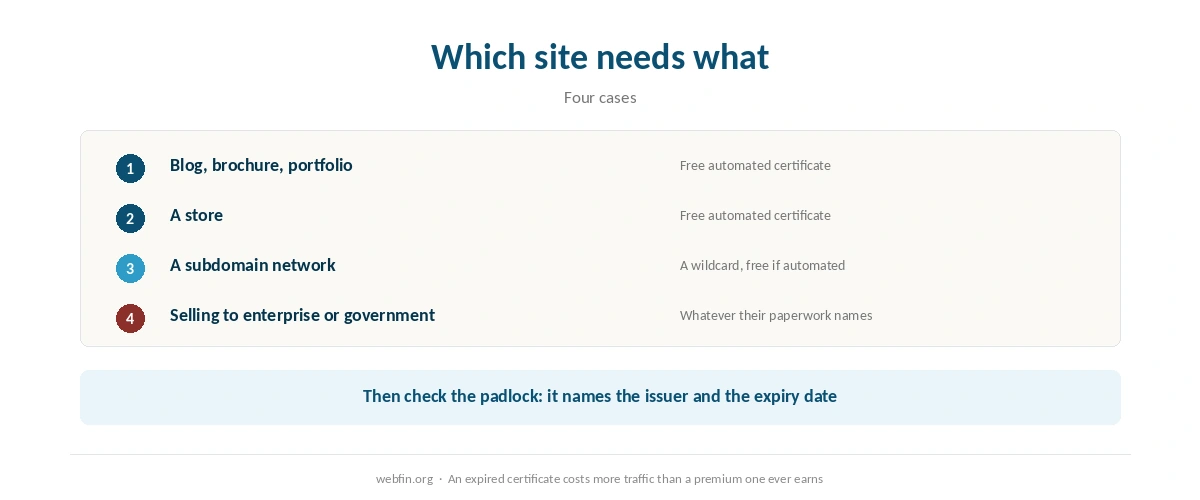
A blog, brochure site or portfolio. Free automated certificate. Nothing else.
A store. Free automated certificate. Payment processors require HTTPS, not a particular price, and our list of hosting for ecommerce covers what actually matters for a checkout.
Subdomain networks. These need a wildcard, free if your host automates it and paid if not.
A site selling to enterprises or government. Whatever their paperwork names, which our guide to reading a hosting agreement is the right frame of mind for.
One Thing Worth Doing Today
Open your site in a browser and click the padlock. It names the issuer and the expiry date, and those two facts tell you whether the automation is working and who to ask if it is not.
If the certificate came from your host’s automated issuer and expires in weeks rather than months, that is normal and healthy. If it expires in a year and you do not remember buying it, check the invoice. A certificate is not the only line that renews quietly, as our page on hosting renewal prices shows.
How We Research
We run no tests and we issue no certificates. The add-on prices here come from the providers’ own pages and from our reviews, read on 20 September 2026. They sit in our table of recurring charges. The GoDaddy three-year total that includes the certificate comes from the same pricing work.
We do not rank certificate authorities, because the cryptography is standardized and the differences that remain are commercial rather than technical. Validation levels and browser behavior follow the CA/Browser Forum requirements and current browser releases. The criteria behind our scores are on our about page.
SSL Certificate FAQ
Almost certainly not. A free automated certificate encrypts identically and browsers show the same padlock. Our table records hosts charging $75.00 to $119.99 a year for certificates they also issue free.
No. The encryption comes from the protocol rather than the price. What money buys is a different validation level, a warranty and support, none of which changes what a visitor’s browser does.
When a procurement document names organization or extended validation. When you need a wildcard your host will not automate. Or when your host cannot issue one at all.
On Economy, $119.99 a year for the certificate from year two, while other tiers include it for the life of the plan. That pushes the Economy three-year total to $455.62 in our pricing table.
Renewal. Free certificates are short-lived by design, so a broken validation path after a DNS change or a host move leaves visitors facing a browser warning. Check the expiry date once a quarter.
The Verdict
For nearly every site the best certificate is the free one your host already issues. The money saved is not small either: $89.88 at Bluehost, $119.99 a year on GoDaddy Economy, $75.00 at Hostwinds. Every year, for something sitting one click away at no charge.
Pay when paperwork demands a validation level or when you need a wildcard nobody will automate for you. Otherwise spend the attention on renewal instead of purchase, because an expired certificate costs more traffic than a premium one ever earns. Our page on what web hosting costs prices the plans underneath.