
Disclosure: WebFin is reader-supported. If you buy hosting through links on this page, we may earn a commission at no extra cost to you. Commissions vary between providers and our ratings do not — here’s our full disclosure.
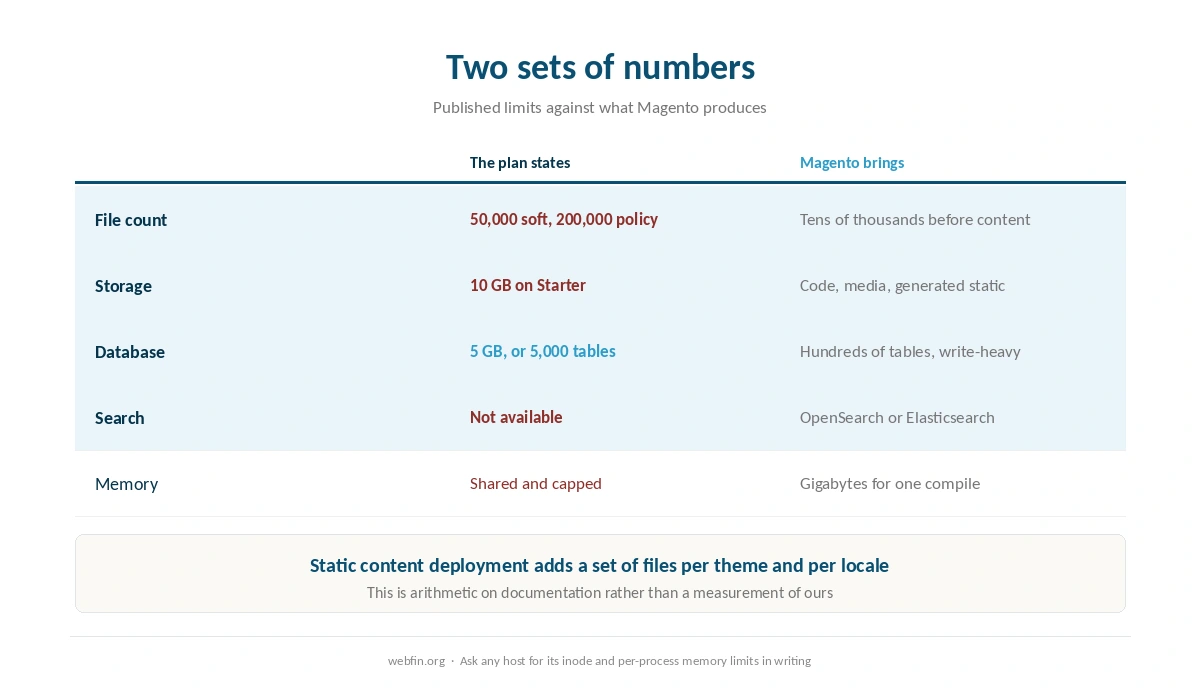
Bluehost is the one host in our tables that publishes its limits properly, which makes this question unusually easy to settle. It states 50,000 inodes as a soft limit and 200,000 as an acceptable use threshold, with 10 GB of storage on Starter. It also states 5 GB for a single database and 5,000 tables across all of them. A Magento 2 installation, with its dependencies and its generated static files, is measured in tens of thousands of files before a single product exists. The arithmetic answers the question.
Is Bluehost Right for Magento? The Short Answer
No, on its shared plans, and the published figures show why rather than a matter of opinion. Magento also needs a search service and gigabytes of memory for a compile. It needs Composer on the command line and cron every minute, none of which a shared account provides. Buy a server: Cloudways from $14.00 a month, Scala’s VPS at $36.00 a year per processor core, or Liquid Web from $33.00 a month.
The File Count Settles It
A Magento 2 codebase arrives as an application plus its Composer dependencies, and that tree alone runs to tens of thousands of files. Then static content deployment generates a further set for every theme and every locale you publish.
Against a soft limit of 50,000 inodes and a policy threshold of 200,000, an empty store is already in the wrong bracket. This is the same limit that bites an image-heavy WooCommerce shop, only sooner: our page on Bluehost for WooCommerce covers that version.
⚠️ These are arithmetic and documentation rather than measurements of ours. The point is that the two sets of numbers do not overlap, which no amount of tuning changes.
| Host and plan | Limit | Where it's stated |
|---|---|---|
| Bluehost shared | 50,000 inodes — soft limit | Hosting Inode Limit article |
| Bluehost shared | 200,000 inodes — AUP threshold | Server Resource Limitations |
| Bluehost shared | 1,000,000 inodes — TOS violation | Hosting Inode Limit article |
| Bluehost shared | 5,000 tables or 10 GB, all databases | Server Resource Limitations |
| Bluehost shared | 5 GB per single database | Server Resource Limitations |
| Bluehost Starter | 100 MB per mailbox | Shared hosting prices page |
| WP Engine Startup | 25,000 monthly visits, then overage handling | Plan pages |
| WP Engine, by tier | 25,000 to 400,000 monthly visits | Plan pages |
| Rocket.net Starter | 25,000 monthly visits, 1 site, 10 GB storage | Plan pages |
| Namecheap EasyWP | 50,000 / 200,000 / 500,000 monthly visits by tier | Plan pages |
| Kinsta Starter | 25,000 monthly visits | Plan pages |
| Scala Hosting VPS | Priced per unit: $3 per core, $1 per gigabyte | Plan pages; adjustable anytime |
| HostGator shared | Weekly backups described as a courtesy, not guaranteed | Hosting terms |
| Liquid Web | Dedicated resources at every tier; no shared plan | Plan pages |
| InterServer Standard | Unlimited storage, bandwidth, email and websites | One plan, no tiers |
| GreenGeeks Lite | One website only | Plan pages |
| IONOS Plus | One email account bundled per plan | Plan pages |
| Hostinger, all plans | Not published | Hostinger support article, 28 Aug 2026 |
| Bluehost Starter | 10 GB NVMe storage | Plan pages, as listed in a 2026 audit |
| InMotion Core | One site, 10 email accounts, SSD storage; NVMe from Launch | TechRadar and a 2026 review |
| SiteGround shared | Shell access by tier — not recorded | Not stated on the plan pages we read, 20 Sep 2026 |
| Bluehost shared | Shell access by tier — not recorded | Not stated on the plan pages we read, 20 Sep 2026 |
| Hostinger, all plans | Shell access by tier — not recorded | Not stated on the plan pages we read, 20 Sep 2026 |
| Cloudways servers | Search service (OpenSearch, Elasticsearch) — not recorded | Not stated on the plan pages we read, 20 Sep 2026 |
The Architecture Blocks It Too
A search service. Magento 2.4 requires OpenSearch or Elasticsearch as a separate service with its own memory. A shared account cannot install one.
Gigabytes of memory for a compile. Adobe’s guidance for building static content is measured in gigabytes rather than megabytes.
The command line. Composer, the Magento CLI, reindexing and cache flushes all run from a shell.
Cron every minute. Indexers, emails and imports depend on it.
The Performance Figures Are Beside the Point
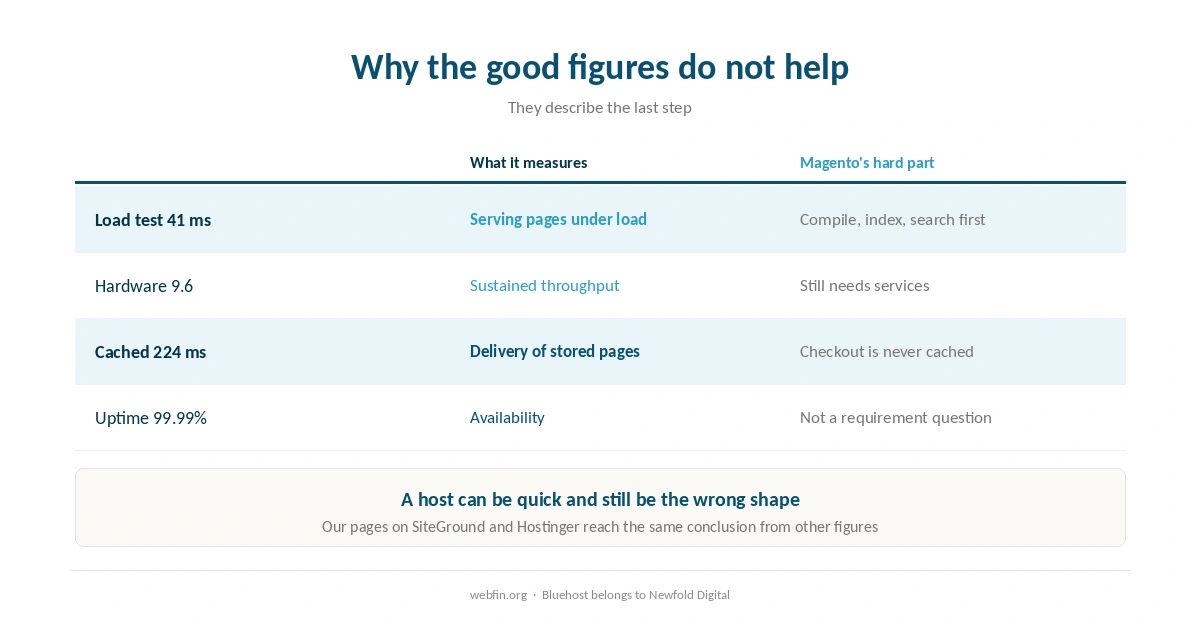
Bluehost measures well. A load test at 41 ms with a 0% error rate, hardware at 9.6 of 10, uptime of 99.99% across nine outages, and 224 ms cached delivery across 40 locations. Those are good numbers on a shared platform.
They describe serving pages, which is the last step of what Magento does rather than the hard part. Before a page exists the platform has to compile, index and search, and that is the work the plan cannot host. Our pages on SiteGround for Magento and Hostinger for Magento reach the same conclusion from different starting figures.
What to Buy Instead
Cloudways. A managed server from $14.00 a month, billed by the hour, with SSH, Composer and staging on every tier. Uptime between 99.996% and 99.999% across five plans in the project we cite. Our Cloudways review covers each cloud.
Scala Hosting’s VPS. Root access with resources priced per unit: $36.00 a year for a processor core and $12.00 for a gigabyte of memory, adjustable at any time. Our Scala Hosting review covers the line.
Liquid Web. Managed VPS from $33.00 a month on annual billing, with dedicated resources and root. It commits to a 59-second support response and 100% network uptime backed by credits, and our Liquid Web review covers the disputes around those promises.
Our list of hosting for SaaS startups covers the same three from the application side, including what none of them is.
The Alternative Most Stores Should Take
Stay on Bluehost and sell through WooCommerce. The load result covers a checkout, the hardware score covers order writes, and 224 ms cached delivery covers customers abroad without extra spending.
Magento earns its cost on large catalogs, complex pricing rules and several storefronts. With fifty products and one currency it is a platform tax rather than an advantage. Our list of hosting for ecommerce ranks hosts checkout actually depends on.
If You Insist on Magento, Size It Properly
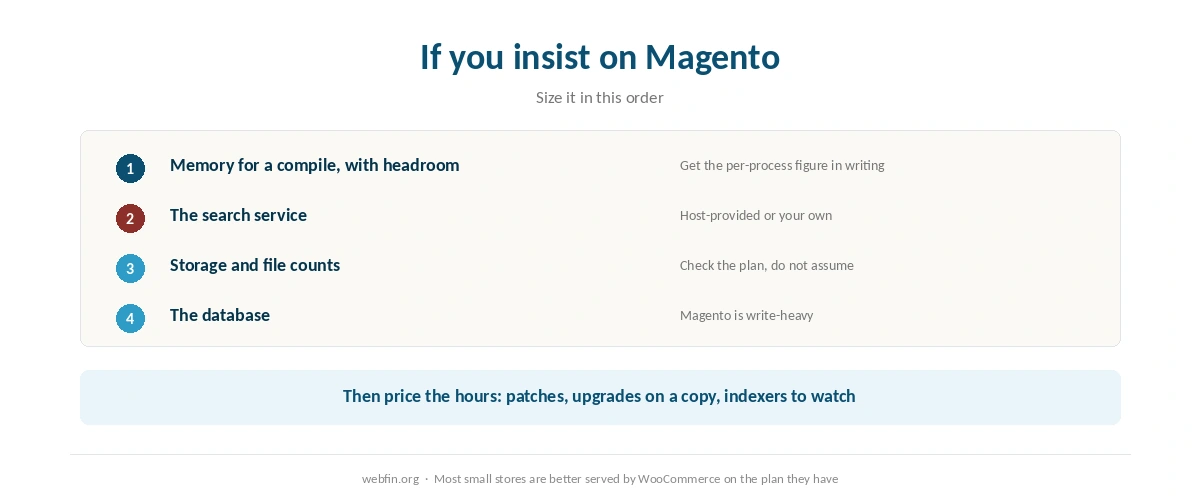
Memory first. Enough for a compile with headroom, and ask any host for the per-process figure in writing.
Then the search service. Either the host runs it or you run it on the same server, and both cost memory.
Then storage and file counts. A server normally gives you room, though the plan still states a figure worth reading.
Then the database. Magento is write-heavy, and our guide to fixing a slow database covers what a year of trading does to it.
The Maintenance Nobody Prices
A Magento store on a server needs security patches, upgrades rehearsed on a copy, and someone watching the indexers. On a shared plan that work does not exist, because the platform never ran there.
So price the hours as well as the plan, and read what a managed provider promises to do for you. Our guide to reading a hosting agreement covers that, and our guide to moving from shared to VPS covers the sizing.
One More Way to Check Any Host
Ask for the inode limit and the per-process memory limit in writing, then compare them with what your intended platform produces. It takes one support ticket and settles most hosting arguments before they start.
Hosts that will not answer are telling you something too. Bluehost publishes both, which is why this page rests on numbers rather than impressions. Our piece on what unlimited hosting means explains why those two figures matter more than the word unlimited.
How We Research
We run no tests. The limits quoted here come from Bluehost’s own pages and support articles, read on 20 September 2026, and sit in our tables. Magento’s requirements come from Adobe’s documentation for version 2.4. The file-count comparison is arithmetic on documented behavior rather than a measurement of ours.
Performance figures come from Hostingstep. The load result is from its July 2026 changelog and hardware from its 2026 benchmarks, with uptime from November 2025 to August 2026 and cached delivery from its Bluehost review. Bluehost belongs to Newfold Digital. The criteria behind our scores are on our about page, and the full workings are in our Bluehost review.
Bluehost for Magento FAQ
Not sensibly. A Magento 2 codebase with its dependencies and generated static files runs to tens of thousands of files. The published soft limit is 50,000 inodes. It also needs a search service, Composer and real cron.
Because they describe serving pages, which is the last step. Magento has to compile, index and search first, and those need services a shared account cannot run.
The file count. Storage is 10 GB on Starter and the soft inode limit is 50,000, with 200,000 as an acceptable use threshold. An empty Magento install is already in the wrong bracket.
A server. Cloudways from $14.00 a month billed by the hour, or Scala’s VPS at $36.00 a year per core and $12.00 per gigabyte. Liquid Web starts at $33.00 a month with dedicated resources and root.
For most small stores, yes. The load result covers a checkout, hardware covers order writes, and 224 ms cached delivery covers customers abroad. Magento pays off on large catalogs and complex pricing.
The Verdict
This is the clearest no in the series, and it is clear because Bluehost publishes numbers. Tens of thousands of files in an empty installation against a 50,000-inode soft limit is not a judgment call. The search service, the compile memory and the shell requirements settle whatever is left.
Buy a server sized to the compile and the checkout, or keep the plan and sell through WooCommerce. Both are defensible. Installing Magento on a shared account is the one option that is not. Our page on what web hosting costs prices the alternatives across three years.