
Disclosure: WebFin is reader-supported. If you buy hosting through links on this page, we may earn a commission at no extra cost to you. Commissions vary between providers and our ratings do not — here’s our full disclosure.
Our page on choosing an SSL certificate answers what to buy. This one answers the objections, because the arguments for paying are repeated so often that they sound like facts. Free certificates are less secure. Google prefers paid ones. Customers trust the padlock differently. A paid certificate comes with support when it breaks. Three of those are wrong. The last one is worth thinking about.
Free vs Paid SSL: The Short Answer
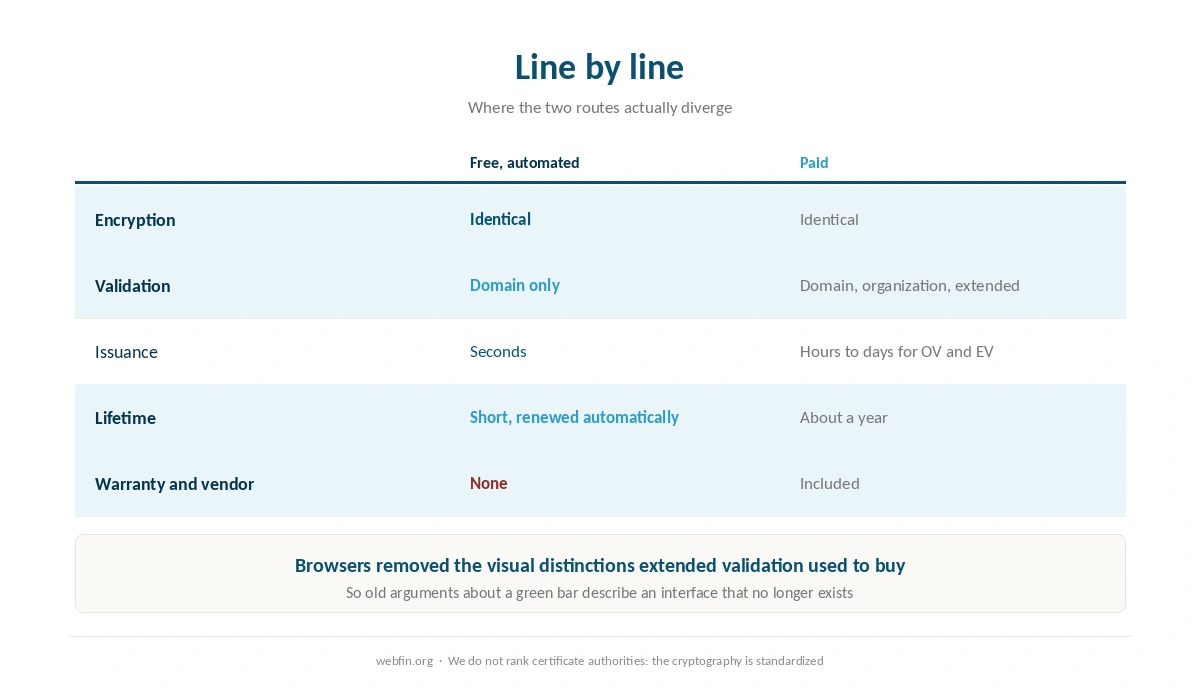
The encryption is identical, browsers show the same padlock, and search engines do not distinguish between them. What money buys is a different validation level, a warranty, a longer certificate lifetime and a vendor to call. For nearly every site the free automated certificate is the better engineering choice, because automation prevents the failure that actually happens: expiry.
Head to Head
| Criterion | Free, automated | Paid |
|---|---|---|
| Encryption strength | Identical | Identical |
| Browser appearance | Same padlock | Same padlock |
| Validation available | Domain only | Domain, organization, extended |
| Issuance time | Seconds | Hours to days for OV and EV |
| Certificate lifetime | Short, renewed automatically | About a year |
| Renewal risk | Handled by automation | A calendar entry you must keep |
| Wildcards | Available; automation varies by host | Sold as a product |
| Warranty | None | Included |
| Support if it breaks | Your host, or the community | The vendor |
| Cost | Nothing | $75.00 to $119.99 a year in our table |
Objection One: Free Is Less Secure
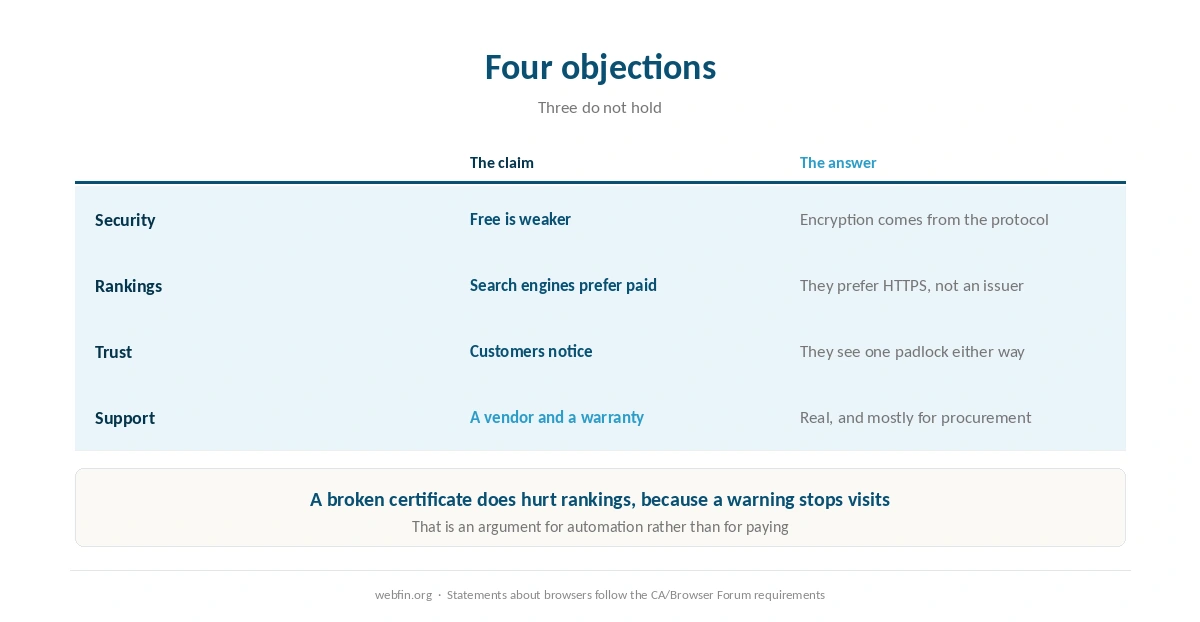
The encryption comes from the protocol and the key, not from the invoice. A domain-validated certificate from a free authority and a domain-validated certificate costing $89.88 a year produce the same connection.
What differs is what the issuer checked before signing. Free authorities verify control of the domain, which is exactly what a paid domain-validated certificate verifies too. Paying more buys checks on the organization, not stronger cryptography.
Objection Two: Search Engines Prefer Paid
They prefer HTTPS to HTTP, which is a different claim. No search engine documents a preference between certificate authorities or validation levels, and there is no mechanism by which one would appear in a ranking signal.
What does affect rankings is a broken certificate, because a browser warning stops visits outright. Our guide to fixing a website that is down covers that morning.
Objection Three: Customers Trust It Less
A visitor sees a padlock. Browsers removed the visual distinctions that extended validation used to buy, so the green bar arguments in old sales pages describe an interface that no longer exists.
For a store, what earns trust is a checkout that works, a real address and a refund policy. Our list of hosting for ecommerce covers the part of that hosting can influence, which is whether the page loads under load.
Objection Four: You Get Support and a Warranty
This one is real, and narrow. A paid certificate comes with a vendor to contact and a warranty measured in tens or hundreds of thousands of dollars, which pays out in the event of mis-issuance.
Almost no site has a claim scenario for that. Where it matters is procurement: an insurer, a partner or a public tender that names a warranty or a validation level. Buy what the document says and move on, as our guide to reading a hosting agreement suggests for any clause of that kind.
The Real Operational Difference
Lifetime. Free certificates are short-lived on purpose, so renewal is automated by design. A paid certificate normally runs for a year, which makes renewal an annual task somebody has to own.
Failure mode. The automated route fails when the validation path breaks, which happens after a DNS change or a host move. The annual route fails when a person leaves the company.
Wildcards. Free authorities issue them, but not every shared host automates the DNS validation they need. Our guide to setting up WordPress Multisite covers the case where that decides your purchase.
Multiple names. Both routes cover several domains on one certificate; the difference is whether your panel exposes it.
| Host | Charge | Cost per year |
|---|---|---|
| Bluehost | Premium SSL, single domain | $89.88 (optional; Let's Encrypt is free) |
| Bluehost | Domain privacy | $15.00 (free year one on Business and up) |
| Bluehost | SiteLock Essentials | $95.88 |
| Bluehost | SiteLock Prevent | $239.88 |
| Bluehost | Yoast SEO Premium | $99.99 |
| Bluehost | Early cancellation, free domain | $15.99 one-off, deducted from refund |
| GoDaddy | SSL on Economy after year one | $119.99; other tiers include it for the plan's life |
| GoDaddy | Pre-checked extras at checkout | $345.39 counted by one review, unverified |
| HostGator | CodeGuard daily backups | $35.88 (weekly copies are a courtesy, not guaranteed) |
| HostGator | SiteLock, pre-selected at checkout | $23.88 |
| HostGator | Dedicated IP | $59.40 |
| HostGator | Professional migration | $149.99 one-off |
| Hostwinds | Standard SSL | $75.00 (free AutoSSL on shared via cPanel) |
| Hostwinds | Wildcard SSL | $150.00 |
| Scala Hosting | Processor core, added or removed anytime | $36.00 per core |
| Scala Hosting | Memory, added or removed anytime | $12.00 per gigabyte |
| Hostinger | WHOIS privacy | Included |
| Hostinger | Domain renewal, .com | $15–$20, no first-party figure published |
| DreamHost | WHOIS privacy | Included for the life of the domain |
| Namecheap | Domain privacy | Included for the life of the domain |
| InterServer | Everything on the one plan | Included; no tiers to upgrade to |
What Hosts Charge, and Why That Matters
Our table of recurring charges records a premium single-domain certificate at $89.88 a year at Bluehost, a Newfold Digital brand, $119.99 a year on GoDaddy Economy from year two, and $75.00 at Hostwinds with a wildcard at $150.00. Each sits beside a free automated option in the same account.
That pattern is the strongest argument in this comparison. A company selling you something it also gives away is selling reassurance, and our guide to avoiding checkout upsells covers declining it politely. Our page on hidden hosting fees lists the rest of the same category.
When Paid Is the Right Answer
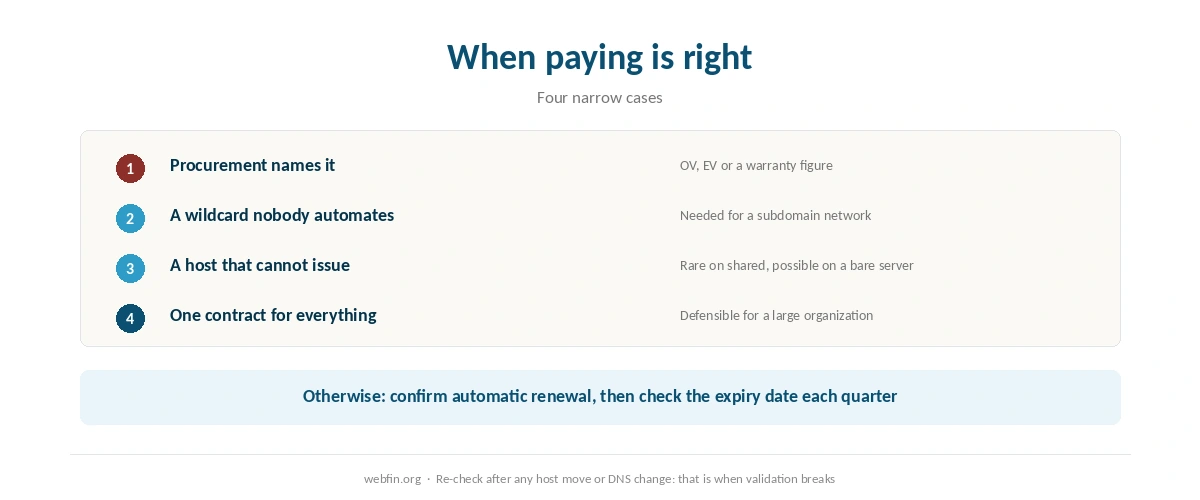
Procurement names it. Organization or extended validation, or a warranty figure.
Your host will not automate a wildcard. And you need one for a subdomain network.
Your host cannot issue certificates at all. Rare on shared hosting, possible on a bare server.
You want one contract for everything. A defensible preference for a large organization, and an expensive one for a small site.
Getting the Free Route Right
Confirm the renewal is automatic. Then check the expiry date once a quarter, because automation fails quietly.
Redirect HTTP to HTTPS everywhere. And fix mixed content, or the padlock reports a problem on pages that are otherwise fine.
Re-check after any move. A host change or a DNS edit is when validation breaks, which our guide to pointing a domain to a new host covers.
Know where the switch lives. On cPanel hosts it sits in an SSL or AutoSSL section, which our guide to understanding cPanel maps out.
Where the Two Routes Behave Differently in Practice
Both are one click on a shared plan, and the free one is already there. On a server you configure the automated route yourself: a client, a renewal timer and a reload hook, which our list of hosting for SaaS startups counts as part of the maintenance column.
For a store the practical question is neither price nor issuer. It is whether the checkout still works when the certificate renews, which is why testing after any change matters more than the certificate type. Our list of hosting for membership sites covers the other case where logged-in pages break quietly.
How We Research
We run no tests and we issue no certificates. The paid prices here are host add-on charges from the providers’ own pages and from our reviews, read on 20 September 2026, and they sit in our tables.
Statements about browser behavior follow the CA/Browser Forum requirements and current browser releases; statements about ranking signals reflect published search engine documentation, which addresses HTTPS rather than certificate type. We do not rank certificate authorities, because the cryptography is standardized and the remaining differences are commercial. The criteria behind our scores are on our about page.
Free vs Paid SSL FAQ
No. The encryption comes from the protocol and the key. A domain-validated certificate from a free authority produces the same connection as a domain-validated one that costs $89.88 a year.
No. Search engines document a preference for HTTPS over HTTP, not for one issuer or validation level over another. A broken certificate does hurt, because a browser warning stops visits.
They see a padlock either way. Browsers removed the visual distinctions extended validation used to buy, so old arguments about a green bar describe an interface that no longer exists.
A warranty, a vendor to call, and a year-long certificate rather than a short one. The short lifetime is why renewal is automated, which prevents the failure that actually happens.
When procurement names organization or extended validation or a warranty figure, when you need a wildcard your host will not automate, or when your host cannot issue certificates at all.
The Verdict
The common arguments for paying mostly do not survive contact with the evidence. The encryption is the same, search engines are indifferent, and the browser shows one padlock. Support and a warranty are real, and they apply to procurement rather than to sites.
So take the free automated certificate and spend the attention on renewal instead of purchase. The failure that costs traffic is an expired certificate, not a cheap one, and automation is what prevents it. Our guide to setting up automatic backups covers the other thing that fails quietly.