
Disclosure: WebFin is reader-supported. If you buy hosting through links on this page, we may earn a commission at no extra cost to you. Commissions vary between providers and our ratings do not — here’s our full disclosure.
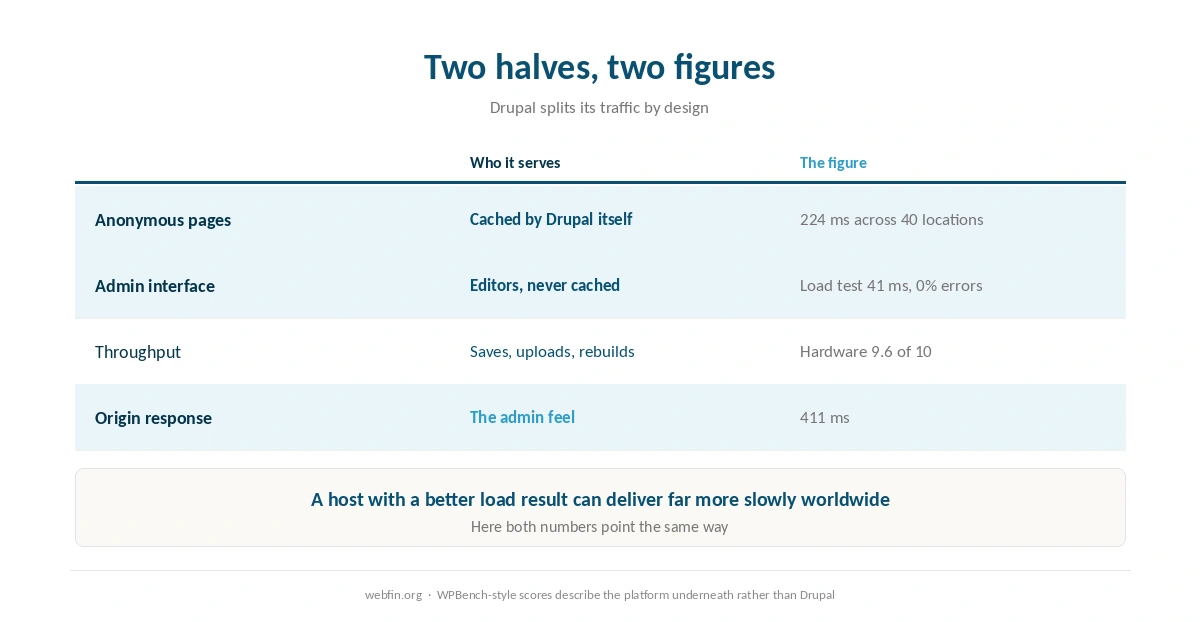
Drupal sits between WordPress and Magento in what it asks of a plan, and Bluehost is the host that lets you check that properly. Both halves of a Drupal site have published figures. Cached delivery runs at 224 ms across 40 locations for anonymous visitors, and the load test finished at 41 ms with a 0% error rate for the administrative work no cache serves. Two conditions apply, and one of them is a file count.
Is Bluehost Right for Drupal? The Short Answer
Yes for a brochure, institutional or editorial site, on the 36-month term. Two conditions: shell access for Composer, and a codebase that fits the published file limits. Bluehost states 50,000 inodes as a soft limit, and a Drupal install with its Composer dependencies is a large tree before any content. Ask about shell access in writing before buying.
Both Halves Are Covered
Anonymous visitors. Drupal caches their pages itself, so what matters is delivery. 224 ms across 40 locations means readers abroad are served quickly without buying a content network. Our page on SiteGround for Drupal covers a host at 632 ms instead.
Editors. The administrative interface is never cached. Every save, preview and media upload reaches the server. The load result of 41 ms with nothing dropped is the closest published proxy for that work.
Sustained throughput. Hardware at 9.6 of 10, which is the top of the range among shared plans in that project.
⚠️ The origin response of 411 ms is the number to hold in mind for the admin side. It feels different from the cached shopfront, and that is normal rather than a fault.
The Condition Nobody Mentions: File Count
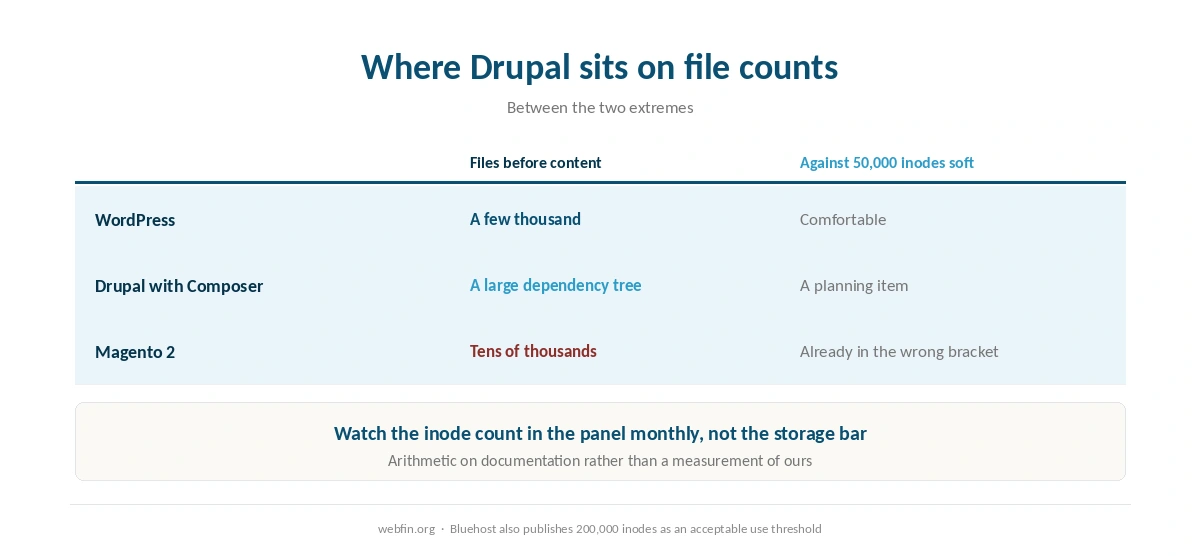
Composer installs dependencies as a tree of files, and a modern Drupal codebase carries thousands of them before you add a module or an image. Bluehost publishes 50,000 inodes as a soft limit and 200,000 as an acceptable use threshold.
That is not a blocker the way it is for Magento, where an empty install already sits in the wrong bracket. It is a planning item instead. A Drupal site with a real media library and a few dozen modules should watch the file count rather than the 10 GB of storage. Our piece on what unlimited hosting means explains.
⚠️ These are figures from documentation and arithmetic rather than measurements of ours. The useful habit is to read your own inode count in the panel once a month.
| Host and plan | Limit | Where it's stated |
|---|---|---|
| Bluehost shared | 50,000 inodes — soft limit | Hosting Inode Limit article |
| Bluehost shared | 200,000 inodes — AUP threshold | Server Resource Limitations |
| Bluehost shared | 1,000,000 inodes — TOS violation | Hosting Inode Limit article |
| Bluehost shared | 5,000 tables or 10 GB, all databases | Server Resource Limitations |
| Bluehost shared | 5 GB per single database | Server Resource Limitations |
| Bluehost Starter | 100 MB per mailbox | Shared hosting prices page |
| WP Engine Startup | 25,000 monthly visits, then overage handling | Plan pages |
| WP Engine, by tier | 25,000 to 400,000 monthly visits | Plan pages |
| Rocket.net Starter | 25,000 monthly visits, 1 site, 10 GB storage | Plan pages |
| Namecheap EasyWP | 50,000 / 200,000 / 500,000 monthly visits by tier | Plan pages |
| Kinsta Starter | 25,000 monthly visits | Plan pages |
| Scala Hosting VPS | Priced per unit: $3 per core, $1 per gigabyte | Plan pages; adjustable anytime |
| HostGator shared | Weekly backups described as a courtesy, not guaranteed | Hosting terms |
| Liquid Web | Dedicated resources at every tier; no shared plan | Plan pages |
| InterServer Standard | Unlimited storage, bandwidth, email and websites | One plan, no tiers |
| GreenGeeks Lite | One website only | Plan pages |
| IONOS Plus | One email account bundled per plan | Plan pages |
| Hostinger, all plans | Not published | Hostinger support article, 28 Aug 2026 |
| Bluehost Starter | 10 GB NVMe storage | Plan pages, as listed in a 2026 audit |
| InMotion Core | One site, 10 email accounts, SSD storage; NVMe from Launch | TechRadar and a 2026 review |
| SiteGround shared | Shell access by tier — not recorded | Not stated on the plan pages we read, 20 Sep 2026 |
| Bluehost shared | Shell access by tier — not recorded | Not stated on the plan pages we read, 20 Sep 2026 |
| Hostinger, all plans | Shell access by tier — not recorded | Not stated on the plan pages we read, 20 Sep 2026 |
| Cloudways servers | Search service (OpenSearch, Elasticsearch) — not recorded | Not stated on the plan pages we read, 20 Sep 2026 |
The Other Condition: A Shell
Drupal expects Composer to manage modules and core updates, and Composer expects a command line. Our tables do not record shell availability by tier at this host, so ask support in writing and keep the reply.
Without it, Drupal is maintainable only awkwardly: uploading files by hand, patching without dependency resolution, and hoping an update does not need a rebuild. That is the same condition our page on Hostinger for Drupal puts first.
What to Watch Otherwise
The cart. Security and backup add-ons are pre-selected. A premium certificate costs $89.88 a year while the free one encrypts identically, and Yoast SEO Premium appears at $99.99. None of it is required.
Mailboxes. 100 MB each on Starter, which an institution with staff addresses fills. Our guide to setting up email on your domain covers moving mail elsewhere.
The renewal. $9.99 on a 36-month term and $11.99 on a 12-month one, so three years cost $143.64 or $335.64 depending on the path.
The refund deduction. $15.99 comes off any refund for the free domain, inside the 30-day window.
Which Drupal Sites Fit
An institutional or association site. Anonymous readers served from cache, a few editors, a phone line for whoever owns the budget.
A publication with a small newsroom. The load result covers the editorial day, and our list of hosting for news sites covers the rest.
A multilingual brochure site. More database work per page, absorbed by Drupal’s own caching, which our guide to configuring caching puts in context.
A site read from several countries. The 224 ms figure is the reason, and few shared plans we price match it.
When a Server Becomes the Answer
A search service. Solr or OpenSearch runs beside the application, which needs root.
Drupal Commerce. A checkout is the demanding uncached case, and our page on Bluehost for WooCommerce covers where a shared plan still holds for selling.
A newsroom rather than a newsletter. Twenty simultaneous editors is a hardware question, and our guide to moving from shared to VPS covers the sizing.
A file count that keeps climbing. Large media libraries plus a big dependency tree, which our list of hosting for developers covers alongside the tooling.
Before and After You Buy
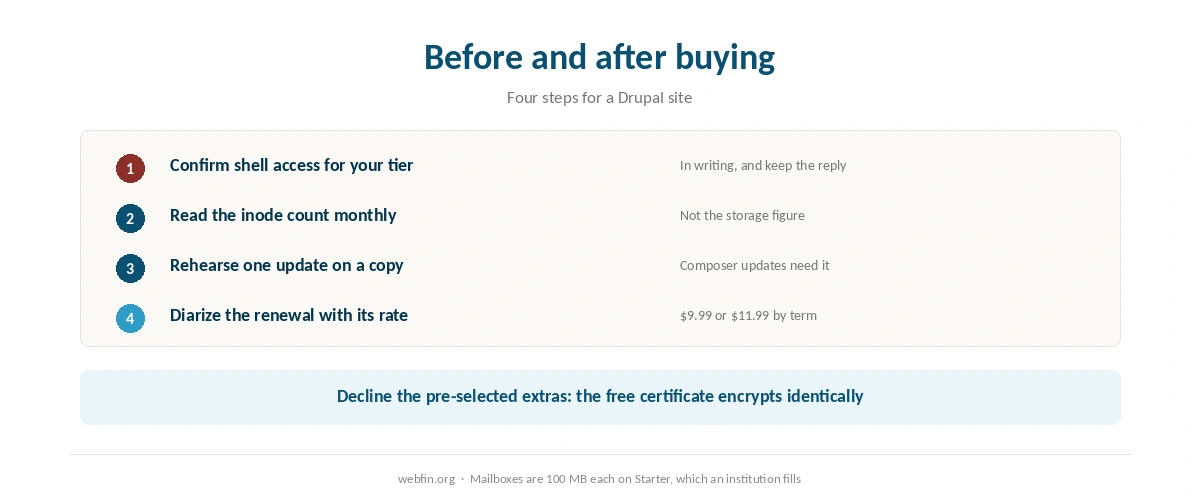
Confirm shell access for your tier. In writing, because it decides whether the site is maintainable here.
Read the inode count monthly. Not the storage figure.
Rehearse one update on a copy. Composer updates are exactly what a staging copy is for, which our guide to setting up a staging site covers.
Diarize the renewal with its rate. The term you chose decides which one applies.
One Practical Comparison
Against the cheaper alternative in this series, the trade is straightforward. Hostinger holds $2.99 for 48 months but has no load result in our tables and does not publish its limits, which our page on Hostinger for WordPress covers.
Here you pay a little more for numbers you can check, which is the whole argument for this host on any platform. Our roundup of cheap web hosting ranks the field on the same basis.
How We Research
We run no tests. The load result comes from Hostingstep’s July 2026 changelog, with hardware and response from its 2026 benchmarks. Uptime runs from November 2025 to August 2026, and cached delivery comes from its Bluehost review of July 2026.
Limits, mailbox caps, add-on charges and refund terms come from Bluehost’s own pages and support articles, read on 20 September 2026. Drupal’s requirements come from its own documentation for current releases, and the file-count comparison is arithmetic on documented behavior rather than a measurement. Our tables do not record shell availability by tier here, and we say so rather than assume. Bluehost belongs to Newfold Digital, and the criteria behind our scores are on our about page.
Bluehost for Drupal FAQ
Yes for a brochure, institutional or editorial site, provided your tier includes shell access so Composer works. Both halves of the workload are covered: 224 ms cached delivery and a load test at 41 ms with no errors.
Because Composer installs dependencies as a large tree of files, and Bluehost publishes 50,000 inodes as a soft limit. It is a planning item rather than a blocker, unlike Magento where an empty install exceeds it.
For a Drupal site, yes. Drupal caches anonymous pages itself, so delivery is what readers experience, and 224 ms across 40 locations means no separate content network is needed.
Then Drupal is maintainable only awkwardly: manual uploads, patching without dependency resolution, and updates that may need a rebuild you cannot run. Ask support before buying rather than after.
For a search service such as Solr, or for Drupal Commerce. Also for a newsroom with many simultaneous editors, or when the file count keeps climbing past the published thresholds.
The Verdict
For Drupal this is a better fit than the brand’s reputation suggests, and the reason is that both halves of the workload have numbers. Visitors get cached pages delivered at 224 ms, and editors get a platform that answered every request under load. The hardware score is the highest among shared plans in that project.
The conditions are specific and checkable: confirm shell access for your tier, and watch the inode count rather than the storage bar. If either fails, a server priced by the unit or the hour is the next step. Our page on what web hosting costs prices both across three years.