
Disclosure: WebFin is reader-supported. If you buy hosting through links on this page, we may earn a commission at no extra cost to you. Commissions vary between providers and our ratings do not — here’s our full disclosure.
We are not going to print a table of domain renewal prices by extension, and the reason is the same reason you are reading this page: those numbers move. A .com renewal quoted in September is a different number in March, promotions change by country, and premium names renew at their own rates regardless of the list price. A table like that is wrong within months, and a wrong table is worse than none. What does not move is the structure around the price, and that is what this page compares.
Domain Renewal Prices: The Short Answer
Compare four things rather than one. The renewal price for your own extension, on each provider’s pricing page. Whether the registrar includes WHOIS privacy or bills it yearly. Whether it charges anything to transfer out, and what happens if the name expires. Namecheap, DreamHost and Hostinger include privacy in our tables. Then register for more than one year, because that fixes the price and removes a deadline.
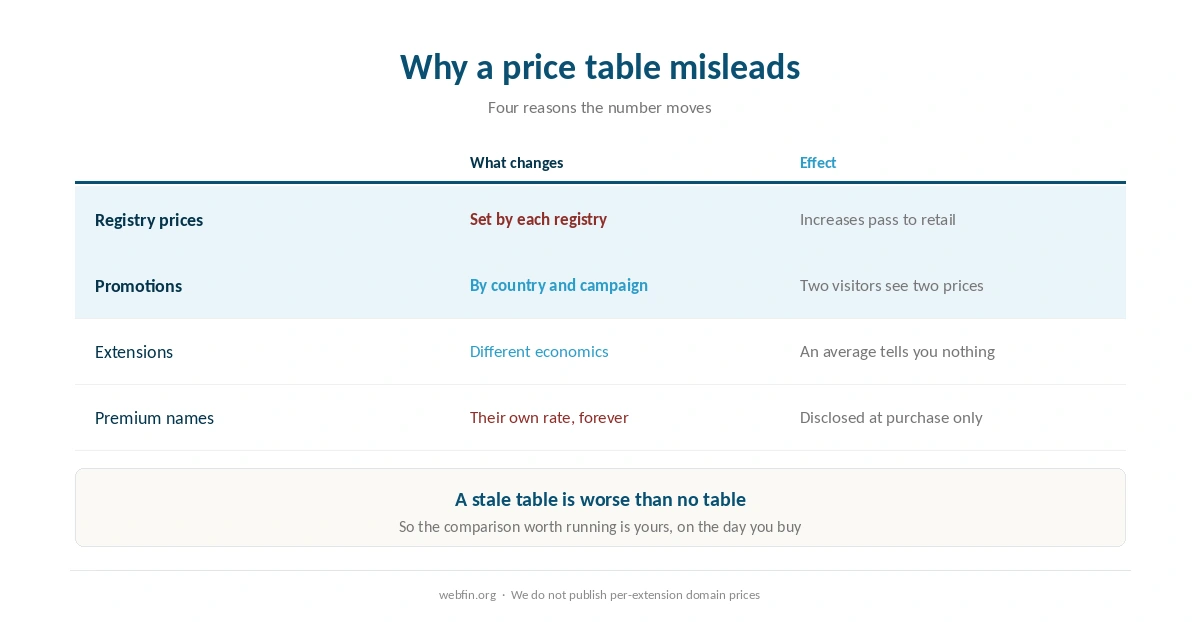
Why a Price Table Would Mislead You
Registry prices change. The wholesale cost of an extension is set by its registry, and increases pass through to retail. A page written last year does not know about this year’s increase.
Promotions differ by market. The same registrar shows different first-year and renewal prices depending on where you are and which campaign is running.
Extensions are not comparable. A .com, a country extension and a novelty extension have different economics. A table that averages them tells you nothing about the one you want.
Premium names have their own rates. Some names renew at a premium price forever, and the registrar discloses that at purchase rather than on a pricing page.
⚠️ So the useful comparison is the one you run yourself, on the day you buy, for your own extension. The rest of this page is how to do that in five minutes and what to watch while you do it.
The Four Things Worth Comparing
The renewal price for your extension. Not the first year. Find it on the registrar’s own pricing page, which sits apart from the search box.
Privacy: included or billed. Namecheap, DreamHost and Hostinger include WHOIS privacy in our tables. Several hosts bill it annually, which our page on hidden hosting fees records alongside the other recurring extras.
Transfer-out charges. Moving a name should cost nothing beyond the receiving registrar’s year of registration. Anything else is a reason to choose elsewhere, and our guide to transferring a domain covers the process.
What expiry costs. After a domain lapses there is a redemption period, and redemption fees are far higher than a renewal. That is the one hosting-adjacent charge worth fearing, because it is avoidable by turning on auto-renew.
| Host and plan | Intro → Renewal | Multiplier |
|---|---|---|
| IONOS Plus | $1.00 → $14.00 | 14.0× over 12 months |
| SiteGround StartUp | $2.99 → $17.99 | 6.0× over 12 months |
| SiteGround GrowBig | $4.99 → $29.99 | 6.0× over 12 months |
| SiteGround GoGeek | $7.99 → $44.99 | 5.6× over 12 months |
| ChemiCloud Starter | $2.49 → not published | Renewal shown at checkout only |
| Scala Hosting Mini | $2.95 → $11.95 | 4.1× over 12 months |
| DreamHost Launch, annual | $2.89 → $10.99 | 3.8× over 12 months |
| Hostinger Premium | $2.99 → $10.99 | 3.7× over 48 months |
| Bluehost Starter | $3.99 → $11.99 | 3.0× over 12 months |
| A2 Hosting Turbo Boost | $6.99 → $20.99 | 3.0× over 12 months |
| HostGator Hatchling | $3.75 → $10.99 | 2.9× over 36 months |
| GoDaddy Economy | $5.99 → $15.32 | 2.6× over 36 months |
| Bluehost Starter | $3.99 → $9.99 | 2.5× over 36 months |
| Namecheap Stellar | $1.98 → $4.88 | 2.5× over 12 or 24 months |
| Namecheap Stellar Plus | $2.98 → $6.88 | 2.3× over 12 or 24 months |
| Namecheap Stellar Business | $4.98 → $9.88 | 2.0× over 12 or 24 months |
| DreamHost Launch, 4-year | $2.89 → $7.99 | 2.8× over 48 months |
| DreamHost, eligible US nonprofits | One shared plan free for the account's life | 501(c)(3) or (c)(19); help article, checked 10 Jun 2026 by a nonprofit directory |
| Bluehost Business | $6.99 → $13.99 | 2.0× over 36 months |
| Bluehost Starter, second reading | $1.99 → $8.99 | Hostingstep, July 2026; conflicts with Bluehost's help page |
| Hostwinds Basic | $4.54 → $6.99 | 1.5× over 12 months |
| WP Engine Startup | $27.00 → $35.00 | 1.3× over 12 months |
| Rocket.net Starter | $25.00 → $30.00 | 1.2× over 12 months |
| InterServer Standard | $2.50 flat | 1.0×, price lock |
| Cloudways, from | $14.00 flat | no promotional term |
| Kinsta Starter | $35.00 flat | no promotional term |
| Liquid Web managed VPS, annual billing | $33.00, no promotional term | No increase described on annual billing |
| Liquid Web managed VPS, monthly billing | $36.00 → $72.00 reported | 2.0× over one month; one pricing guide, disputed |
| GreenGeeks Lite | $2.95 → $13.95 | 4.7× after one term; renewal was $12.95 before 2026 |
| ChemiCloud Starter, third-party figures | $9.95, $11.95 or $12.95 quoted | Sources disagree; 4.0× to 5.2× over 36 months |
| SiteGround StartUp, by term | $2.99 → $14.99, $17.99 or $24.99 | 5.0× over 24 months, 6.0× over 12, 8.4× month to month |
| ChemiCloud Kickstart, reseller | $8.99 → $29.95 | Term not stated in the source we read |
| InterServer reseller | $19.95, price locked | No increase described in sources |
| GreenGeeks reseller | $19.95 with WHMCS included | Promotional rate; renewal not published |
| Hostwinds white-label reseller | $10.00 with WHMCS included | Plain reseller plan excludes WHMCS |
| InMotion Core, 36-month term | $3.19 → $10.99 | 3.4× over 36 months; TechRadar, 2026 |
| InMotion Launch, 36-month term | $4.99 → $13.99 | 2.8× over 36 months; TechRadar and plan cards, 2026 |
| InMotion Core, by term | Renews at $10.99, $11.99 or $14.49 | Longest term lowest; one review, May 2026 |
A Five-Minute Method
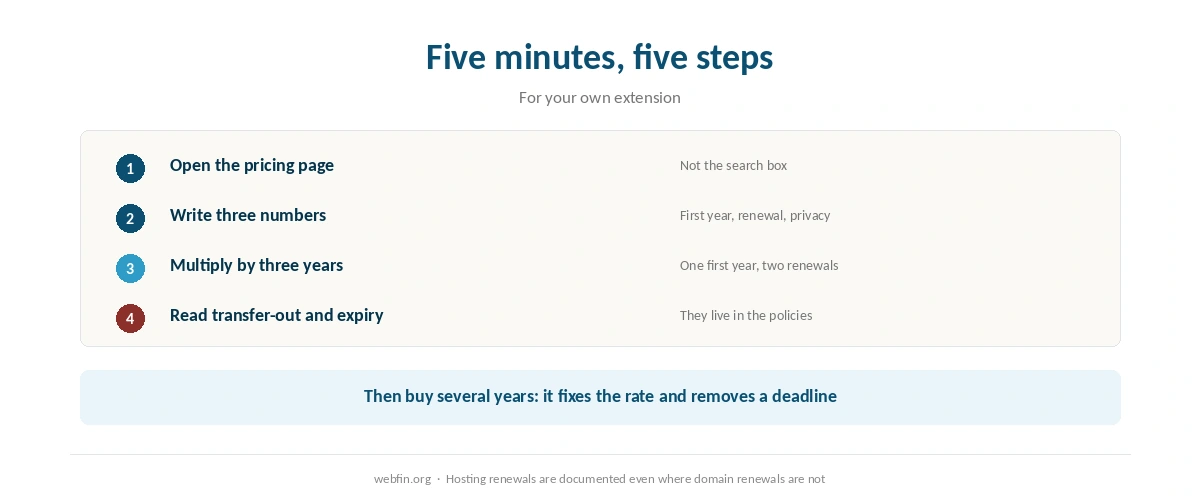
Open the pricing page, not the search box. Search results show the promotion; the pricing page shows the renewal.
Write down three numbers per candidate. First year, renewal, and privacy where it carries its own charge.
Multiply by three years. One first year plus two renewals, plus privacy where it applies. That is the figure to compare.
Check the transfer-out and expiry terms. Both live in the registrar’s policies rather than on the price page, and our guide to reading a hosting agreement covers reading that kind of document quickly.
Then buy multiple years. It fixes the rate at purchase and removes an annual deadline from your list.
What Our Tables Do Say
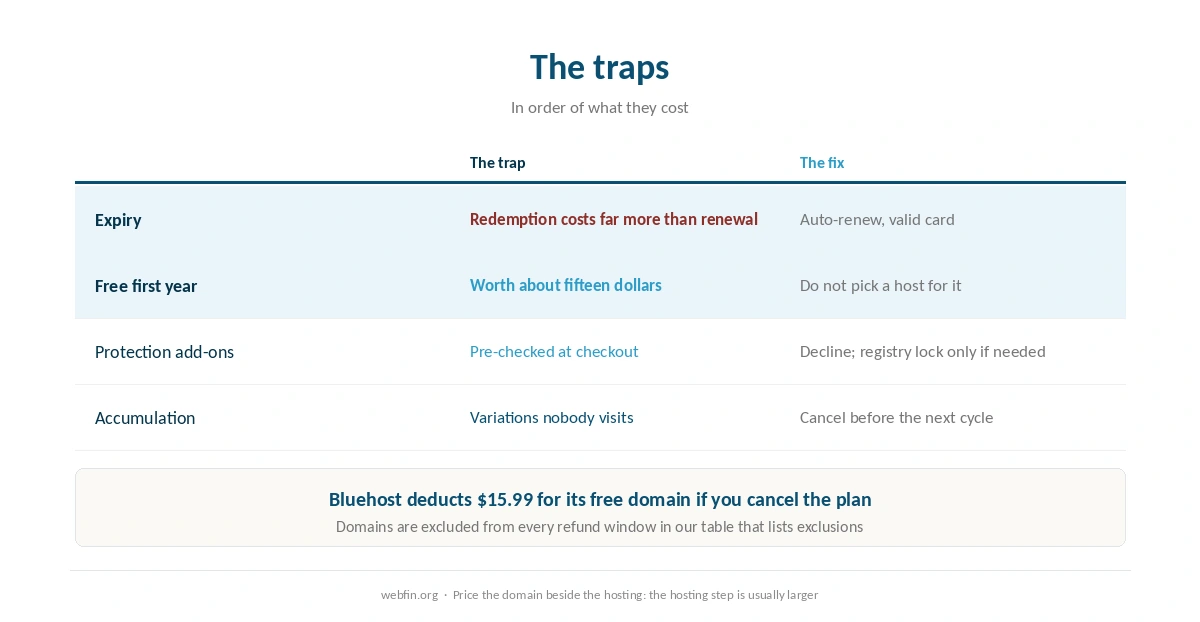
Two things, both structural. First, domains are excluded from every refund window in our table that lists exclusions, and Bluehost, a Newfold Digital brand, deducts $15.99 for its free domain if you cancel the plan. Our guide to canceling hosting and getting a refund covers that.
Second, hosting renewals are documented even where domain renewals are not. The table above records the step each plan takes, from Hostinger’s $2.99 to $10.99 across 48 months to IONOS’s $1.00 to $14.00 across 12. Those are the numbers we can stand behind, and our page on hosting renewal prices lists them all.
One More Comparison Worth Running
Price the domain beside the hosting rather than separately, because the two renewals arrive in the same year and the hosting step is the larger one. A plan that triples at renewal costs more than any domain decision on this page.
Our roundup of cheap web hosting ranks plans with that step included, and our page on what web hosting costs runs three-year totals for each.
The Traps That Cost Real Money
The free first year. Worth about fifteen dollars, and it renews at the registrar’s standard rate. It is not a reason to choose a host.
The promotion tied to a long term. Some domain discounts require multi-year registration, which is fine, and some hosting discounts bundle a domain whose renewal is separate, which is where people get surprised.
Domain protection add-ons. Pre-checked extras at checkout, which our guide to avoiding checkout upsells covers. Registry lock has a real purpose for valuable names. Generic protection bundles rarely add anything you cannot do yourself.
Letting a name lapse. The expensive one. Auto-renew plus a card that has not expired prevents it entirely.
Where the Domain Should Live
At a registrar rather than a host, for the same reason we give on our registrar page: a name held at a registrar turns a host change into a DNS edit. A name bundled with hosting turns it into a transfer, with a 30-day lock after registration under the revised ICANN policy.
If you would rather keep everything together, DreamHost and Hostinger both include privacy and hold the name beside the hosting. Our page on Hostinger for WordPress covers the hosting side.
What Changes a Domain Bill Over a Decade
Three things, and none of them is the sticker price. Whether privacy is a line item, whether you ever let the name lapse, and whether the name sits somewhere you would rather leave. A dollar a year on the renewal is noise beside any of those.
The fourth is quieter: how many domains you accumulate. Registrars make it easy to buy variations nobody visits, and each one renews forever. Cancel the ones that redirect nowhere before the next cycle, and keep the list in the same note as your host and DNS, which our guide to pointing a domain to a new host assumes you have.
If the Domain Sits With a Host You Are Leaving
Move the site first, then the name, and keep the old plan running while both settle. The lock after a registration or a previous transfer runs 30 days under the revised ICANN policy, so plan around it rather than discovering it.
A cPanel host makes the site half of that easy, and our guide to migrating web hosting covers the order. The domain half is a TAC and a wait.
How We Research
We run no tests. Privacy inclusions, refund exclusions and hosting renewal rates come from the providers’ own pages and from our reviews, read on 20 September 2026, and sit in our tables. The Bluehost deduction for a free domain is from its own refund terms.
We do not publish per-extension domain prices, because they change between registry increases, campaigns and markets, and a stale table is worse than no table. Redemption and its own policies rather than in our tables. tables. The criteria behind our scores are on our about page.
Domain Renewal FAQ
Because they move. Registry increases pass through to retail, promotions differ by market, and premium names renew at their own rates. A table would be wrong within months, so we explain how to check your own extension instead.
The renewal price for your extension on each provider’s pricing page, whether privacy is included or billed, whether transferring out costs anything, and what happens if the name expires.
Namecheap, DreamHost and Hostinger include it in our tables. Several hosts bill it yearly, which is the kind of recurring charge worth adding to the three-year total before you buy.
It is worth about fifteen dollars and renews at the standard rate. Bluehost deducts $15.99 for it if you cancel the plan within the refund window, so treat it as a small discount rather than a feature.
Letting a name lapse. Redemption fees after expiry are far higher than a renewal, and auto-renew with a valid card prevents the whole situation.
The Verdict
Anyone promising a definitive table of domain renewal prices is promising something that decays. Check your own extension on the pricing page, add privacy if it is billed, multiply by three years, and read the transfer-out and expiry terms once.
Then buy several years at a registrar that includes privacy, turn on auto-renew, and diarize the date anyway. The structure around the price is what you can actually compare, and it is the part that decides what a domain costs you over a decade. Our guide to choosing between annual and three-year terms runs the same arithmetic for hosting.