
Disclosure: WebFin is reader-supported. If you buy hosting through links on this page, we may earn a commission at no extra cost to you. Commissions vary between providers and our ratings do not — here’s our full disclosure.
The premium is sold as speed, and our tables do not support that. In the 2026 load test GreenGeeks’ shared plan finished at 26 ms without an error, and Bluehost, a Newfold Digital brand, at 41 ms. SiteGround managed 170 ms, while Kinsta answered every request at 40 ms on a managed platform costing $35.00 a month flat.
So the question is not which is faster. It is what the extra money actually buys, and the answer is specific.
Shared vs Managed WordPress: The Short Answer
Buy managed for isolation, tooling and someone else owning updates: a container per site, performance monitoring, staging, and an edge network included. Buy shared for price, email and several sites on one account. And read the visit allowance before anything else, because Kinsta and WP Engine both meter it at 25,000 a month on their entry tiers.
What Each One Is
Shared hosting. Many accounts on one server, a control panel, email included, and limits set by the host. Prices in our tables start at $2.50 a month with the price locked at InterServer.
Managed WordPress. A platform that runs only WordPress, meters visits, handles core updates, and bundles tooling. Kinsta charges $35.00 a month flat and WP Engine $27.00 rising to $35.00.
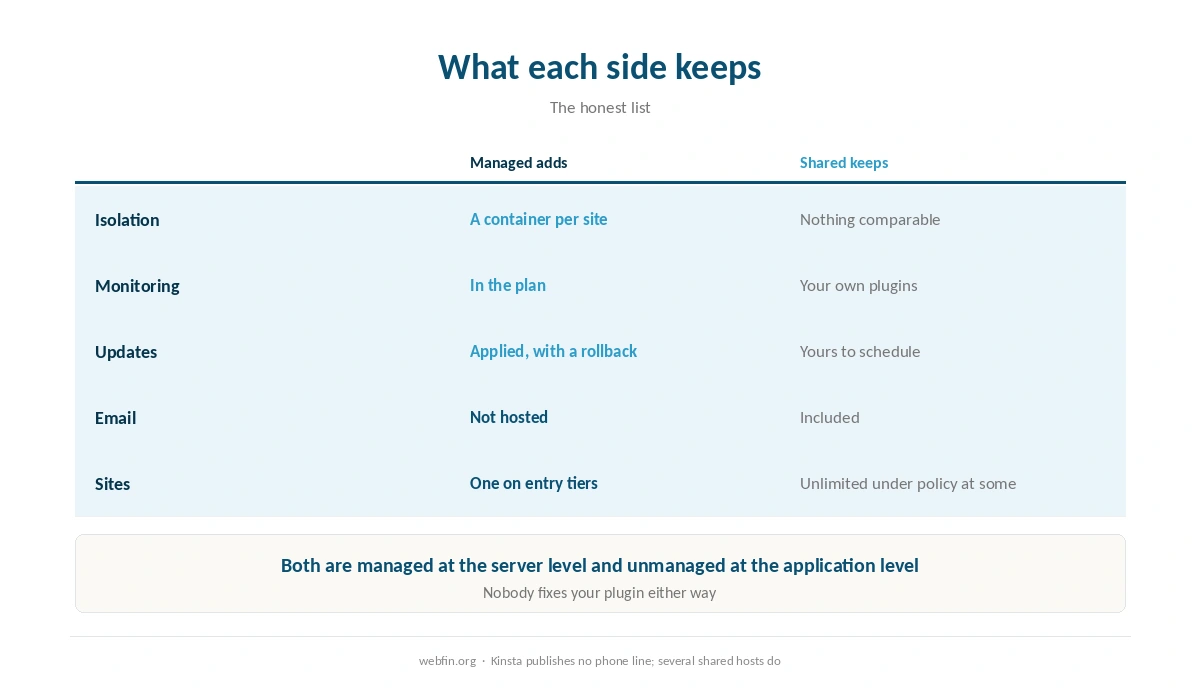
The overlap. Both are managed at the server level and unmanaged at the application level, which our page on managed against unmanaged hosting works through. Nobody fixes your plugin either way.
| Host | Rating | Renewal price |
|---|---|---|
| Hostinger | ⭐ 4.2 | $10.99/mo after 48 months |
| InterServer | ⭐ 4.1 | $2.50/mo, never changes |
| Cloudways | ⭐ 4.1 | $14.00/mo, never changes |
| WP Engine | ⭐ 4.1 | $35.00/mo after 12 months |
| Kinsta | ⭐ 4.1 | $35.00/mo, never changes |
Head to Head on Measurements
| Measure | Shared, at its best | Managed WordPress |
|---|---|---|
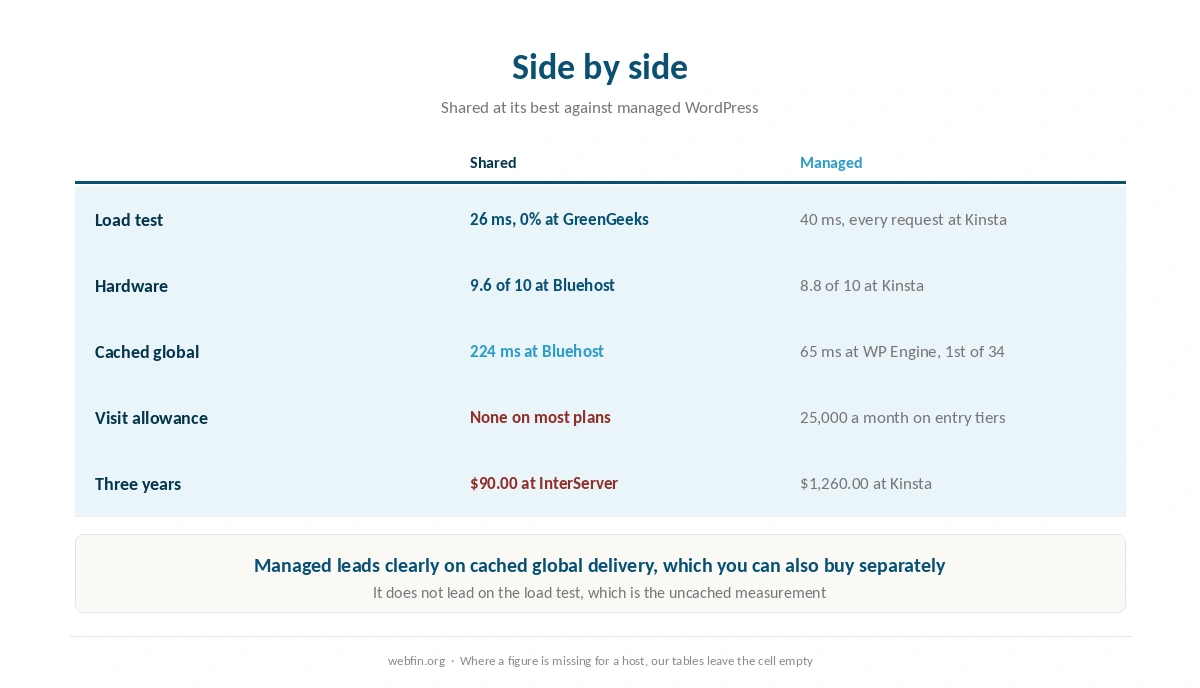
| Load test | 26 ms, 0% errors at GreenGeeks | 40 ms, every request answered at Kinsta |
| Hardware benchmark | 9.6 of 10 at Bluehost | 8.8 of 10 at Kinsta |
| Cached global delivery | 224 ms at Bluehost | 65 ms at WP Engine, 1st of 34 |
| Visit allowance | None on most plans | 25,000 a month on entry tiers |
| Included | Not hosted | |
| Phone support | Published at several hosts | Not at Kinsta; higher tiers at WP Engine |
| Price, three years | $90.00 at InterServer | $1,260.00 at Kinsta |
| Sites per plan | Unlimited under policy at some | One on entry tiers |
What the Premium Actually Buys
Isolation. A container per site at Kinsta, so another customer’s traffic cannot reach yours. Shared hosting does not promise this at any price.
Performance monitoring. Application monitoring in the plan, which finds the plugin query behind a slow page rather than leaving you to guess. Our guide to fixing a slow database explains why that matters.
Updates with a rollback. The platform applies core updates and keeps a way back, which is the part small site owners most often skip.
An edge network included. Cloudflare Enterprise at Kinsta and Rocket.net, which our page on content delivery networks shows is worth real milliseconds for distant readers.
Staging as a habit. WP Engine gives three environments per site.
What Shared Hosting Keeps
Email. Managed platforms host none, so a business on Kinsta pays a mail provider as well, which our guide to setting up email on your domain covers.
Several sites for one price. InterServer allows unlimited under its usage policy at $2.50 a month locked, where managed tiers price per site.
A phone line. Published at Bluehost, SiteGround and InterServer among others; Kinsta publishes none.
Portability. A cPanel account exports in a standard format, which our guide to migrating web hosting covers. Leaving a managed platform means moving the site instead.
The Visit Allowance Is the Real Trap
Kinsta Starter and WP Engine Startup both include 25,000 monthly visits and one site. Growth means a higher tier rather than a bigger server, and a visit is counted per session rather than per person.
For a site with steady traffic that is fine and predictable. For one whose traffic arrives in bursts it is the wrong meter, and a host priced by server size removes the ceiling, which our page on shared against VPS hosting covers.
One More Cost to Count
A managed platform that hosts no email adds a mail bill. A store or a business needs mailboxes somewhere, so price that alongside the plan rather than after it.
The same goes for a content network if you stay on shared hosting and your readers are distant, which our guide to setting up a CDN covers. Either way the comparison to make is the total, not the headline.
Four Situations
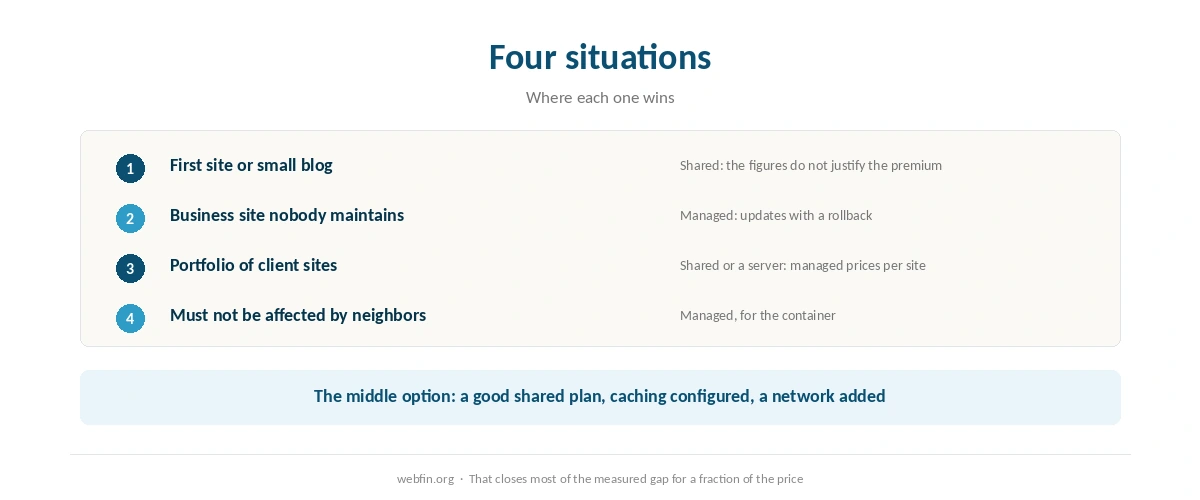
A first site or a small blog. Shared. The measurements do not justify the premium, and our roundup of cheap web hosting ranks the options.
A business site nobody maintains. Managed, because updates with a rollback are the feature you are actually buying.
A portfolio of client sites. Shared or a server, because managed tiers price per site, as our list of hosting for multiple sites covers.
A site that must not be affected by neighbors. Managed, for the container, or a server of your own.
The Middle Option
A good shared plan plus the two things managed adds. Turn on caching properly, which our guide to configuring caching covers in order, and add a content network if readers are distant.
That combination closes most of the measured gap for a fraction of the price. What it does not buy is isolation or somebody else owning your update schedule, and those are the honest reasons to pay ten times more.
Two Questions That Settle It
Who applies core updates, and what happens if one breaks? If the answer is “nobody, and we restore a backup”, managed is worth considering for that alone. Our guide to setting up automatic backups covers the other side.
How many visits do you get in your busiest month? Against 25,000 on the entry tiers, and our page on hosting renewal prices records what the next tier costs at each platform.
How We Research
We run no tests. Load, hardware and delivery figures come from Hostingstep. Load results and hardware are from its 2026 benchmarks and July 2026 changelog.
The WP Engine global ranking is from its 2025 list of 34 hosts, and the Bluehost delivery figure from its July 2026 review.
Prices, visit allowances, inclusions and support channels come from the providers’ own pages, read on 20 September 2026, and sit in our tables. Where a figure is missing for a host we leave the cell empty rather than inferring one. The criteria behind our scores are on our about page.
Shared vs Managed WordPress FAQ
Not in our tables. GreenGeeks’ shared plan finished the 2026 load test at 26 ms without an error and Bluehost at 41 ms, against 40 ms at Kinsta. Where managed leads clearly is cached global delivery.
Isolation in a container, performance monitoring in the plan, core updates with a rollback, staging, and an edge network included. Those are real features; speed alone is not the argument.
Email, which managed platforms do not host, and a phone line at some hosts. Also unlimited sites under a usage policy, and roughly ten times the three-year price at the entry level.
Kinsta Starter and WP Engine Startup both include 25,000 monthly visits and one site, counted per session. Growth means a higher tier rather than a bigger server.
On the load test it already does at several hosts. Add proper caching and a content network and most of the measured gap closes, though isolation and managed updates do not come with it.
The Verdict
Do not buy managed WordPress for speed. Our own figures show cheap shared plans finishing the load test level with or ahead of a $35.00 platform. The clearest managed advantage is cached delivery, which you can buy separately.
Buy it for the container, the monitoring and updates you no longer own, and accept the visit ceiling and the missing mailboxes as the price. Otherwise take a shared plan with a clean load result, configure caching, and spend the difference elsewhere. Our page on what web hosting costs prices both across three years.