
Disclosure: WebFin is reader-supported. If you buy hosting through links on this page, we may earn a commission at no extra cost to you. Commissions vary between providers and our ratings do not — here’s our full disclosure.
The best hosting for multiple sites depends less on how many sites a plan allows than on what those sites share. Several entry plans allow only one site. Others allow unlimited sites, and every one of them then draws on the same file limit, the same processor share and, if one is hacked, the same account. So the useful question is how much you want your sites to share, and what you will pay to keep them apart.
Best Hosting for Multiple Sites: The Short Answer
InterServer for several small sites on one bill: unlimited sites on one plan at $2.50 a month, locked. Cloudways for a growing portfolio: unlimited sites within a server you can resize, from $14.00 a month. Scala Hosting for a portfolio that needs daily backups and malware monitoring across every site.
What Multiple Sites Share
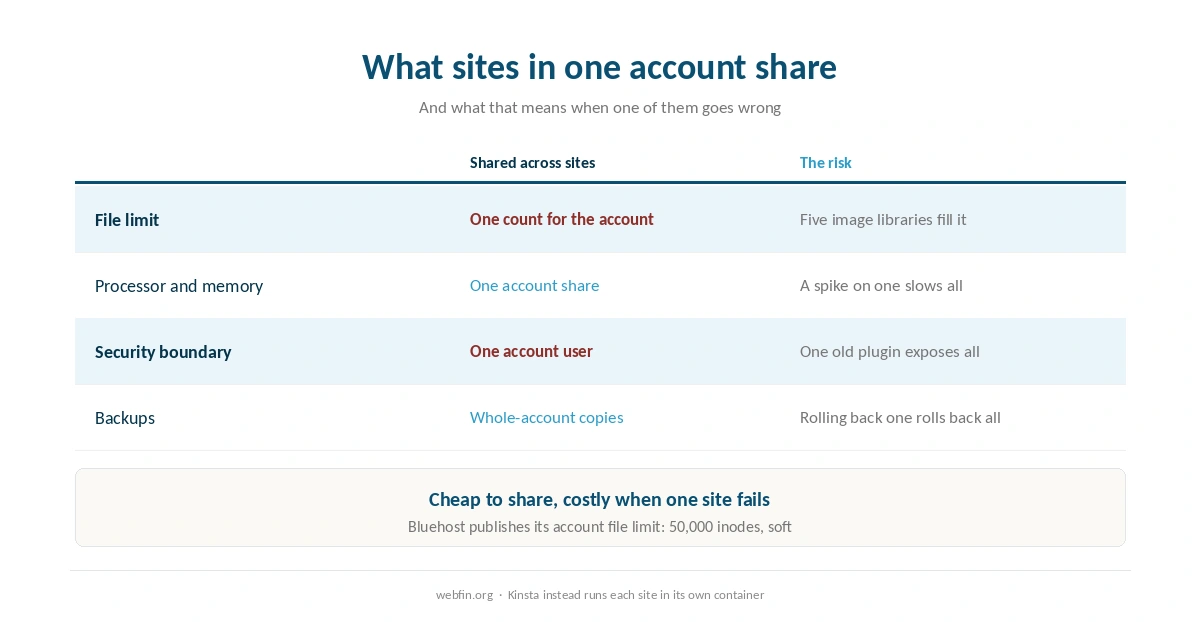
The file limit. On shared hosting, every site in the account counts against one file limit. Bluehost, a Newfold Digital brand, publishes it: 50,000 inodes as a soft limit for the whole account. Five sites with their own image libraries reach that sooner than one.
The processor and memory. The account’s share of the server is divided among its sites. A spike on one slows the others, and our guide to checking whether your host is throttling you explains how to see it.
The security boundary. On a standard shared account, every site runs under the same account user. An outdated plugin on a forgotten side project can give an attacker a way into all of them.
The backups. A whole-account backup restores every site to the same moment. That is fine after a disaster and awkward when only one site needs rolling back.
| Host and plan | Limit | Where it's stated |
|---|---|---|
| Bluehost shared | 50,000 inodes — soft limit | Hosting Inode Limit article |
| Bluehost shared | 200,000 inodes — AUP threshold | Server Resource Limitations |
| Bluehost shared | 1,000,000 inodes — TOS violation | Hosting Inode Limit article |
| Bluehost shared | 5,000 tables or 10 GB, all databases | Server Resource Limitations |
| Bluehost shared | 5 GB per single database | Server Resource Limitations |
| Bluehost Starter | 100 MB per mailbox | Shared hosting prices page |
| WP Engine Startup | 25,000 monthly visits, then overage handling | Plan pages |
| WP Engine, by tier | 25,000 to 400,000 monthly visits | Plan pages |
| Rocket.net Starter | 25,000 monthly visits, 1 site, 10 GB storage | Plan pages |
| Namecheap EasyWP | 50,000 / 200,000 / 500,000 monthly visits by tier | Plan pages |
| Kinsta Starter | 25,000 monthly visits | Plan pages |
| Scala Hosting VPS | Priced per unit: $3 per core, $1 per gigabyte | Plan pages; adjustable anytime |
| HostGator shared | Weekly backups described as a courtesy, not guaranteed | Hosting terms |
| Liquid Web | Dedicated resources at every tier; no shared plan | Plan pages |
| InterServer Standard | Unlimited storage, bandwidth, email and websites | One plan, no tiers |
| GreenGeeks Lite | One website only | Plan pages |
| IONOS Plus | One email account bundled per plan | Plan pages |
| Hostinger, all plans | Not published | Hostinger support article, 28 Aug 2026 |
| Bluehost Starter | 10 GB NVMe storage | Plan pages, as listed in a 2026 audit |
| InMotion Core | One site, 10 email accounts, SSD storage; NVMe from Launch | TechRadar and a 2026 review |
| SiteGround shared | Shell access by tier — not recorded | Not stated on the plan pages we read, 20 Sep 2026 |
| Bluehost shared | Shell access by tier — not recorded | Not stated on the plan pages we read, 20 Sep 2026 |
| Hostinger, all plans | Shell access by tier — not recorded | Not stated on the plan pages we read, 20 Sep 2026 |
| Cloudways servers | Search service (OpenSearch, Elasticsearch) — not recorded | Not stated on the plan pages we read, 20 Sep 2026 |
Plans That Allow One Site
Check the site count before anything else. Several entry plans in our tables allow a single site: Rocket.net Starter, GreenGeeks Lite and InMotion Core among them. Managed WordPress hosts such as Kinsta and WP Engine price per site, so each extra site means another plan or a higher tier.
That is not a flaw for one site, and it is the wrong shape for five. Check the limit on the tier you would actually buy, because the step up can lift it, as InMotion Launch does for Core. For an owner with several sites, the plans below either allow unlimited sites or price by the server rather than by the site. Our list of hosting for agencies covers the per-site model in depth.
InterServer: Many Sites, One Low Bill
InterServer Standard holds unlimited sites, storage, bandwidth and email on one plan, under an acceptable use policy. It costs $2.50 a month and the price is locked for the life of the account, so adding a tenth site costs nothing extra. Support answers by phone, chat and tickets around the clock.
Strengths. The lowest cost per site in this guide. Standard cPanel, so every site sits in a familiar panel. No tier to outgrow.
Weaknesses. Every site shares one account’s resources and security boundary. Its measured record is thinner than the larger brands’.
Choose it if you run several small sites that rarely see crowds. Skip it if one of them is a busy store. Our InterServer review explains the lock.
Cloudways: A Server You Grow Into
Cloudways puts unlimited sites on a server you pay for, from $14.00 a month flat. Each site runs as its own application, and you resize the server as the portfolio grows. Staging, SSH, WP-CLI and Git ship on every tier, and uptime held between 99.996% and 99.999% across five plans in the benchmark project we cite.
Strengths. Capacity that follows the portfolio, billed by the hour. Separate applications, so one site can be rolled back without the others.
Weaknesses. No email, so each domain needs a mailbox provider. You manage capacity yourself. Phone support is a paid add-on.
Choose it if the portfolio is growing or mixed. Skip it if you want email in the same panel. Our Cloudways review covers each cloud.
Scala Hosting: Protection Across the Portfolio
Scala’s SPanel includes daily backups, WordPress staging and cloning, and a real-time malware monitor. For a portfolio, the monitor and the daily copies matter most, because one neglected site can open the way into all of them. Its VPS prices a processor core at $36.00 a year and a gigabyte of memory at $12.00.
Strengths. Security and backups built in rather than sold per site. Resources you size precisely. Pro-rated refunds of the unused term after 30 days.
Weaknesses. SPanel is proprietary, so moving away means moving each site. No phone line.
Choose it if you want protection across many sites without buying it per site. Our Scala Hosting review covers the VPS line.
InMotion and Kinsta: Two Other Routes
InMotion Launch lifts Core’s one-site limit and adds unlimited email and NVMe storage, at $4.99 for 36 months renewing to $13.99. It runs cPanel and answers the phone from US staff, which suits an owner who wants help on hand. Our InMotion review covers the tiers.
Kinsta runs each site in its own container, so one site’s traffic or trouble cannot reach another. That isolation is the strongest in this guide, and it is priced per site: Starter is $35.00 a month for one. It suits a few valuable sites rather than many small ones. Our Kinsta review has the detail.
What Five Sites Cost on Each Route
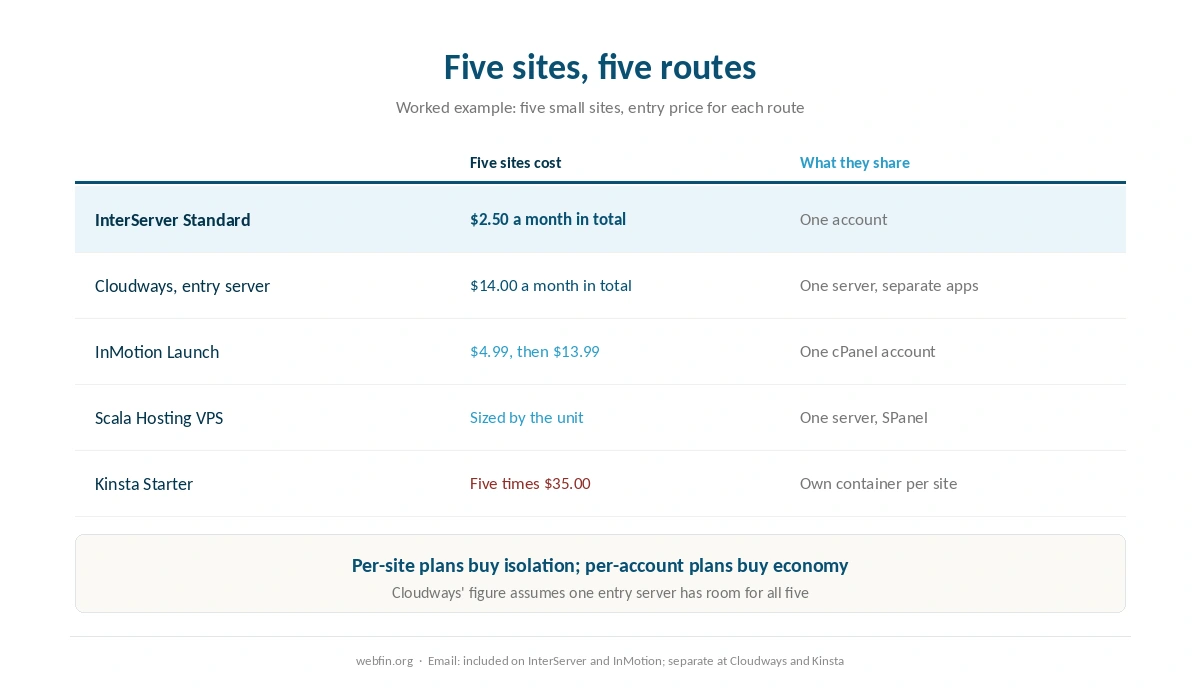
Take five small sites as a worked example. InterServer charges $2.50 a month for all of them, because the plan allows unlimited sites. Cloudways charges $14.00 a month in total, as long as one entry server has room for all five. InMotion Launch costs $4.99 a month for the first three years, then $13.99.
Per-site managed plans change the shape of the arithmetic. Five sites on separate Kinsta Starter plans would be five times $35.00 a month, before any move to a tier built for several sites. That buys isolation and a strong load result for each one, and it only makes sense when each site earns. Our page on what web hosting costs runs these totals over three years.
Domains and Email for Each Site
Every site needs its own domain, and every domain renews on its own date at its own price. Keep them at one registrar, in one account you control, so renewals do not slip through. Point each one at the host rather than transferring it, as our guide to pointing a domain to a new host explains.
On an unlimited plan, each domain can have its own mailboxes in the same panel. On Cloudways, each domain needs mailboxes from a separate provider. For a portfolio of five brands, that difference adds up every month.
Multisite or Separate Installs?
WordPress can run many sites from one installation, called a network or multisite. The sites share one set of plugins, one set of updates and one database. That suits a group of similar sites run the same way, such as a set of local branches.
Separate installations keep each site independent. They cost more effort to update, and they let one site break without taking the others with it. For unrelated sites with different plugins and different owners, separate installs are the safer default. Separating one site from a network later is also more work than moving a standalone installation.
Keeping Many Sites Healthy
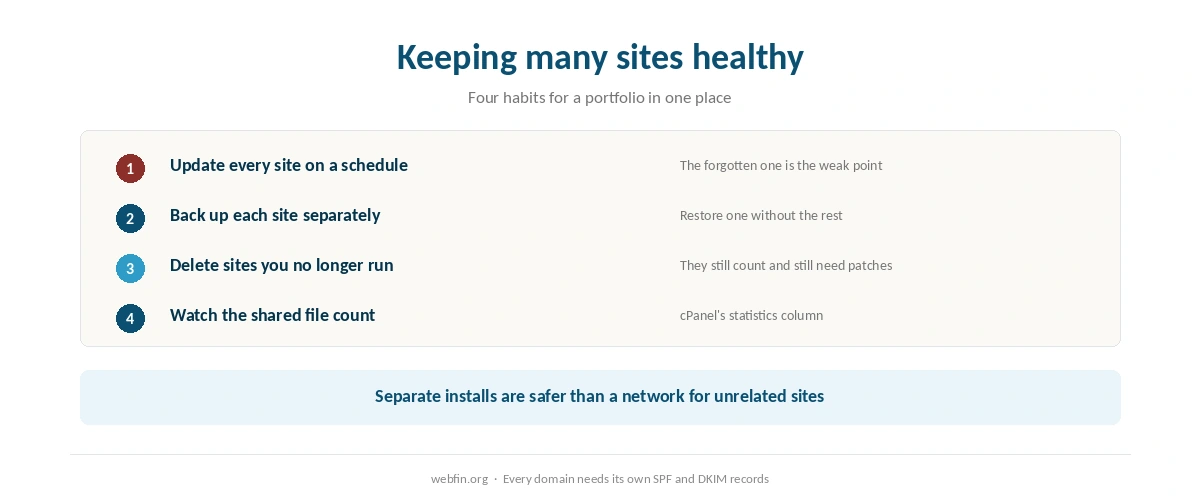
Update on a schedule. A forgotten site with an old plugin is the weak point. Our guide to recovering a hacked website shows what that costs.
Back up each site separately. Per-site backups let you restore one without rolling back the rest. Our guide to backing up a WordPress site covers the routine.
Watch the shared file count. cPanel shows it in the statistics column, as our guide to understanding cPanel explains, and our piece on what unlimited hosting means covers where the ceiling comes from.
Remove what you no longer use. An abandoned site still counts against limits and still needs updates. Delete it, or archive it off the host.
Give each domain its own email records. Every domain needs its own SPF and DKIM, as our guide to setting up email on your domain explains.
How We Research
We run no tests. Site limits come from the providers’ plan pages, as recorded in our table. Cloudways uptime comes from Hostingstep’s 2026 benchmarks. Prices come from the providers’ own pages, read on 20 September 2026.
Features such as Kinsta’s per-site containers and Scala’s malware monitor are those documented in our reviews. The criteria behind our scores are on our about page.
Multiple Sites Hosting FAQ
A plan with unlimited sites. InterServer holds unlimited sites on one plan at $2.50 a month, locked, so each extra site costs nothing more. All of them then share the account’s resources and security boundary.
It is cheaper and riskier. Sites in one account share its file limit, processor share and security boundary, so one outdated plugin can expose all of them. Update every site and back each one up separately.
Several entry plans do, including Rocket.net Starter, GreenGeeks Lite and InMotion Core. Managed WordPress hosts such as Kinsta and WP Engine price per site, so each extra site needs another plan or a higher tier.
For a group of similar sites run the same way, it can simplify updates. For unrelated sites with different plugins or owners, separate installations are safer, because one site can break without affecting the others.
When they slow each other down, or when the file and resource limits of a shared account become the constraint. Cloudways and Scala Hosting both let you size the server to the portfolio.
The Verdict
InterServer is the cheapest home for several small sites: unlimited sites on one plan at a price that never changes. A growing or mixed portfolio suits Cloudways, which gives each site its own application on a server you can resize. And Scala builds in the backups and malware monitoring that a portfolio needs most.
Whatever you choose, remember what the sites share. Keep each one updated, back each one up on its own, and delete the ones you no longer run. When the shared account becomes the limit, our guide to moving from shared to VPS covers the next step.