
Disclosure: WebFin is reader-supported. If you buy hosting through links on this page, we may earn a commission at no extra cost to you. Commissions vary between providers and our ratings do not — here’s our full disclosure.
Cloudways vs Liquid Web is the first comparison in this series between two managed servers rather than a server and a shared plan. Cloudways starts at $14.00 a month on the cloud you choose. A Liquid Web managed VPS starts at $33.00 a month on annual billing. That is nineteen dollars a month more, and $1,188.00 against $504.00 across 36 months. The extra buys resources reserved for you, root access, and a support response time written into the contract. It does not buy a measured record, because Liquid Web has none in the benchmark project we cite. The same Liquid Web figures against Kinsta are in our Kinsta and Liquid Web comparison.
Cloudways vs Liquid Web: The Short Answer
Cloudways, at 4.1 against 3.8 in our reviews. It costs well under half as much, has measured uptime, and bills by the hour. Liquid Web is the better choice when a support contract with a number in it, dedicated resources and root access are requirements rather than preferences.
Head to Head
| Criterion | Cloudways | Liquid Web managed VPS |
|---|---|---|
| Product | Managed cloud server | Managed VPS, dedicated resources |
| Entry price | $14.00/mo flat | $33.00/mo on annual billing |
| 36 months | $504.00 | $1,188.00 |
| Uptime, named | 99.996% to 99.999% | Not covered by that project |
| Uptime, promised | Not stated in our table | 100% network, with credits |
| Support | Chat and tickets; phone as a paid add-on | 59 seconds, contractual |
| Server access | SSH per application | Root on the VPS |
| Choice of cloud | Several providers | Liquid Web’s own |
| Billing | Hourly, no contract | Monthly, no contract |
| Owner | DigitalOcean, 2022 | CloudOne Digital, One Equity Partners |
| Our score | 4.1 | 3.8 |
What Nineteen Dollars a Month Buys
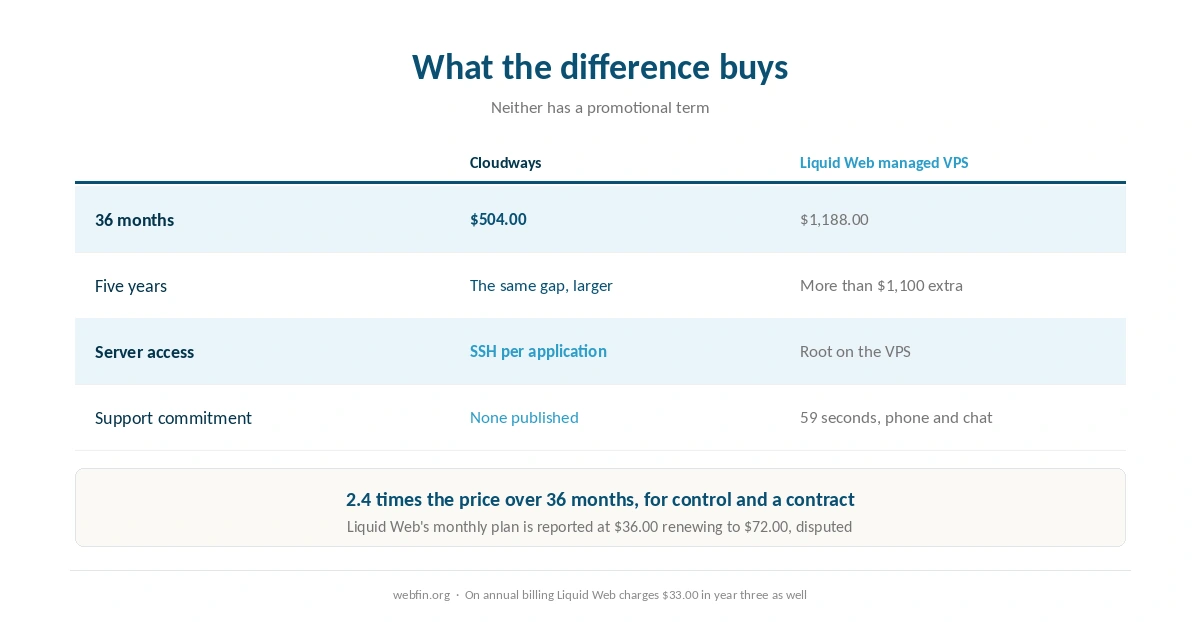
Cloudways charges $14.00 a month for its entry server, and Liquid Web $33.00 on annual billing, both with no promotional term. Across 36 months that is $504.00 against $1,188.00, or 2.4 times as much over 36 months. Neither price steps up at renewal, so the gap grows by the same amount every month. For the same host against Hostinger, see Hostinger vs Liquid Web.
Liquid Web’s monthly price is disputed: one 2026 pricing guide reports $36.00 renewing at $72.00 on monthly billing, which we record as disputed. On annual billing the $33.00 figure holds in year three. Our page on what web hosting costs puts both beside shared hosting, and our page on hosting renewal prices records the dispute.
| Host and plan | How it builds | 36-month total |
|---|---|---|
| ChemiCloud Starter, 36-month term | 36 prepaid months at $2.49 | $89.64 |
| InterServer Standard | 36 months at $2.50, price locked | $90.00 |
| DreamHost Launch, 48-month term | 36 of 48 prepaid months at $2.89 | $104.04 |
| Namecheap Stellar, 24-month term | 24 at $1.98, then 12 at $4.88 | $106.08 |
| Hostinger Premium, 48-month term | 36 of 48 prepaid months at $2.99 | $107.64 |
| HostGator Hatchling, 36-month term | 36 months at $3.75, renewal not reached | $135.00 |
| HostGator Hatchling, with daily backups | 36 at $3.75, plus CodeGuard at $35.88 a year | $242.64 |
| Bluehost Starter, 36-month term | 36 months at $3.99, renewal not reached | $143.64 |
| GoDaddy Economy, 36-month term | 36 months at $5.99, renewal not reached | $215.64 |
| GoDaddy Economy, with SSL from year two | 36 at $5.99, plus $119.99 in years two and three | $455.62 |
| Hostwinds Basic, annual | 12 at $4.54, then 24 at $6.99 | $222.24 |
| SiteGround StartUp, 24-month term | 24 at $2.99, then 12 at $14.99 | $251.64 |
| DreamHost Launch, annual | 12 at $2.89, then 24 at $10.99 | $298.44 |
| Scala Hosting Mini, annual | 12 at $2.95, then 24 at $11.95 | $322.20 |
| Bluehost Starter, 12-month term | 12 at $3.99, then 24 at $11.99 | $335.64 |
| IONOS Plus, annual | 12 at $1.00, then 24 at $14.00 | $348.00 |
| GreenGeeks Lite, 36-month prepay | 36 months at $2.95 | $106.20 |
| GreenGeeks Lite, annual | 12 at $2.95, then 24 at $13.95 | $370.20 |
| SiteGround StartUp, 12-month term | 12 at $2.99, then 24 at $17.99 | $467.64 |
| Cloudways, from | 36 months at $14.00, flat | $504.00 |
| A2 Hosting Turbo Boost, annual | 12 at $6.99, then 24 at $20.99 | $587.64 |
| Rocket.net Starter, annual | 12 at $25.00, then 24 at $30.00 | $1,020.00 |
| WP Engine Startup, annual | 12 at $27.00, then 24 at $35.00 | $1,164.00 |
| Liquid Web managed VPS | 36 months at $33.00 | $1,188.00 |
| Kinsta Starter | 36 months at $35.00, flat | $1,260.00 |
| InMotion Core, 36-month term | 36 months at $3.19, renewal not reached | $114.84 |
| InMotion Launch, 36-month term | 36 months at $4.99, renewal not reached | $179.64 |
A Measured Record Against a Written Promise
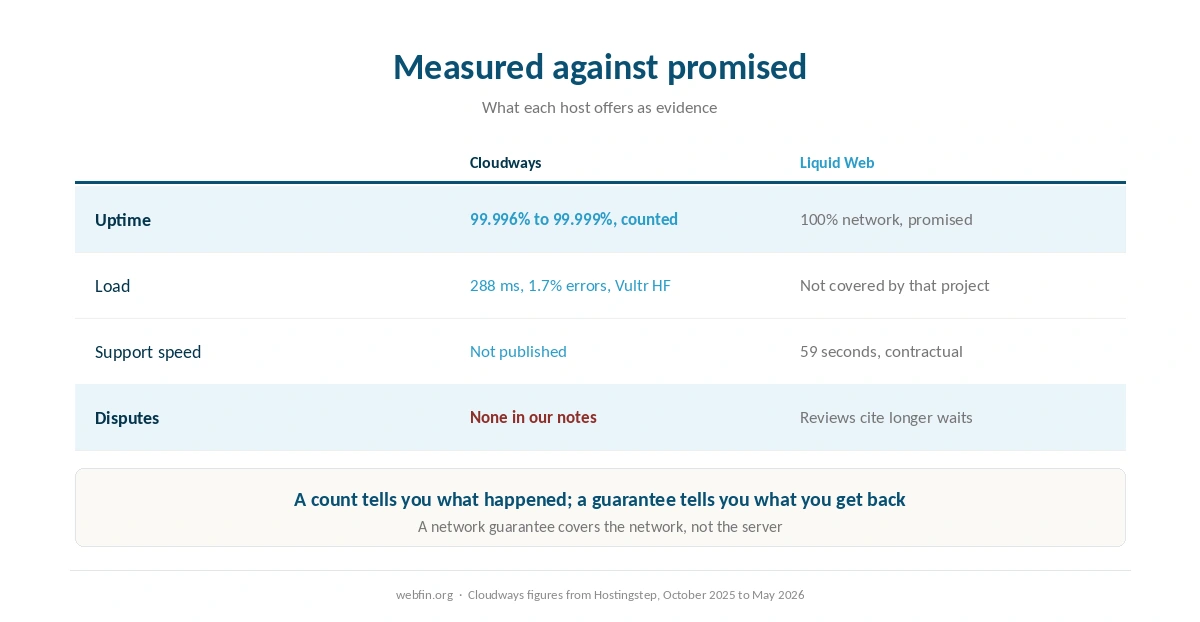
We run no tests, so the Cloudways figures belong to Hostingstep. It held uptime between 99.996% and 99.999% across five plans from October 2025 to May 2026. Its weakest published result is a load test on its Vultr High Frequency plan, at 288 ms with a 1.7% error rate.
Liquid Web does not appear in that project, because it covers shared and managed WordPress plans rather than servers. What Liquid Web offers instead is a commitment: 100% network uptime backed by credits, and a 59-second response on phone and chat, both on its own service promise page.
⚠️ Those are different kinds of evidence. A counted uptime figure tells you what happened; a network guarantee tells you what you get back if it does not. A network promise also covers the network rather than the server, which our guide to reading an uptime report explains. Our guide to reading a hosting agreement explains how to read a credit.
Support: Channel and Commitment
Liquid Web commits to answering phone and chat within 59 seconds, every day of the year. That is unusual in a category that prefers adjectives to numbers. Reviews published this year cite G2 and Trustpilot accounts of longer waits, so the commitment is evidence of intent more than proof of outcome.
Cloudways answers chat and tickets around the clock and sells phone support as an add-on. It publishes no response time. For a business that must call someone when a server fails at night, that difference can decide the purchase. Our Liquid Web review covers the disputed side.
Control: Root Against Applications
Liquid Web sells a VPS with root access and resources reserved for your account. You decide the stack, install what you need and carry the consequences of those choices. That suits an application with fixed requirements or a business under rules that demand isolation.
Cloudways gives SSH access to each application on a server it manages, with staging, WP-CLI, Git deployment and PHP version selection on every tier. It runs the operating system and patches for you. The trade is less control over the machine and less work to keep it running. Our list of hosting for developers weighs both.
Clouds and Billing
Cloudways lets you choose the underlying cloud provider for each server, which matters for data residency and for placing a site near its audience. It bills by the hour, so a server for a short project costs only the hours it runs.
Liquid Web runs on its own infrastructure and bills monthly with no contract. It refunds managed VPS and cloud plans within 30 days. Both arrangements avoid long lock-in; Cloudways’ is simply finer-grained.
What Isolation Means in Practice
Resources reserved for your account mean that a neighbor’s busy afternoon cannot slow your site. On a VPS the processor and memory you pay for are yours, whatever else runs on the physical machine. Compliance rules and fixed application requirements can ask for exactly that predictability.
Cloudways servers are also dedicated to your account on the cloud you choose, and you can resize them. The difference is less about sharing than about who controls the machine: Liquid Web hands you root, and Cloudways keeps the operating system in its own hands.
Traffic Spikes and Resizing
Cloudways lets you resize a server by the hour, so a site expecting a launch can grow for a week and shrink afterward, paying only for the hours at the larger size. On Liquid Web you move to a larger VPS tier, which suits steady growth better than short bursts.
Neither host has a load result for its servers beyond the Cloudways figure on one cloud. Our roundup of hosting for high traffic ranks hosts that do publish one, and our list of hosting for ecommerce covers the store case.
When a Server Is Not the Answer
A WordPress site that has outgrown shared hosting does not always need a server. Managed WordPress hosts handle caching, staging and updates without a machine to configure, and some publish strong load results. Our comparison of Cloudways against WP Engine covers that route.
A server makes sense when the site runs something WordPress hosts will not allow, or when you want to control capacity yourself. For everything else, a managed WordPress plan can cost less effort for similar results. Our comparison of SiteGround against Liquid Web makes the shared-or-server decision from the other side.
Choice of cloud matters in a quieter way too. If a client or a regulation requires data to stay in a particular region, Cloudways lets you place the server there deliberately. On a single provider’s infrastructure, the available locations decide the answer for you.
The Family Behind Each
DigitalOcean acquired Cloudways in 2022 and sells the cloud underneath many of its servers. Liquid Web belongs to CloudOne Digital, formed when One Equity Partners acquired it in April 2023, alongside Nexcess, StellarWP and Modern Tribe.
Both groups also sell managed WordPress. For a WordPress site that does not need root, the Liquid Web group’s Nexcess line and Cloudways’ own WordPress servers are worth comparing before a VPS. Our guide to moving from shared to VPS covers when a server is the right step.
The Five-Year View
Neither host has a promotional term, so the long view is simple arithmetic. The monthly gap of nineteen dollars adds up to more than eleven hundred dollars over five years. That is the price of Liquid Web’s commitments, and it is worth paying only if you would otherwise pay for the same assurance some other way.
Moving Between Them
A site can move from Cloudways to Liquid Web when it needs root or a support contract, or the other way when those needs fall away and the price stops making sense. In either direction the domain can stay at its registrar and simply point at the new server.
Plan the move for a quiet period, keep the old server running until traffic has shifted, and check email separately, because Cloudways does not host it. Our guide to pointing a domain to a new host covers the DNS side.
Which Business Belongs Where
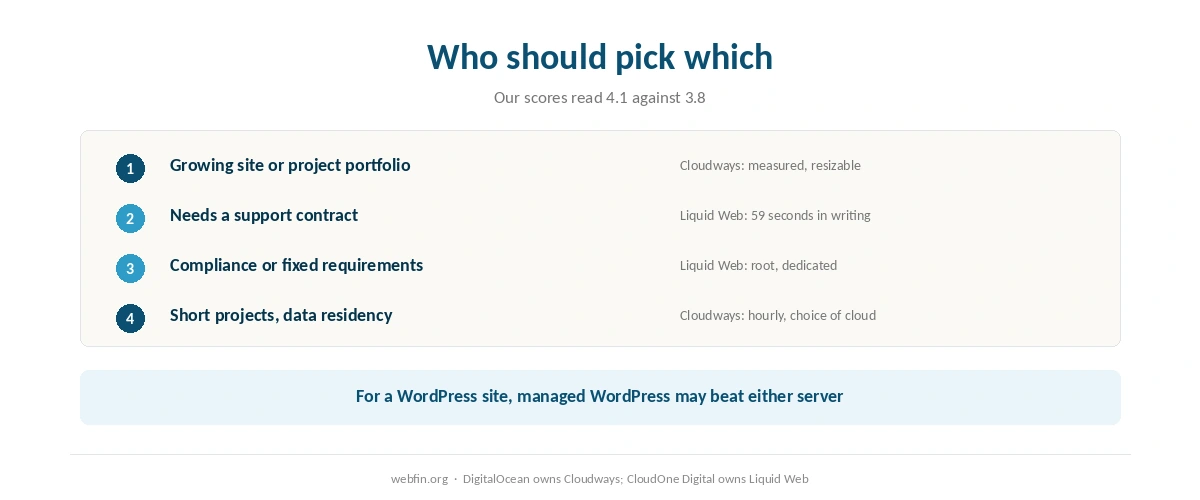
A growing site or a portfolio of projects. Cloudways, for measured uptime at less than half the price and servers you can resize.
A business that needs a support contract. Liquid Web, for a response time written into its terms.
An application with fixed requirements or compliance rules. Liquid Web, for root access and resources reserved for your account.
A developer running short projects. Cloudways, for billing by the hour.
Where Each One Is Weakest
Liquid Web is weakest on evidence and price. No benchmark project we cite measures its servers, reviews dispute its support promise, and it costs 2.4 times as much over 36 months.
Cloudways is weakest on commitments and on what it leaves out. It publishes no support response time, sells phone support as an add-on, includes no email, and its weakest load result showed a 1.7% error rate on one cloud. Our Cloudways review covers each cloud.
Winners by Category
Price: Cloudways, at $504.00 against $1,188.00 over 36 months. Named uptime: Cloudways. Written commitments: Liquid Web, on uptime and support response. Server control: Liquid Web, with root. Choice of cloud: Cloudways. Billing granularity: Cloudways, hourly.
How We Research
We run no tests. Cloudways figures come from Hostingstep’s 2026 benchmarks with their windows. Liquid Web has no measurement row, because that project does not test servers, and we say so rather than borrow a figure. Its support and uptime terms come from its own service promise page.
Prices come from the providers’ own pages, read on 20 September 2026, and the disputed monthly figure from a 2026 pricing guide. The criteria behind our scores are on our about page. For Liquid Web against a shared host, see our comparison of Bluehost against Liquid Web; Bluehost belongs to Newfold Digital.
Cloudways vs Liquid Web FAQ
Cloudways, at $14.00 a month flat, or $504.00 across 36 months. A Liquid Web managed VPS costs $33.00 a month on annual billing, or $1,188.00 over the same stretch. Neither steps up at renewal.
Cloudways has the measured record: 99.996% to 99.999% uptime across five plans. Liquid Web is not covered by the benchmark project we cite and offers a 100% network uptime commitment with credits instead, which is a promise rather than a measurement.
It is written into Liquid Web’s service promise for phone and chat. Reviews published this year cite G2 and Trustpilot accounts of longer waits. Cloudways publishes no response time and sells phone support as an add-on.
Cloudways gives SSH access to each application on a server it manages, and handles the operating system and patches. Liquid Web sells a managed VPS with root access and resources reserved for your account.
DigitalOcean has owned Cloudways since 2022. Liquid Web belongs to CloudOne Digital, formed when One Equity Partners acquired it in April 2023.
The Verdict
Cloudways takes this, at 4.1 against 3.8. It costs well under half as much, it has the only measured record in this comparison, and it bills by the hour on the cloud you choose. For most growing sites and developers, that is the better server.
Liquid Web earns its price when the requirements are contractual: a support response time in writing, resources reserved for you, and root. If those are on your list, the nineteen dollars a month buys them. If they are not, the same money spent on a larger Cloudways server buys more capacity instead. Our guide to migrating web hosting covers the move either way.