
Disclosure: WebFin is reader-supported. If you buy hosting through links on this page, we may earn a commission at no extra cost to you. Commissions vary between providers and our ratings do not — here’s our full disclosure.
Bluehost vs Namecheap sets the lower renewal against the better record. Namecheap Stellar opens at $1.98 and renews at $4.88, which is less than half of Bluehost’s $9.99. Bluehost answers with measurements: a load test passed at 41 ms, 99.99% uptime and the top hardware score among shared hosts in the benchmark project we cite. Namecheap’s monitoring in that project stopped reporting on 30 June 2026. And both brands now answer to investment groups, which changes how to read either renewal. The same Namecheap figures against Kinsta are in our Kinsta and Namecheap comparison.
Bluehost vs Namecheap: The Short Answer
Namecheap, for most small sites. It is cheaper at every stage we can price, renews at $4.88 against $9.99, and includes domain privacy for life. Bluehost scores higher in our reviews, at 4.0 against 3.7, on a measured record that Namecheap cannot currently match.
Head to Head
| Criterion | Bluehost Starter | Namecheap Stellar |
|---|---|---|
| Intro rate | $3.99/mo, 36-month term | $1.98/mo |
| Renewal | $9.99 on 36 months, $11.99 on 12 | $4.88 on 12 or 24 |
| Renewal step | 2.5× over 36 months | 2.5× over 24 months |
| First 36 months | $143.64 | $106.08 |
| Domain privacy | $15.00 a year | Included for life |
| Response time | 411 ms, 99.99% uptime | 461 ms, monitoring paused |
| Load test | 41 ms, no errors | Not in our table |
| Server hardware | 9.6 of 10 | 5.0 of 10 |
| Support | Phone and chat, 24/7 | Chat and tickets, no phone |
| Owner | Newfold Digital, 2021 | CVC Capital Partners majority, 2025 |
| Our score | 4.0 | 3.7 |
Cheaper at Every Stage
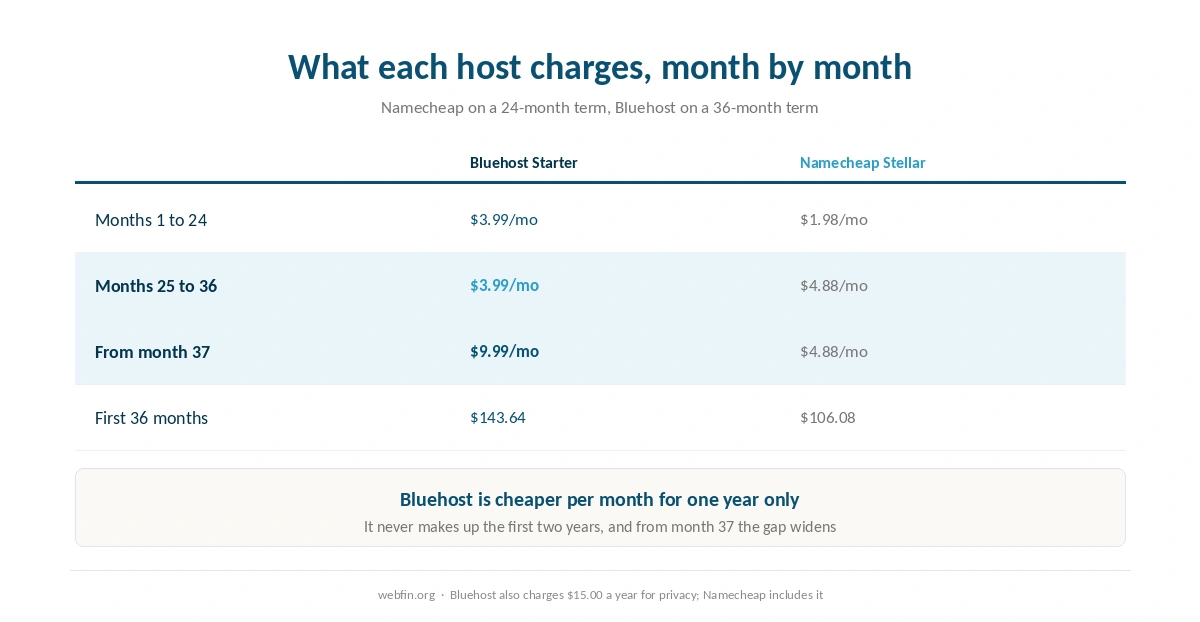
Namecheap bills 24 months at $1.98 and then $4.88, so the first 36 months come to $106.08. Bluehost bills 36 months at $3.99, which is $143.64. The renewal step is 2.5× at both, over 24 months at Namecheap and 36 at Bluehost, and the difference is entirely in the starting point.
There is one stretch where Bluehost charges less per month: months 25 to 36, when Namecheap has renewed and Bluehost is still on its promotion. It never makes up the first two years, though. From month 37 Bluehost charges $9.99 against $4.88, and the gap widens every month after that. Our page on hosting renewal prices puts both beside the field.
⚠️ Bluehost prices are disputed between sources. Its own help page gives $3.99 renewing at $9.99, while the benchmark project’s July 2026 review quotes $1.99 renewing at $8.99. Even the lower reading leaves Namecheap’s renewal little more than half of Bluehost’s.
| Host and plan | Intro → Renewal | Multiplier |
|---|---|---|
| IONOS Plus | $1.00 → $14.00 | 14.0× over 12 months |
| SiteGround StartUp | $2.99 → $17.99 | 6.0× over 12 months |
| SiteGround GrowBig | $4.99 → $29.99 | 6.0× over 12 months |
| SiteGround GoGeek | $7.99 → $44.99 | 5.6× over 12 months |
| ChemiCloud Starter | $2.49 → not published | Renewal shown at checkout only |
| Scala Hosting Mini | $2.95 → $11.95 | 4.1× over 12 months |
| DreamHost Launch, annual | $2.89 → $10.99 | 3.8× over 12 months |
| Hostinger Premium | $2.99 → $10.99 | 3.7× over 48 months |
| Bluehost Starter | $3.99 → $11.99 | 3.0× over 12 months |
| A2 Hosting Turbo Boost | $6.99 → $20.99 | 3.0× over 12 months |
| HostGator Hatchling | $3.75 → $10.99 | 2.9× over 36 months |
| GoDaddy Economy | $5.99 → $15.32 | 2.6× over 36 months |
| Bluehost Starter | $3.99 → $9.99 | 2.5× over 36 months |
| Namecheap Stellar | $1.98 → $4.88 | 2.5× over 12 or 24 months |
| Namecheap Stellar Plus | $2.98 → $6.88 | 2.3× over 12 or 24 months |
| Namecheap Stellar Business | $4.98 → $9.88 | 2.0× over 12 or 24 months |
| DreamHost Launch, 4-year | $2.89 → $7.99 | 2.8× over 48 months |
| DreamHost, eligible US nonprofits | One shared plan free for the account's life | 501(c)(3) or (c)(19); help article, checked 10 Jun 2026 by a nonprofit directory |
| Bluehost Business | $6.99 → $13.99 | 2.0× over 36 months |
| Bluehost Starter, second reading | $1.99 → $8.99 | Hostingstep, July 2026; conflicts with Bluehost's help page |
| Hostwinds Basic | $4.54 → $6.99 | 1.5× over 12 months |
| WP Engine Startup | $27.00 → $35.00 | 1.3× over 12 months |
| Rocket.net Starter | $25.00 → $30.00 | 1.2× over 12 months |
| InterServer Standard | $2.50 flat | 1.0×, price lock |
| Cloudways, from | $14.00 flat | no promotional term |
| Kinsta Starter | $35.00 flat | no promotional term |
| Liquid Web managed VPS, annual billing | $33.00, no promotional term | No increase described on annual billing |
| Liquid Web managed VPS, monthly billing | $36.00 → $72.00 reported | 2.0× over one month; one pricing guide, disputed |
| GreenGeeks Lite | $2.95 → $13.95 | 4.7× after one term; renewal was $12.95 before 2026 |
| ChemiCloud Starter, third-party figures | $9.95, $11.95 or $12.95 quoted | Sources disagree; 4.0× to 5.2× over 36 months |
| SiteGround StartUp, by term | $2.99 → $14.99, $17.99 or $24.99 | 5.0× over 24 months, 6.0× over 12, 8.4× month to month |
| ChemiCloud Kickstart, reseller | $8.99 → $29.95 | Term not stated in the source we read |
| InterServer reseller | $19.95, price locked | No increase described in sources |
| GreenGeeks reseller | $19.95 with WHMCS included | Promotional rate; renewal not published |
| Hostwinds white-label reseller | $10.00 with WHMCS included | Plain reseller plan excludes WHMCS |
| InMotion Core, 36-month term | $3.19 → $10.99 | 3.4× over 36 months; TechRadar, 2026 |
| InMotion Launch, 36-month term | $4.99 → $13.99 | 2.8× over 36 months; TechRadar and plan cards, 2026 |
| InMotion Core, by term | Renews at $10.99, $11.99 or $14.49 | Longest term lowest; one review, May 2026 |
The Record Favors Bluehost
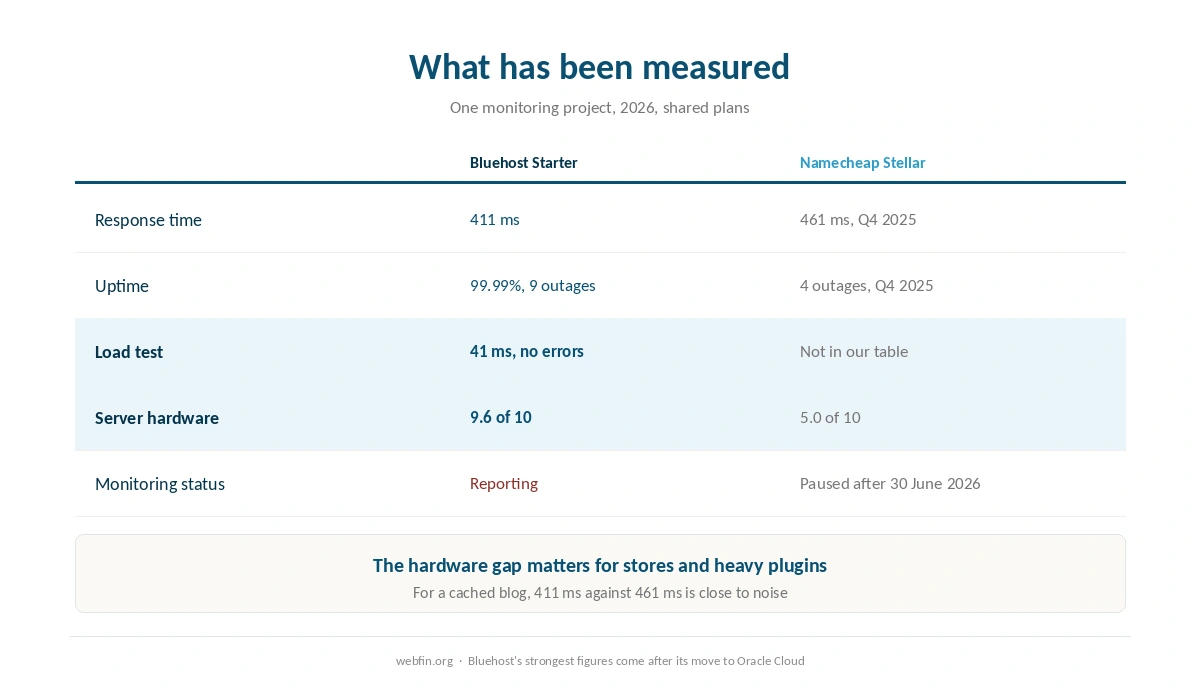
We run no tests, so these figures belong to Hostingstep. Bluehost records 411 ms response time and 99.99% uptime over 9 outages between November 2025 and August 2026. After its move to Oracle Cloud it passed the load test at 41 ms with no errors, and its hardware scores 9.6 of 10, at the top of that project’s shared results.
Namecheap recorded 461 ms and 4 outages in the last quarter of 2025, with hardware at 5.0 of 10. Then its shared hosting stopped reporting to the monitor after 30 June 2026, and the project marks every Namecheap figure with an asterisk. So the evidence is thinner and older than Bluehost’s, and the benchmark project says so itself.
⚠️ Fairness cuts the other way too. Bluehost’s best figures are recent, taken after the Oracle move. A buyer who values stability over a strong recent result could read this section differently. Our guide to reading an uptime report explains why the window matters as much as the number.
Which Measurement Matters for Your Site
The hardware gap is the one to weigh, and it matters for some sites far more than others. A score of 9.6 against 5.0 describes processor, memory and database speed on uncached work: admin pages, search, carts and anything a plugin builds on each visit. Stores and plugin-heavy membership sites feel that difference every day.
A brochure site or a blog behind a page cache feels it far less, because most visitors receive a stored copy rather than a freshly built page. For those sites, a first byte of 461 ms against 411 ms is close to noise, and the renewal gap is the number that shows up. Our guide to reducing TTFB explains how caching moves that line.
Domains: Where Namecheap Starts With an Advantage
Namecheap is a registrar first, so domain and hosting sit in one account, and domain privacy is included for the life of the domain. Bluehost charges $15.00 a year for privacy, and it keeps $15.99 of a refund for a free domain if you leave early.
Neither matters much for one site. Across several domains and several years, the privacy charge alone adds up, and a domain held at a registrar rather than a host makes every future move easier. Our guide to pointing a domain to a new host covers why.
The Tiers Above the Entry Plan
The same pattern holds one step up. Namecheap Stellar Plus opens at $2.98 and renews at $6.88, and Stellar Business opens at $4.98 and renews at $9.88. Bluehost Business opens at $6.99 and renews at $13.99 on a 36-month term, which is 2.0× over 36 months.
So Namecheap’s top shared tier renews for less than Bluehost’s entry tier does on an annual term. The tiers are not identical, and the higher Namecheap plans add sites and storage in their own way. Still, a buyer who expects to outgrow the entry plan pays less at Namecheap at every step of that growth. Our guide to choosing a hosting plan covers when an upgrade pays for itself.
Refunds, Trials and Leaving
Both refund within 30 days and exclude domains. Namecheap adds a 30-day trial of its EasyWP managed WordPress line that needs no card, which is a rare way to test a host without paying first. Bluehost keeps $15.99 of a refund for the free domain.
Leaving is easy at both, because both run cPanel and accounts export in a standard format. The difference is the domain: at Namecheap it already sits at the registrar, so moving hosts is a DNS change. At Bluehost a bundled domain can make it one step longer. Our guide to canceling hosting and getting a refund covers the order that keeps the domain safe.
Two Brands, Two Investment Groups
Bluehost has belonged to Newfold Digital since 2021, alongside HostGator and Yoast SEO, and who owns Bluehost traces that group. CVC Capital Partners bought a majority stake in Namecheap in September 2025, and its founder stepped down as chief executive that December. Namecheap’s own leadership page now lists a new chief executive.
That makes this a comparison between two investor-owned brands rather than a corporate host and a founder-run one, which is how older reviews describe it. The practical point is renewal policy. Namecheap’s low renewal was set under its founder, and a new owner is where such policies tend to change. Our Namecheap review will record it if that happens.
What has not changed yet matters as much. As of 20 September 2026, Stellar still renews at $4.88, the same figure recorded before the sale. A 24-month term signed today fixes the $1.98 intro for two years. The renewal that follows will be whatever the owner sets by then, so check it again before the term ends.
Support and Everyday Use
Bluehost answers phone and chat around the clock. Namecheap answers chat and tickets, with no telephone line. Neither publishes a measured response time, and no controlled test of hosting support exists in the sources we found.
Both run cPanel, so accounts export in a standard format. Bluehost wraps it in a WordPress dashboard that also sells add-ons: a premium certificate at $89.88 that most sites do not need, SiteLock and Yoast SEO Premium. Namecheap keeps the shared panel plain and sells less after checkout.
Where Each One Is Weakest
Namecheap is weakest on evidence and ownership. Its monitoring is paused, its hardware score is low, and its renewal policy now sits with a new owner. None of that has raised a price yet, and all of it is worth watching.
Bluehost is weakest on price and after checkout. It costs more at every stage, keeps part of a refund for the free domain, and charges yearly for privacy. Those are costs a buyer can see in advance. Our page on hidden hosting fees collects them across the field.
One practical rule follows from all of this. If you choose Namecheap, sign the longest term you are comfortable with, because it holds the $1.98 intro longest, and note the renewal date. If you choose Bluehost, decline every add-on at checkout and in the dashboard until you have a reason for it. Either way, the cheapest version of each host is the one bought with its terms read first.
Winners by Category
Price at every stage: Namecheap, from $1.98 renewing at $4.88. Renewal: Namecheap, at less than half of Bluehost’s $9.99. Domain privacy: Namecheap, included for life. Measured record: Bluehost, complete and current. Hardware and load: Bluehost, at 9.6 and 41 ms. Support channels: Bluehost, with a phone line. Ownership stability: neither, since both answer to investors.
When to Choose Bluehost Instead
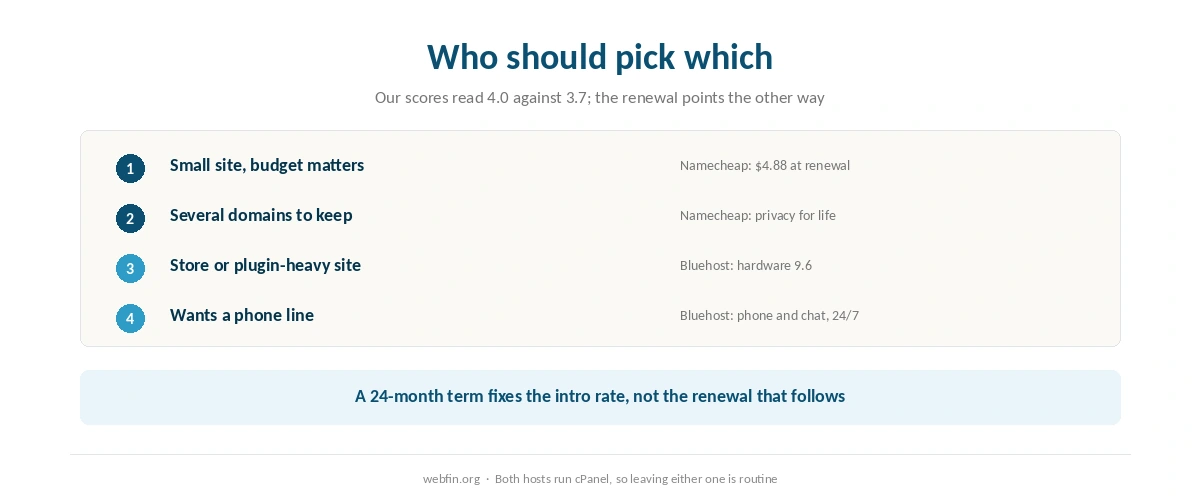
Take Bluehost if you want the measured record before paying, or a phone line when something breaks. Its hardware and load result are the strongest numbers on this page, and they matter most for a site that runs heavy plugins or a store. Our comparison of Bluehost against DreamHost weighs it against another cheaper rival.
Take Namecheap if the site is small and the budget matters, and especially if you keep several domains. For the full budget field, our comparison of SiteGround against Namecheap covers the ownership change in more depth.
How We Research
We run no tests. Measurements come from Hostingstep’s 2026 benchmarks and reviews with their windows, and we mark where Namecheap’s monitoring paused. Prices, privacy terms and ownership come from the providers’ own pages and published reporting, read on 20 September 2026.
Where sources disagree, as they do on Bluehost pricing, we print both readings. The criteria behind our scores are on our about page, and the monthly figures in the image above come from arithmetic on the published rates.
Bluehost vs Namecheap FAQ
Namecheap at every stage we can price. The first 36 months cost $106.08 against $143.64, and from month 37 Namecheap renews at $4.88 against $9.99 at Bluehost. Namecheap also includes domain privacy for life, which Bluehost charges $15.00 a year for.
Bluehost, on the published record: 411 ms response, 99.99% uptime, a load test at 41 ms with no errors and hardware at 9.6 of 10. Namecheap recorded 461 ms and hardware at 5.0, and its monitoring stopped reporting after 30 June 2026.
Bluehost belongs to Newfold Digital, which also owns HostGator and Yoast SEO. CVC Capital Partners bought a majority stake in Namecheap in September 2025. Both now answer to investment groups, which is where renewal policy gets decided.
No. It offers chat and tickets. Bluehost answers phone and chat around the clock. Neither publishes a measured response time, so the difference is the channel rather than a proven speed of reply.
For many buyers, yes. Namecheap is a registrar first and includes domain privacy for life. Keeping the domain at a registrar rather than a host also makes moving hosts later a DNS change rather than a transfer.
The Verdict
Namecheap is the better buy for most small sites, and the reason is the renewal. At $4.88 against $9.99 it keeps the gap open every month after the promotion, and domain privacy is included on top. Our scores read 4.0 against 3.7 in Bluehost’s favor, because measured performance and a phone line count, and both facts stand together.
Bluehost is the better host to verify, with a load result and hardware score Namecheap cannot match on current evidence. Buy Namecheap for the price and keep an eye on its new owner, or buy Bluehost for the record. If you move either way, our guide to migrating web hosting covers the order.