
Disclosure: WebFin is reader-supported. If you buy hosting through links on this page, we may earn a commission at no extra cost to you. Commissions vary between providers and our ratings do not — here’s our full disclosure.
Cloudways vs DreamHost puts a managed cloud server against one of the cheapest shared hosts to keep. DreamHost Launch holds $2.89 a month for 48 months, so three years cost $104.04. Cloudways charges $14.00 a month flat, which is $504.00 over the same stretch. That is 4.8 times the price over 36 months. What the extra buys is evidence: Cloudways held 99.996% or better across five plans in the benchmark project we cite. DreamHost’s record there is a response band for shared hosting and a weak result for its managed line. The same DreamHost figures against Kinsta are in our Kinsta and DreamHost comparison.
Cloudways vs DreamHost: The Short Answer
Cloudways, at 4.1 against 3.7 in our reviews, for any site where uptime and control matter. DreamHost is the better buy for a small site on a budget. It costs a fraction as much, includes domain privacy for life, gives a long refund window, and is free for eligible US charities.
Head to Head
| Criterion | Cloudways | DreamHost Launch |
|---|---|---|
| Product | Managed cloud server | Shared hosting |
| Price | $14.00/mo flat | $2.89/mo for 48 months, then $7.99 |
| 36 months | $504.00 | $104.04 |
| Uptime, named | 99.996% to 99.999% | Not in our table |
| Response time | Varies by cloud | 450 to 500 ms band |
| Managed line under load | 288 ms at 1.7% errors | DreamPress: 221 ms, slowest managed |
| Domain privacy | Not applicable | Included for life |
| Refund window | Billing stops when you stop | 97 days by four sources |
| Not included | Included on shared plans | |
| Support | Chat and tickets; phone as a paid add-on | Chat, email and tickets; no phone |
| Owner | DigitalOcean, 2022 | Independent, employee-owned |
| Our score | 4.1 | 3.7 |
Nearly Five Times the Price
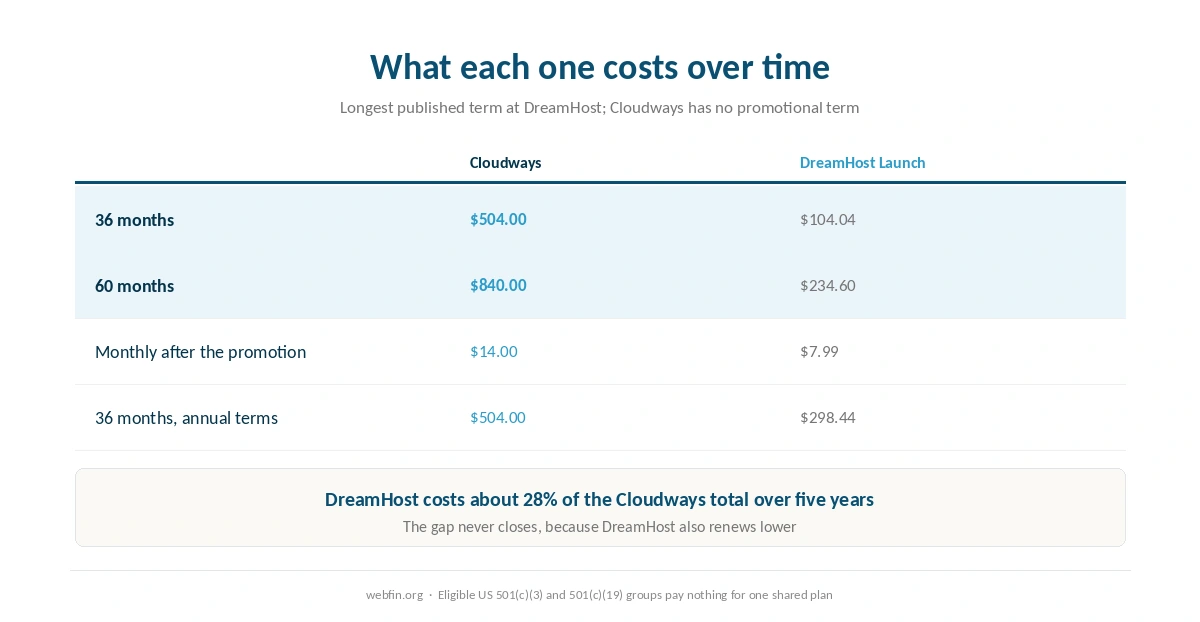
DreamHost Launch holds $2.89 a month for 48 months on its longest term. Three years come to $104.04, and the renewal is $7.99, which is 2.8× over 48 months. Cloudways has no promotional term: $14.00 in month one is $14.00 in month sixty. Across 36 months that is $504.00.
The gap never closes, because DreamHost’s renewal is also lower than Cloudways’ flat rate. Over five years DreamHost costs little more than a quarter of the Cloudways total. The catch is the prepayment: DreamHost’s best rate means paying 48 months up front, while Cloudways bills by the hour. Our page on hosting renewal prices lists both.
⚠️ On annual terms DreamHost renews at $10.99 rather than $7.99, and three years come to $298.44. That is still well under Cloudways. Check the term in the cart, because the rate depends on it.
| Host and plan | How it builds | 36-month total |
|---|---|---|
| ChemiCloud Starter, 36-month term | 36 prepaid months at $2.49 | $89.64 |
| InterServer Standard | 36 months at $2.50, price locked | $90.00 |
| DreamHost Launch, 48-month term | 36 of 48 prepaid months at $2.89 | $104.04 |
| Namecheap Stellar, 24-month term | 24 at $1.98, then 12 at $4.88 | $106.08 |
| Hostinger Premium, 48-month term | 36 of 48 prepaid months at $2.99 | $107.64 |
| HostGator Hatchling, 36-month term | 36 months at $3.75, renewal not reached | $135.00 |
| HostGator Hatchling, with daily backups | 36 at $3.75, plus CodeGuard at $35.88 a year | $242.64 |
| Bluehost Starter, 36-month term | 36 months at $3.99, renewal not reached | $143.64 |
| GoDaddy Economy, 36-month term | 36 months at $5.99, renewal not reached | $215.64 |
| GoDaddy Economy, with SSL from year two | 36 at $5.99, plus $119.99 in years two and three | $455.62 |
| Hostwinds Basic, annual | 12 at $4.54, then 24 at $6.99 | $222.24 |
| SiteGround StartUp, 24-month term | 24 at $2.99, then 12 at $14.99 | $251.64 |
| DreamHost Launch, annual | 12 at $2.89, then 24 at $10.99 | $298.44 |
| Scala Hosting Mini, annual | 12 at $2.95, then 24 at $11.95 | $322.20 |
| Bluehost Starter, 12-month term | 12 at $3.99, then 24 at $11.99 | $335.64 |
| IONOS Plus, annual | 12 at $1.00, then 24 at $14.00 | $348.00 |
| GreenGeeks Lite, 36-month prepay | 36 months at $2.95 | $106.20 |
| GreenGeeks Lite, annual | 12 at $2.95, then 24 at $13.95 | $370.20 |
| SiteGround StartUp, 12-month term | 12 at $2.99, then 24 at $17.99 | $467.64 |
| Cloudways, from | 36 months at $14.00, flat | $504.00 |
| A2 Hosting Turbo Boost, annual | 12 at $6.99, then 24 at $20.99 | $587.64 |
| Rocket.net Starter, annual | 12 at $25.00, then 24 at $30.00 | $1,020.00 |
| WP Engine Startup, annual | 12 at $27.00, then 24 at $35.00 | $1,164.00 |
| Liquid Web managed VPS | 36 months at $33.00 | $1,188.00 |
| Kinsta Starter | 36 months at $35.00, flat | $1,260.00 |
| InMotion Core, 36-month term | 36 months at $3.19, renewal not reached | $114.84 |
| InMotion Launch, 36-month term | 36 months at $4.99, renewal not reached | $179.64 |
The Evidence Favors Cloudways
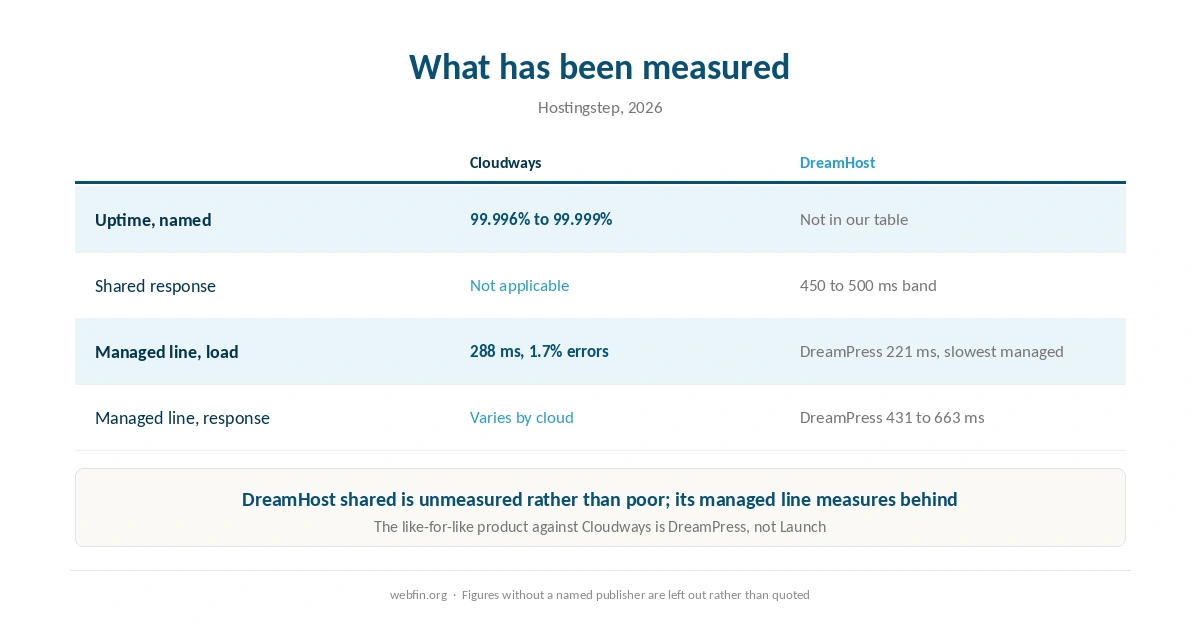
We run no tests, so these figures belong to Hostingstep. Cloudways held uptime between 99.996% and 99.999% across five plans from October 2025 to May 2026. That allows well under an hour of downtime a year. Its weakest published result is a load test on its Vultr High Frequency plan, at 288 ms with a 1.7% error rate.
DreamHost’s shared hosting sits in the 450 to 500 ms band for response time in the same project, a reasonable result alongside several budget hosts. We hold no named uptime figure for it. Its managed WordPress line, DreamPress, is the closer match to Cloudways, and there the record is weak. It slowed from 431 ms to 663 ms between years and posted the slowest load score of any managed host in that project, at 221 ms.
⚠️ So on shared hosting DreamHost is unmeasured rather than poor. On managed hosting, the product that competes directly with Cloudways, it measures behind. Our guide to reading an uptime report explains why a thin record and a weak one are different things.
What Near Five Nines Buys a Small Site
Uptime of 99.996% allows about 21 minutes of downtime a year. That is the promise the Cloudways record supports. Whether a small site needs it is a separate question, and the answer depends on what an hour offline costs.
For a brochure site, a blog or a portfolio, an hour offline at an odd time may cost nothing at all. Visitors return, and the site carries on. For a shop or a booking page, the same hour can mean lost orders. The price of Cloudways is best read as insurance against that hour, and only some sites need the policy.
What DreamHost Includes
DreamHost includes WHOIS privacy for the life of the domain, which several hosts bill every year. Four sources quote its refund window at 97 days and one at 30, so confirm it at checkout. Reviews this year describe mailboxes on its shared plans, so email lives in the same account as the site.
It also runs one of the longest-standing nonprofit programs. Eligible US 501(c)(3) and 501(c)(19) organizations get one shared plan free for the life of the account. Our list of hosting for nonprofits covers the terms.
What Cloudways Includes, and Leaves Out
Cloudways runs a managed server on the cloud provider you choose. SSH, WP-CLI, Git deployment, staging and PHP version selection ship on every tier, and it runs any PHP application. Billing is by the hour, so stopping the server stops the bill.
It leaves out what a shared host includes. There is no cPanel and no email; mailboxes come through Rackspace at about a dollar each per month. Phone support is a paid add-on. For a developer that is a fair trade, as our list of hosting for developers explains. For a first site it is friction.
Panels and Everyday Use
DreamHost runs its own control panel rather than cPanel. It is clean and complete, but tutorials written for cPanel will not match the screen. Cloudways runs its own console built around servers and applications, which feels closer to infrastructure than to a hosting account.
If you learned hosting on cPanel, both panels will take some adjustment. Our guide to understanding cPanel explains what the standard panel shows, which helps when a different panel names the same things differently.
Neither exports an account in the standard cPanel format, so leaving either one means moving the site rather than the account. Our guide to migrating web hosting covers the steps.
Support
Neither host answers the phone as standard. DreamHost offers chat, email and tickets. Cloudways offers chat and tickets around the clock and sells phone support as an add-on. Neither publishes a measured response time, and no controlled test of hosting support exists in the sources we found.
The Prepayment Question
DreamHost’s lowest rate asks for 48 months in advance. That is the price of the discount, and it moves the risk to the buyer: if the site closes in year two, the remaining months are spent. The refund window covers the start of the term, not the middle.
Cloudways asks for nothing in advance. You pay for the hours the server runs and can stop at any point. For a project with an uncertain future, that flexibility is worth part of the price difference. For a site you know you will keep, the prepayment is simply the cheaper route.
Moving Between Them
The common path runs from shared hosting to a cloud server as a site grows. A DreamHost site that outgrows its plan can move to Cloudways, which provides a migration plugin for WordPress. The domain can stay at its registrar and simply point at the new server.
Our guide to moving from shared to VPS lists the signals that it is time. Moving the other way, from a cloud server to shared hosting, makes sense when a project has become quiet and the server costs more than it earns.
A First Site, Specifically
For someone building a first site, DreamHost is the gentler start. It handles email in the same account, needs no server decisions, and gives time to change your mind. Cloudways assumes you are comfortable choosing a cloud, sizing a server and adding an email provider. Our list of hosting for beginners weighs the same trade across more hosts.
The practical difference lies in who you are when something breaks. A developer on Cloudways has the console to start diagnosing a problem before contacting support. A non-technical owner on DreamHost needs someone to walk them through the fix, and a written chat thread they can follow step by step serves that well.
Who Owns Them
DigitalOcean acquired Cloudways in 2022 and sells the cloud underneath many of its servers. DreamHost describes itself as independent and employee-owned, and no outside group appears in its ownership in anything we read.
For a buyer prepaying four years at DreamHost, that independence is worth something. Renewal policy tends to change with owners, and DreamHost has not changed hands.
Which Site Belongs Where
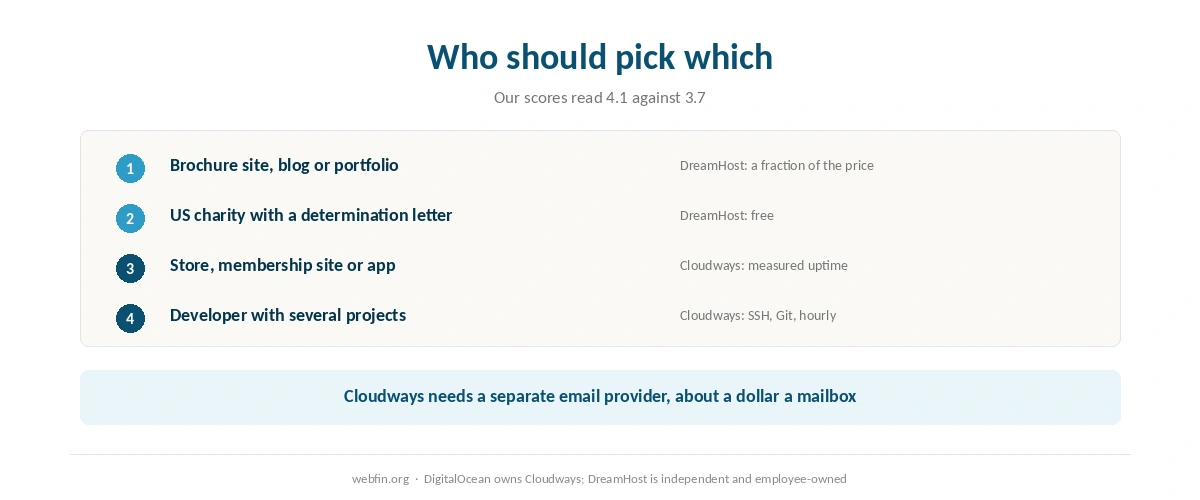
A small business brochure, a blog or a portfolio. DreamHost. Its cached pages do not need a cloud server, and the saving is large.
A US charity with a determination letter. DreamHost, for free.
A store, a membership site or an application. Cloudways, for uptime you can check and capacity you can resize. Our list of hosting for ecommerce covers the store case.
A developer running several projects. Cloudways, for SSH, Git and billing by the hour. Our comparison of Cloudways against HostGator makes the same cloud-or-shared choice with another budget host, and our comparison of Bluehost against DreamHost sets DreamHost against a shared rival from Newfold Digital.
Where Each One Is Weakest
DreamHost is weakest on evidence and on its managed line. Its shared hosting has no named uptime figure, and DreamPress measured slow. It also has no phone line and no cPanel.
Cloudways is weakest on price for a small site and on what it leaves out. Nearly five times the three-year cost buys uptime and control that a quiet site may never need. Email, cPanel and a phone line all cost extra or are missing. Our Cloudways review covers each cloud.
Winners by Category
Price: DreamHost, at $104.04 against $504.00 over 36 months.
Renewal: DreamHost, at $7.99 against $14.00.
Named uptime: Cloudways, at 99.996% or better.
Managed product under load: Cloudways, ahead of DreamPress.
Domain privacy and refunds: DreamHost.
Billing flexibility: Cloudways, hourly.
Nonprofits: DreamHost, free for eligible US charities.
How We Research
We run no tests. Uptime, response and load figures come from Hostingstep’s 2026 benchmarks and reviews, each with its window, and we say where DreamHost has no named figure. Prices, privacy and refund terms come from the providers’ own pages, read on 20 September 2026. The mailbox description comes from reviews this year.
The criteria behind our scores are on our about page, and the full workings are in our DreamHost review.
Cloudways vs DreamHost FAQ
DreamHost, by a wide margin. Launch costs $104.04 across 36 months on its longest term and renews at $7.99. Cloudways costs $504.00 over the same stretch at a flat $14.00. The gap never closes, because DreamHost’s renewal is also lower.
Cloudways has the named record: 99.996% to 99.999% uptime across five plans. We hold no named uptime figure for DreamHost’s shared hosting, and its managed line, DreamPress, posted the slowest load score of any managed host in the same project.
For eligible US 501(c)(3) and 501(c)(19) organizations, one shared plan is free for the life of the account, with an IRS determination letter. Cloudways has no equivalent program in anything we read.
No. Mailboxes come through Rackspace at about a dollar each per month. DreamHost’s shared plans include mailboxes, according to reviews this year.
DigitalOcean has owned Cloudways since 2022. DreamHost describes itself as independent and employee-owned.
The Verdict
Cloudways takes this on score, at 4.1 against 3.7, because its uptime is measured and strong and its managed product outperforms DreamHost’s. For a store, an application or a busy site, that is worth the difference.
For most small sites, though, DreamHost is the better purchase. It costs a fraction as much at every stage, includes privacy and a long refund window, and is free for eligible US charities. If the site later outgrows it, the move to a cloud server is routine. Our page on what web hosting costs runs both totals further.