
Disclosure: WebFin is reader-supported. If you buy hosting through links on this page, we may earn a commission at no extra cost to you. Commissions vary between providers and our ratings do not — here’s our full disclosure.
Kinsta vs Scala Hosting is closer than the prices suggest. Both completed the benchmark load test cleanly: Kinsta at 40 ms with every request answered, Scala’s shared plan at 48 ms with no errors. Scala also has a named uptime figure of 99.98%, which our table does not hold for Kinsta. And it costs $322.20 across 36 months against $1,260.00, 3.9 times less over that term. What Kinsta adds is the tooling around a WordPress site rather than a faster result.
Kinsta vs Scala Hosting: The Short Answer
Scala Hosting for a small business or a growing site, at 4.0 against 4.1 in our reviews. It is a quarter of the price, clean under load, has the only named uptime figure of the two, and includes daily backups, a malware monitor and email. Kinsta earns its price when you need performance monitoring in the plan, a container per site, or an edge network on every plan. For the same host against Hostinger, see Hostinger vs Scala Hosting.
Head to Head
| Criterion | Kinsta Starter | Scala Hosting Mini |
|---|---|---|
| Product | Managed WordPress, one container | Shared hosting, own panel |
| Price | $35.00/mo flat | $2.95/mo, then $11.95 |
| 36 months, annual terms | $1,260.00 | $322.20 |
| Load test | 40 ms, every request answered | 48 ms, no errors |
| Uptime | Not in our table | 99.98% |
| Benchmark scores | WPBench 8.8 of 10 | Hardware 8.8 of 10 |
| Visit allowance | 25,000 monthly visits | Not published as a cap |
| Backups and security | Daily backups, edge network | Daily backups, malware monitor |
| Performance monitoring | Included in the plan | Not included |
| Not included | Included in SPanel | |
| Owner | Not established in our sources | Not documented in our sources |
| Our score | 4.1 | 4.0 |
Both Are Clean Under Load
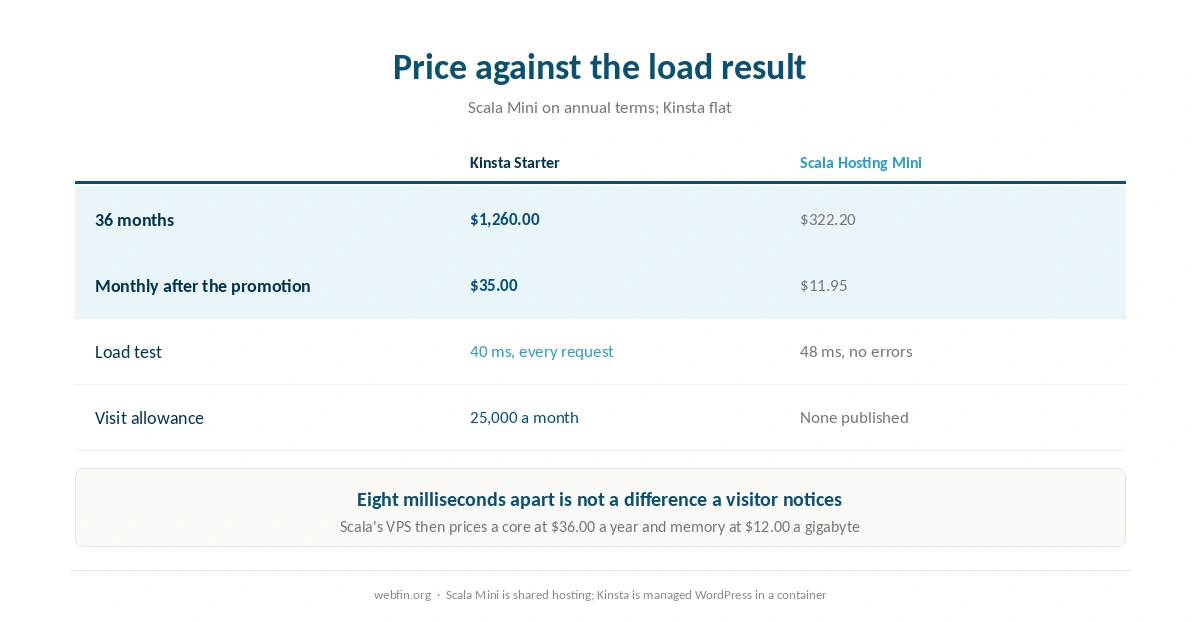
We run no tests, so these figures belong to Hostingstep. Its load test ramps to 100 concurrent visitors over 60 seconds. Kinsta finished at 40 ms with every request answered. Scala’s shared plan finished at 48 ms with no errors, and its hardware scores 8.8 of 10.
Eight milliseconds apart on a test like that is not a difference a visitor would notice, and both results are in the group that completed the test without dropping requests. That matters, because several plans we price did drop them: ChemiCloud lost 4.2% and the IONOS entry plan failed with a 65.4% error rate.
On uptime the evidence runs the other way. Scala recorded 99.98% in the same project, and our table holds no uptime percentage for Kinsta from a named project. So the cheaper host has the only counted reliability figure here. Our guide to reading an uptime report explains why we leave the other cell empty.
A Quarter of the Price
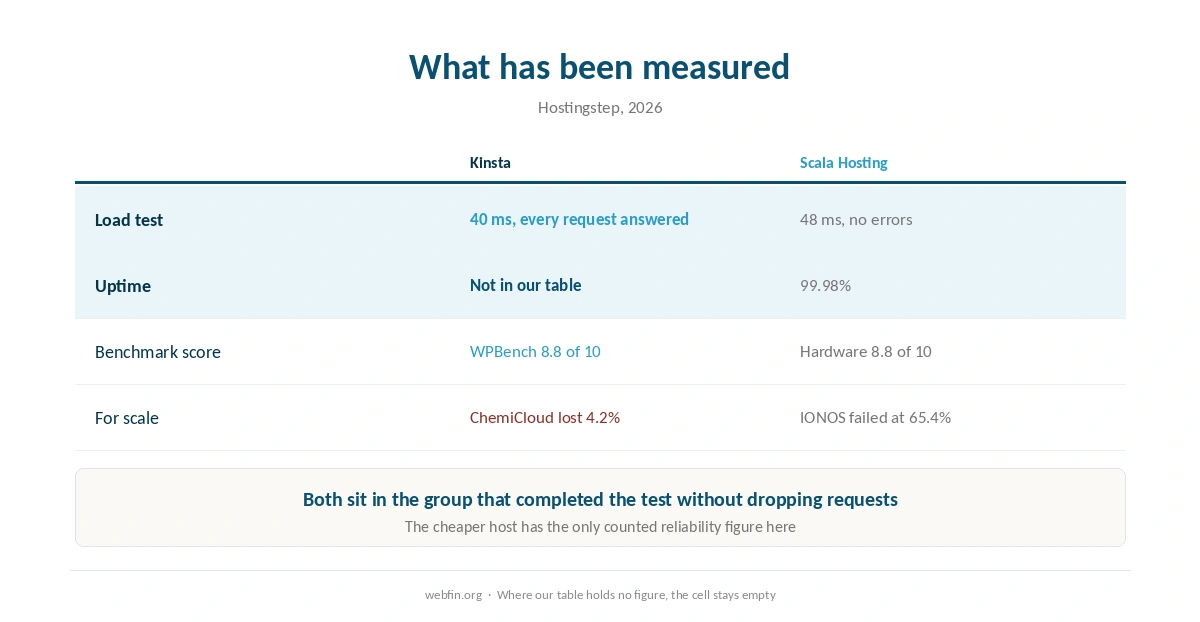
Scala Mini opens at $2.95 a month and renews at $11.95, which is 4.1× over 12 months. On annual terms three years come to $322.20. Kinsta charges $35.00 from the first month with no promotional term, which is $1,260.00.
The renewal gap is what lasts: $11.95 against $35.00, or about a third. Scala’s VPS then prices a processor core at $36.00 a year and a gigabyte of memory at $12.00, so a growing site buys resources rather than a higher visit tier. Our page on hosting renewal prices lists both.
⚠️ These are different products: Scala Mini is shared hosting on its own panel, and Kinsta is managed WordPress in a container. The server-to-server comparison would be Scala’s VPS against a Kinsta tier sized for the same traffic, and Scala’s VPS pricing is per unit rather than per plan.
| Host and plan | How it builds | 36-month total |
|---|---|---|
| ChemiCloud Starter, 36-month term | 36 prepaid months at $2.49 | $89.64 |
| InterServer Standard | 36 months at $2.50, price locked | $90.00 |
| DreamHost Launch, 48-month term | 36 of 48 prepaid months at $2.89 | $104.04 |
| Namecheap Stellar, 24-month term | 24 at $1.98, then 12 at $4.88 | $106.08 |
| Hostinger Premium, 48-month term | 36 of 48 prepaid months at $2.99 | $107.64 |
| HostGator Hatchling, 36-month term | 36 months at $3.75, renewal not reached | $135.00 |
| HostGator Hatchling, with daily backups | 36 at $3.75, plus CodeGuard at $35.88 a year | $242.64 |
| Bluehost Starter, 36-month term | 36 months at $3.99, renewal not reached | $143.64 |
| GoDaddy Economy, 36-month term | 36 months at $5.99, renewal not reached | $215.64 |
| GoDaddy Economy, with SSL from year two | 36 at $5.99, plus $119.99 in years two and three | $455.62 |
| Hostwinds Basic, annual | 12 at $4.54, then 24 at $6.99 | $222.24 |
| SiteGround StartUp, 24-month term | 24 at $2.99, then 12 at $14.99 | $251.64 |
| DreamHost Launch, annual | 12 at $2.89, then 24 at $10.99 | $298.44 |
| Scala Hosting Mini, annual | 12 at $2.95, then 24 at $11.95 | $322.20 |
| Bluehost Starter, 12-month term | 12 at $3.99, then 24 at $11.99 | $335.64 |
| IONOS Plus, annual | 12 at $1.00, then 24 at $14.00 | $348.00 |
| GreenGeeks Lite, 36-month prepay | 36 months at $2.95 | $106.20 |
| GreenGeeks Lite, annual | 12 at $2.95, then 24 at $13.95 | $370.20 |
| SiteGround StartUp, 12-month term | 12 at $2.99, then 24 at $17.99 | $467.64 |
| Cloudways, from | 36 months at $14.00, flat | $504.00 |
| A2 Hosting Turbo Boost, annual | 12 at $6.99, then 24 at $20.99 | $587.64 |
| Rocket.net Starter, annual | 12 at $25.00, then 24 at $30.00 | $1,020.00 |
| WP Engine Startup, annual | 12 at $27.00, then 24 at $35.00 | $1,164.00 |
| Liquid Web managed VPS | 36 months at $33.00 | $1,188.00 |
| Kinsta Starter | 36 months at $35.00, flat | $1,260.00 |
| InMotion Core, 36-month term | 36 months at $3.19, renewal not reached | $114.84 |
| InMotion Launch, 36-month term | 36 months at $4.99, renewal not reached | $179.64 |
What Kinsta Adds for the Difference
Performance monitoring in the plan. Application performance monitoring is normally a paid tool, and it is the fastest way to find the plugin query that slows a page. Our guide to testing your site speed properly explains what it saves you from guessing.
A container per site. Another customer’s traffic cannot reach yours. On shared hosting that is never guaranteed, however good the hardware score.
An edge network on every plan. Cloudflare Enterprise in front of the site, where Scala leaves the content network to you.
WordPress-shaped tooling. Staging, backups and updates presented for one application rather than for a hosting account.
What Scala Includes That Kinsta Does Not
SPanel handles domains, email, databases and certificates, and includes daily backups, WordPress staging and cloning, and a real-time malware monitor. For a small business that wants those without buying them separately, the plan is unusually complete at this price.
Email is the clearest difference. Kinsta hosts none, so a business needs a separate provider and another bill, while Scala keeps mailboxes in the same panel as the site. Refunds are better too: after the first 30 days Scala refunds the unused part of a term, pro-rated, which few hosts do. Our Scala Hosting review covers the VPS line.
Which Result Matters for Your Site
For a cached brochure site or blog, both hosts are far better than the plan needs, and the price gap decides. For a store or a community, uncached pages reach the server on every click, and both handled a hundred of those cleanly in the benchmark.
So the deciding question is not speed but diagnosis and isolation. If something slows down, Kinsta tells you what; if a neighbor misbehaves, Kinsta keeps it away from your site. Our list of hosting for ecommerce covers the store case, and our guide to checking whether your host is throttling you covers diagnosing a shared plan without those tools.
Two Gaps Neither Host Fills
Neither answers the phone. Scala offers chat and tickets, and Kinsta the same, with no telephone line at any tier. Neither publishes a measured response time, and no controlled test of hosting support exists in the sources we found.
Neither ownership is documented in the sources we read either. That is unusual for two hosts at this level, and it is a gap rather than an implication. For a buyer paying monthly at Kinsta it matters little; for a buyer prepaying a year at Scala it is worth noting, because renewal policy tends to follow owners.
Which Site Belongs Where
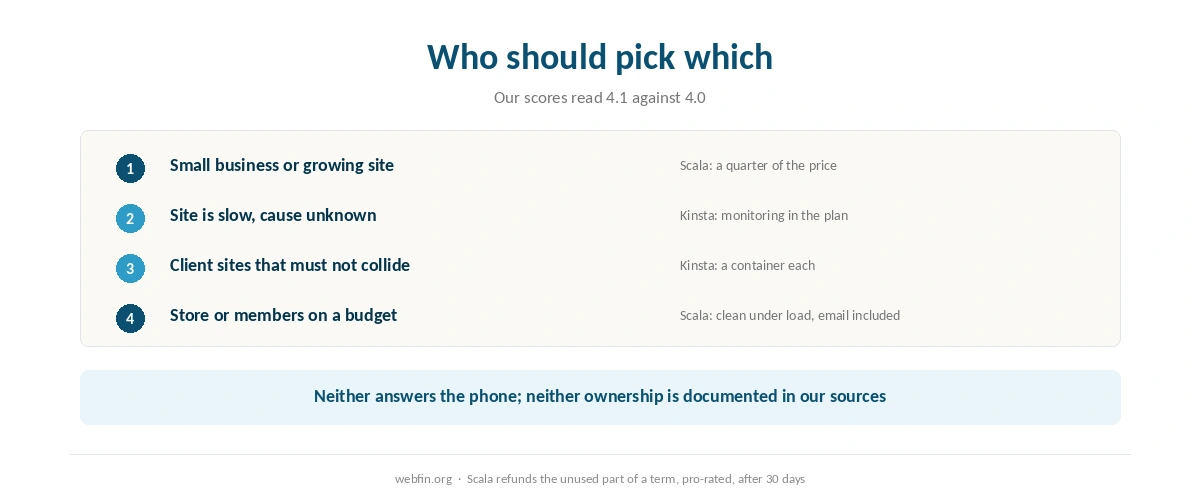
A small business or a growing site. Scala, for a clean load result, a named uptime figure and email, at a quarter of the price.
A site that is already slow and nobody knows why. Kinsta, because the monitoring is in the plan rather than on a shopping list.
Client sites that must not affect each other. Kinsta, for the container per site, as our list of hosting for agencies explains.
A store or membership site on a budget. Scala, whose shared plan handled the load test cleanly, as our list of hosting for membership sites covers.
Growing on Each
Kinsta grows by visit tier, priced per site, so a successful month moves the bill. Scala grows by moving to a VPS on the same panel, sized by processor core and memory, so growth is a resource decision rather than a traffic threshold.
For steady growth either works. For traffic that arrives in bursts, a visit allowance is the harder ceiling, and our roundup of hosting for high traffic covers hosts that price by server size instead.
Where Each One Is Weakest
Kinsta is weakest on price, scope and the missing uptime figure. Over 36 months it costs 3.9 times as much, hosts WordPress only, includes no email, has no phone line, and no named project publishes its uptime.
Scala is weakest on portability and on extras it leaves to you. SPanel is proprietary, so leaving means moving the site rather than the account, there is no edge network bundled, and its renewal steps by 4.1× over 12 months. Our Kinsta review and our Scala review price both in full.
Winners by Category
Price: Scala, at $322.20 against $1,260.00 over 36 months. Load test: Kinsta, narrowly, at 40 ms against 48 ms. Named uptime: Scala, at 99.98%. Performance monitoring: Kinsta, included. Isolation: Kinsta, a container per site. Email and malware monitoring: Scala. Refunds: Scala, pro-rated after 30 days.
How We Research
We run no tests. Load, hardware and uptime figures come from Hostingstep’s 2026 benchmarks and reviews, each with its window. Where our table holds no figure, as with Kinsta’s uptime, the cell stays empty. Prices, inclusions and refund terms come from the providers’ own pages, read on 20 September 2026.
Features such as Kinsta’s monitoring and Scala’s malware monitor are those documented in our reviews. The criteria behind our scores are on our about page, and our comparison of Cloudways against Scala Hosting sets the same host beside a cloud server.
Kinsta vs Scala Hosting FAQ
Scala, by a wide margin: $322.20 across 36 months on annual terms against $1,260.00 at Kinsta. Its renewal of $11.95 is about a third of Kinsta’s flat $35.00.
Both completed the 2026 load test cleanly, Kinsta at 40 ms with every request answered and Scala at 48 ms with no errors. Eight milliseconds apart is not a difference a visitor would notice.
Scala has the only counted figure: 99.98% uptime in the project we cite. Our table holds no uptime percentage for Kinsta from a named project, so we do not claim one.
Application performance monitoring in the plan, a container per site and Cloudflare Enterprise on every plan. Scala answers with daily backups, a malware monitor and email in its own panel.
No. Both offer chat and tickets only, and neither publishes a measured response time. Neither host’s ownership is documented in the sources we read either.
The Verdict
Scala Hosting is the better buy for a small business or a growing site. It costs a quarter as much, completed the load test cleanly, holds the only named uptime figure in this comparison, and includes daily backups, a malware monitor and email in the same panel as the site. Our page on Kinsta for Magento covers a question of scope rather than quality.
Kinsta scores a tenth higher for reasons that are real but specific: monitoring in the plan, a container per site and an edge network on every tier. If a site is slow and nobody knows why, or if client sites must not touch each other, those are worth the difference. Our page on what web hosting costs runs both totals further.