
Disclosure: WebFin is reader-supported. If you buy hosting through links on this page, we may earn a commission at no extra cost to you. Commissions vary between providers and our ratings do not — here’s our full disclosure.
A scope note first. Our tables price shared plans and managed servers, and one row says it plainly: the benchmark project we cite does not cover VPS or dedicated machines. So this page does not rank dedicated providers. It answers the question worth answering, which is when a whole machine beats a virtual one, and the answer is narrower than the category’s marketing suggests.
Dedicated vs Cloud: The Short Answer
Take a virtual server unless you have a specific reason not to: resizing, snapshots and hourly billing all favor it, and recovery is faster. Choose a dedicated machine for single tenancy demanded by a contract, for sustained heavy load where the ceiling is known, or for licensing tied to physical cores. Everything else is better served by a managed server from $14.00 a month.
What Each One Actually Is
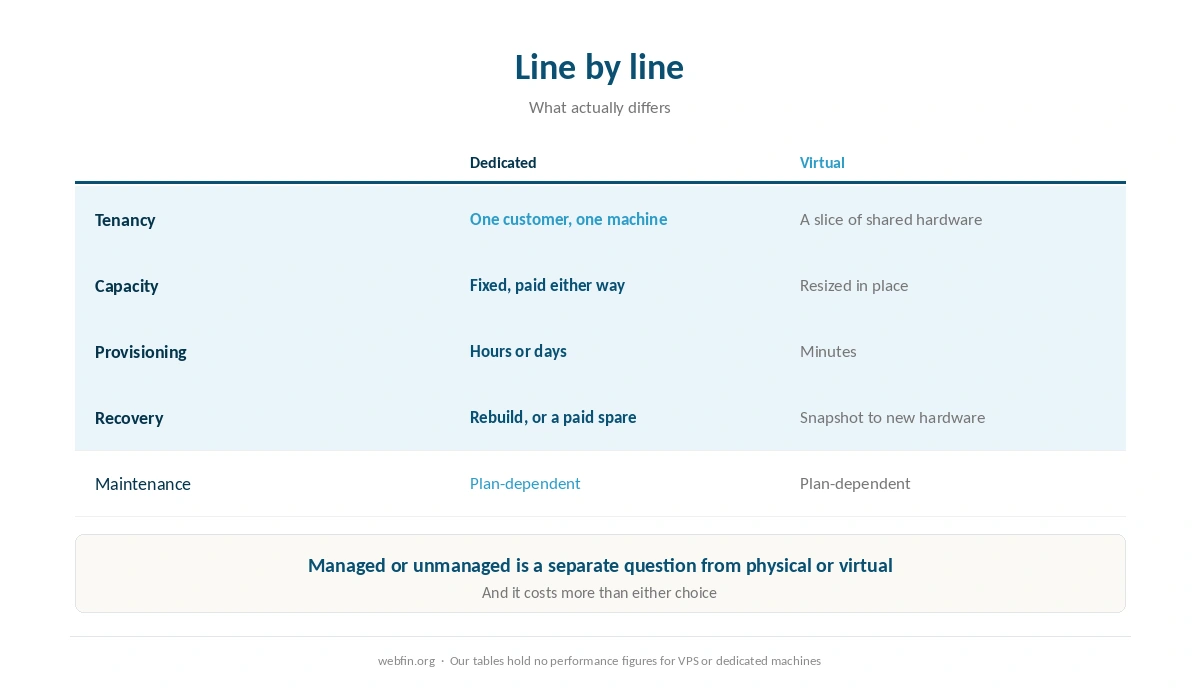
Dedicated. One physical machine, one tenant. Fixed hardware, fixed cost, and capacity you pay for whether you use it or not. Provisioning is measured in hours or days.
Virtual, sold as cloud or VPS. A slice of a machine on a platform that resizes in place and snapshots on demand, sometimes billed by the hour. Our page on VPS against cloud hosting covers why those two words overlap so much.
What both share. Somebody has to patch the operating system. Whether that is you depends on the plan rather than the hardware, as our page on managed against unmanaged hosting works through.
| Host and plan | How it builds | 36-month total |
|---|---|---|
| ChemiCloud Starter, 36-month term | 36 prepaid months at $2.49 | $89.64 |
| InterServer Standard | 36 months at $2.50, price locked | $90.00 |
| DreamHost Launch, 48-month term | 36 of 48 prepaid months at $2.89 | $104.04 |
| Namecheap Stellar, 24-month term | 24 at $1.98, then 12 at $4.88 | $106.08 |
| Hostinger Premium, 48-month term | 36 of 48 prepaid months at $2.99 | $107.64 |
| HostGator Hatchling, 36-month term | 36 months at $3.75, renewal not reached | $135.00 |
| HostGator Hatchling, with daily backups | 36 at $3.75, plus CodeGuard at $35.88 a year | $242.64 |
| Bluehost Starter, 36-month term | 36 months at $3.99, renewal not reached | $143.64 |
| GoDaddy Economy, 36-month term | 36 months at $5.99, renewal not reached | $215.64 |
| GoDaddy Economy, with SSL from year two | 36 at $5.99, plus $119.99 in years two and three | $455.62 |
| Hostwinds Basic, annual | 12 at $4.54, then 24 at $6.99 | $222.24 |
| SiteGround StartUp, 24-month term | 24 at $2.99, then 12 at $14.99 | $251.64 |
| DreamHost Launch, annual | 12 at $2.89, then 24 at $10.99 | $298.44 |
| Scala Hosting Mini, annual | 12 at $2.95, then 24 at $11.95 | $322.20 |
| Bluehost Starter, 12-month term | 12 at $3.99, then 24 at $11.99 | $335.64 |
| IONOS Plus, annual | 12 at $1.00, then 24 at $14.00 | $348.00 |
| GreenGeeks Lite, 36-month prepay | 36 months at $2.95 | $106.20 |
| GreenGeeks Lite, annual | 12 at $2.95, then 24 at $13.95 | $370.20 |
| SiteGround StartUp, 12-month term | 12 at $2.99, then 24 at $17.99 | $467.64 |
| Cloudways, from | 36 months at $14.00, flat | $504.00 |
| A2 Hosting Turbo Boost, annual | 12 at $6.99, then 24 at $20.99 | $587.64 |
| Rocket.net Starter, annual | 12 at $25.00, then 24 at $30.00 | $1,020.00 |
| WP Engine Startup, annual | 12 at $27.00, then 24 at $35.00 | $1,164.00 |
| Liquid Web managed VPS | 36 months at $33.00 | $1,188.00 |
| Kinsta Starter | 36 months at $35.00, flat | $1,260.00 |
| InMotion Core, 36-month term | 36 months at $3.19, renewal not reached | $114.84 |
| InMotion Launch, 36-month term | 36 months at $4.99, renewal not reached | $179.64 |
The Recovery Asymmetry
This is the argument that decided the market. A snapshot of a virtual server restores onto new hardware in minutes, because the platform has spare hardware and you are not attached to any of it.
A dedicated machine that fails needs a replacement built, or a spare already paid for. That is hours rather than minutes. It is the scenario worth rehearsing before you choose, which our guide to fixing a website that is down covers from the other side.
⚠️ Neither option is highly available on its own. One machine is one machine, physical or virtual, and real redundancy needs several instances behind a balancer.
When Dedicated Still Wins
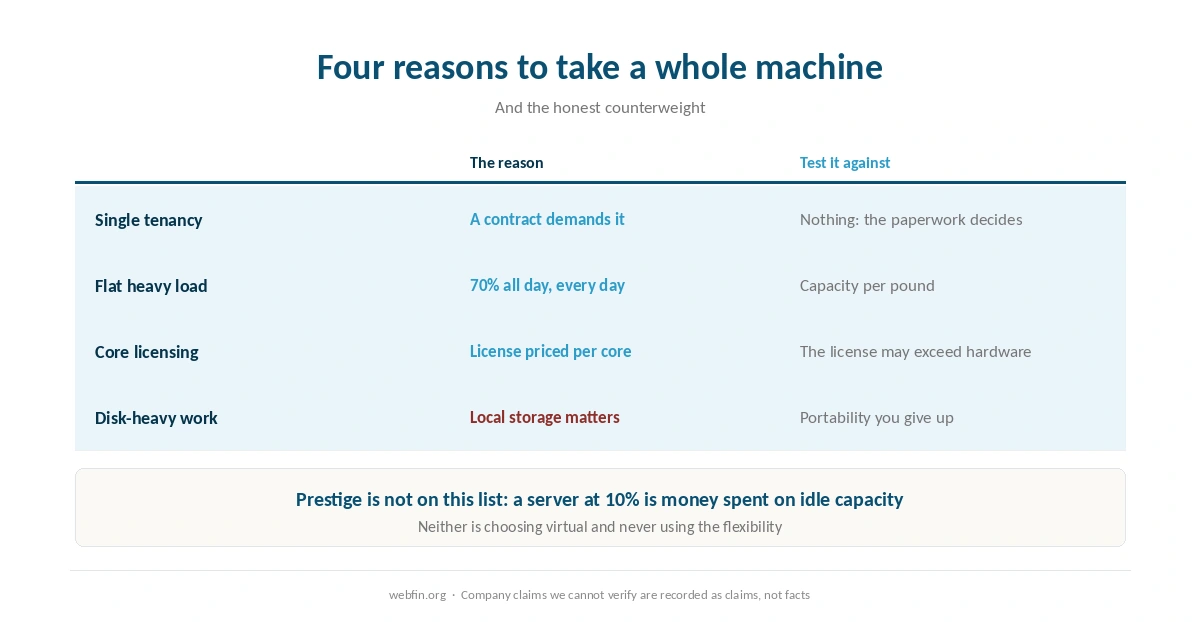
A contract demands single tenancy. Some compliance regimes and some clients require that no other customer shares the hardware. That is a paperwork answer and it is final, which our guide to reading a hosting agreement is the right frame for.
Sustained heavy load with a known ceiling. If the machine runs at 70% all day, every day, flexibility is worth less than capacity per pound.
Licensing tied to physical cores. Some database and application licenses are priced that way, and the license can cost more than the hardware.
Very high sustained disk activity. Where noisy neighbors would be intolerable and local storage matters more than portability.
When Virtual Wins, Which Is Usually
Traffic that changes. Resize for a campaign and shrink afterward, which our guide to handling a traffic spike covers.
Anything that needs a rehearsal. A second server for an afternoon costs the hours it runs.
Recovery that has to be quick. Snapshots restore onto other hardware.
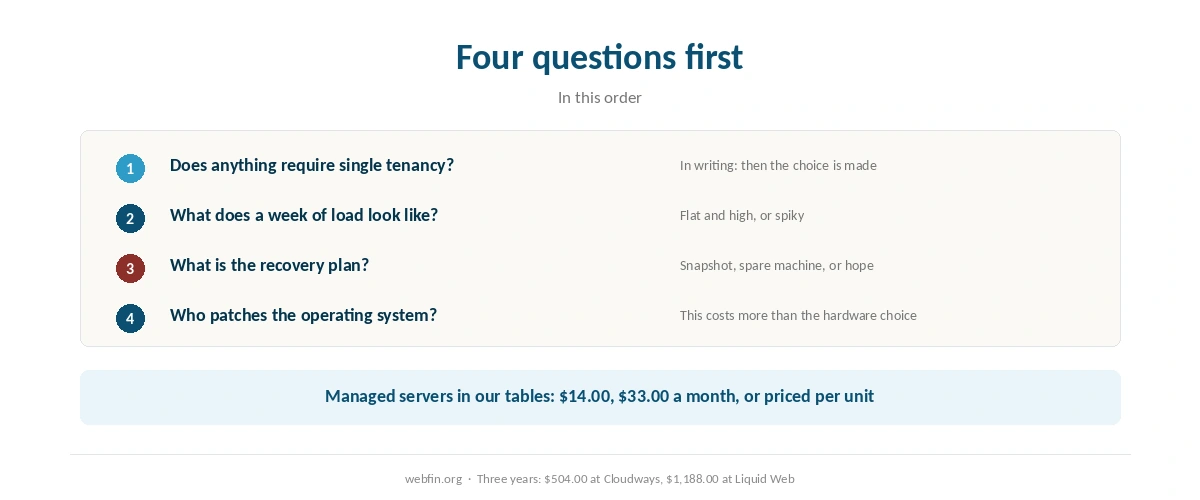
Budgets under scrutiny. Three years on a managed VPS in our tables cost $1,188.00 at Liquid Web and $504.00 at Cloudways, and a dedicated machine starts above either.
What Our Tables Can and Cannot Tell You
They can price managed servers. Cloudways starts at $14.00 a month billed hourly, and Scala Hosting charges $36.00 a year per processor core and $12.00 per gigabyte of memory.
Liquid Web starts at $33.00 a month on annual billing, with dedicated resources on every managed tier.
They cannot rank dedicated hardware, because the benchmark project we cite does not test it and we run no tests of our own. Where a provider makes a claim we cannot verify, we record it as a claim. Hostwinds publishes 99.9999% uptime, and our tables note that no independent measurement was found.
Four Questions Before You Choose
Does anything require single tenancy in writing? If yes, the decision is made.
What does your load look like across a week? Flat and high favors dedicated; spiky favors virtual.
What is your recovery plan? Snapshot to new hardware, spare machine, or hope. Our guide to setting up automatic backups covers testing it.
Who patches the operating system? Managed or not is a separate question from physical or virtual, and it costs more than either.
Four Situations
A growing application. Virtual, sized to the month, which our list of hosting for SaaS startups covers.
A busy store with seasonal peaks. Virtual, billed hourly.
A regulated workload with a single-tenancy clause. Dedicated, and the paperwork decides the provider.
A heavy database running flat out. Dedicated, if the ceiling is genuinely known, and our roundup of hosting for high traffic covers the step before that.
The Mistake Both Ways
Buying a dedicated machine for prestige is the commonest error in one direction: a server at 10% utilization is money spent on idle capacity.
The other direction is subtler. Choosing virtual and then never using the flexibility, so you pay a platform premium for a fixed-size instance you resize once a year. If that describes you, a per-unit VPS is cheaper, which our page on shared against VPS hosting covers.
One Middle Option
A managed VPS with dedicated resources is not the same thing as a dedicated machine. For many buyers it answers the question they were actually asking. Liquid Web puts dedicated resources on every managed tier, so your memory is not shared.
That gets you the isolation argument without the recovery problem, and our guide to moving from shared to VPS covers sizing it. Our list of hosting for developers records which providers expose the tooling to run it well.
How We Research
We run no tests. Prices, resource units, support commitments and billing terms come from the providers’ own pages, read on 20 September 2026. They sit in our tables, along with the three-year totals quoted here.
Our tables record that the benchmark project we cite does not cover VPS or dedicated machines. No performance figures appear for those categories, and we do not invent any. Company claims we cannot verify are recorded as claims. Cloud platforms priced per instance or per request are outside what we review. The criteria behind our scores are on our about page.
Dedicated vs Cloud FAQ
Not inherently, and we cannot show you figures either way: the benchmark project we cite does not test either category. What dedicated gives you is single tenancy and a known ceiling.
Recovery and flexibility. A snapshot restores onto new hardware in minutes, and you can resize for a campaign then shrink again. A failed physical machine needs a replacement built or a spare paid for.
When a contract demands single tenancy, or when load is flat and high with a known ceiling. Also when licensing is tied to physical cores, or sustained disk activity makes shared hardware intolerable.
No. One machine is one machine, physical or virtual. Real redundancy needs several instances behind a balancer, shared session storage and a separate database.
Cloudways from $14.00 a month billed hourly, and Scala Hosting at $36.00 a year per processor core plus $12.00 per gigabyte. Liquid Web starts at $33.00 a month on annual billing, which is $1,188.00 over three years.
The Verdict
Default to virtual. Resizing, snapshots and hourly billing are practical advantages you will use, and faster recovery is the one that matters on a bad day.
Choose a dedicated machine when paperwork, licensing or a flat heavy load makes single tenancy the requirement rather than the preference. And either way, remember that managed or unmanaged is the choice that actually changes your workload. Our page on what web hosting costs prices the managed options across three years.