
Disclosure: WebFin is reader-supported. If you buy hosting through links on this page, we may earn a commission at no extra cost to you. Commissions vary between providers and our ratings do not — here’s our full disclosure.
These two words describe overlapping products, and in hosting marketing one of them often means nothing measurable. A VPS is a slice of a machine with resources reserved for you. Cloud hosting, as hosts sell it, is normally the same thing on a virtualization layer that makes resizing and snapshots easier. So skip the vocabulary and ask four questions with checkable answers.
VPS vs Cloud: The Short Answer
Ask how billing is measured, whether you can resize without a migration, how snapshots work, and what the provider commits to in writing. Cloudways answers the first two well at $14.00 a month billed hourly. Scala prices resources per unit at $36.00 a year per processor core. Liquid Web answers the fourth with a 59-second support promise and 100% network uptime backed by credits. Neither label makes a single server highly available.
What Each Word Usually Means
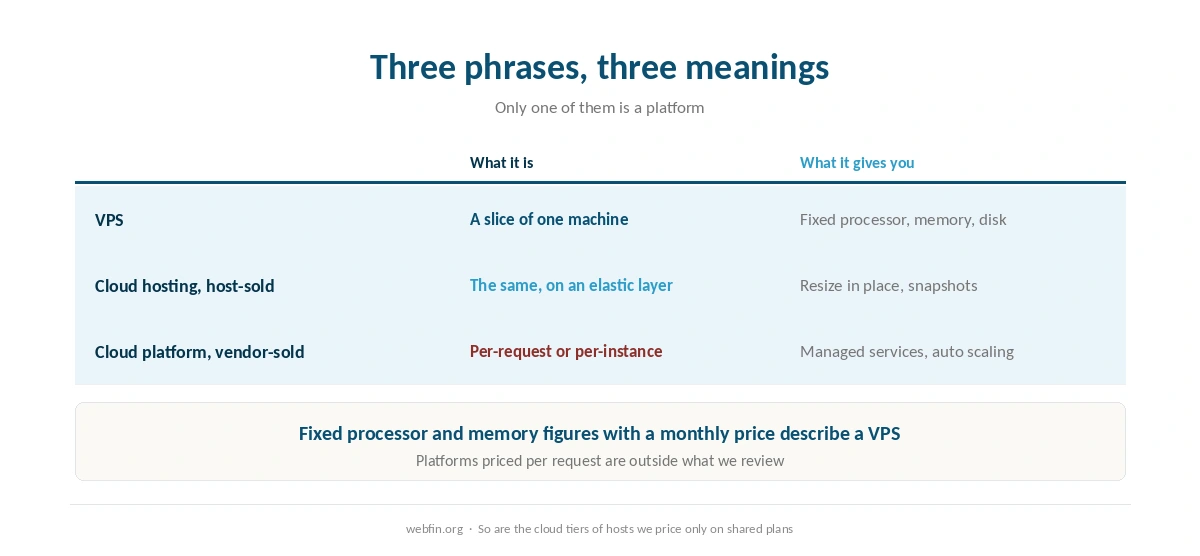
VPS. A virtual machine on one physical host, with a fixed allocation of processor, memory and disk. Resizing may mean a short reboot, or a migration to another machine.
Cloud hosting, as hosts use it. The same virtual machine on a platform built for elasticity: resize in place, snapshot on demand, sometimes billed by the hour. The marketing implies redundancy, and the plan still gives you one instance.
Cloud platform, as vendors use it. Per-request or per-instance pricing, managed services, automatic horizontal scaling. Those platforms are outside what we review, and our list of hosting for SaaS startups says so plainly.
⚠️ If a page says “cloud” and lists fixed processor and memory figures with a monthly price, you are reading about a VPS.
The Four Questions
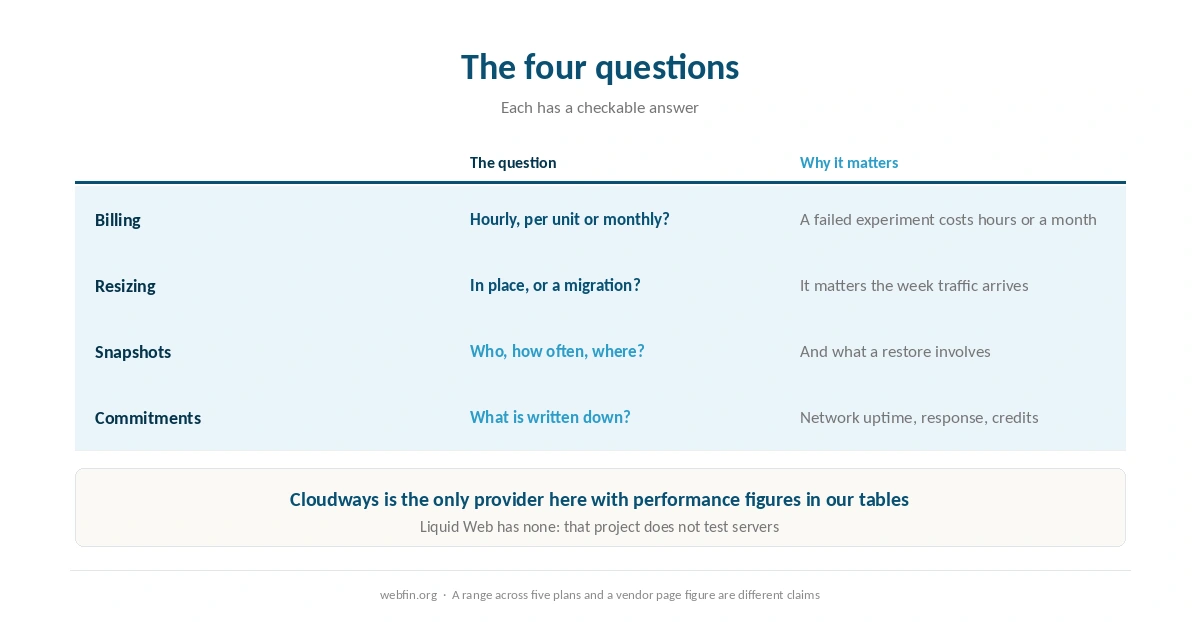
How is billing measured? Hourly billing means an experiment that fails costs the hours it ran. Monthly billing means the month.
Can you resize without migrating? Adding memory in place is a different experience from rebuilding on a bigger box, and it matters the week traffic arrives.
How do snapshots and backups work? Who takes them, how often, where they live, and what a restore involves. Our guide to setting up automatic backups covers testing that before you need it.
What is committed in writing? Network uptime, response times, credits. A promise you can quote is worth more than an adjective, which our guide to reading a hosting agreement covers.
Where Our Measurements Land
Of the three providers here, only Cloudways has performance figures in our tables. Uptime runs between 99.996% and 99.999% across five plans. Its weakest published load result was 288 ms with a 1.7% error rate on the Vultr High Frequency plan.
That range is the honest picture of a server. It depends on which cloud and which size you pick.
Scala’s shared platform finished the load test at 48 ms without an error, and its VPS is priced per unit with root. Liquid Web has no measurement row at all, because the benchmark project we cite does not test servers. Its monthly price is reported two ways in our sources.
⚠️ Our guide to reading an uptime report is worth a minute here. A range across five plans and a single figure from a vendor page are not the same kind of claim.
| Host | Measurement | Source and date |
|---|---|---|
| WP Engine | Global TTFB 65 ms, 1st of 34 hosts | Hostingstep, 2025 ranking, 40 locations |
| WP Engine | US TTFB 365 ms across 22 locations | Hostingstep, 2025 ranking |
| WP Engine | TTFB 355 ms, 349,920 checks | Hostingstep, Oct 2025 – May 2026 |
| WP Engine | Uptime 99.976%, 10th of 14 managed hosts | Study of 14 managed hosts, 2026 |
| WP Engine | Load 27 ms at 0% errors | Hostingstep, 2026 benchmarks |
| Rocket.net | Cached TTFB 85 ms globally | 12-month test, Mar 2025 – Mar 2026 |
| Rocket.net | Origin TTFB 310 ms; checkout bypasses cache | Same 12-month test |
| Rocket.net | Uptime 99.97%, seven outages in the window | Hostingstep, Oct 2025 – May 2026 |
| Rocket.net | Hardware score fell 8.5 → 7.5; not recommended | Hostingstep, 2026, tracked since Oct 2020 |
| Hostinger Business | Global TTFB 223 ms, 5th of 34 hosts | Hostingstep, 2026 |
| Hostinger Premium | Global TTFB 495 ms, 28th of 34; no CDN | Hostingstep, 2026 |
| Hostinger | TTFB 707 ms; server response 246 ms | Cybernews, June 2026 |
| Hostinger | Uptime 99.99%, 33 min down in 2025 | Hostingstep, continuous since 2021 |
| Hostinger | Uptime 99.93%, 6-month window | HostPro Reviews, 2026 |
| Hostinger | LCP 0.607 s, 2nd of 15 hosts | TechRadar, 10-week window, 2026 |
| Bluehost | Hardware score 9.6 of 10 | Hostingstep, 2026 |
| Bluehost | Load 41 ms at 0% errors after the Oracle move | Hostingstep changelog, 9 Jul 2026 |
| Bluehost | Response 411 ms; uptime 99.99% across 9 outages | Hostingstep, Nov 2025 – Aug 2026 |
| Bluehost | Global TTFB 224 ms across 40 locations, cached | Hostingstep Bluehost review, Jul 2026 |
| HostGator | Global TTFB 1.23 s; uptime 99.68%; 762 ms at 500 users | Hostingstep HostGator review, 2026 |
| HostGator | Hardware joint-highest in the field after the Oracle move | Hostingstep, 1 Sep 2026 update |
| ChemiCloud | US TTFB 531 ms; global 460 ms | Hostingstep, Oct 2025 – May 2026 |
| ChemiCloud | Load 1,068 ms at a 4.2% error rate | Hostingstep, same window |
| ChemiCloud | Uptime 99.76%; overall 6.1 of 10, degrading | Hostingstep, tracked since 2021 |
| GoDaddy shared | TTFB 751 ms; load test did not complete | Hostingstep, Nov 2025 – Jun 2026 |
| GoDaddy shared | Uptime 99.76% | Hostingstep, Nov 2025 – Jun 2026 |
| GoDaddy Managed WordPress | TTFB 344 ms; hardware 3.8 of 10 | Hostingstep, 2026 |
| GreenGeeks | TTFB 395 ms North America, 447 ms Europe | Long-term independent testing, 2026 |
| GreenGeeks | TTFB 580–610 ms Asia and Australia | Same testing window |
| GreenGeeks | Load 26 ms at 0% errors; WPBench 5.0 of 10 | Hostingstep, 2026 |
| GreenGeeks | 25 outages in the window; no integrated CDN found | Hostingstep, 2026 |
| Kinsta | Origin TTFB 525 ms; edge figures differ | Hostingstep, 2026 |
| Kinsta | Load 40 ms at 0% errors; WPBench 8.8 of 10 | Hostingstep, 2026 reviews |
| DreamHost | TTFB 450–500 ms band | Hostingstep, 2026 benchmarks |
| Scala Hosting | Uptime 99.97% across twelve months | Live site, 40,000 monthly visitors, UptimeRobot |
| Scala Hosting | 29 ms at the 95th percentile, 50 users | k6 load test, 2026 |
| InterServer | Uptime 99.98% across eighteen months | Six production sites, UptimeRobot |
| InterServer | Load under 700 ms; under 1.5 s by another source | Two 2026 reviews |
| A2 Hosting | TTFB 150–198 ms | 2026 studies; LiteSpeed on Turbo tiers |
| IONOS | Global TTFB 480 ms; WPBench 7.2 of 10 | Hostingstep, 2026 benchmarks |
| IONOS | Uptime 99.99%; load test failed at 65.4% errors | Hostingstep, 2026 benchmarks |
| Namecheap | TTFB 461 ms; global 448 ms; WPBench 5.0 | Hostingstep, Q4 2025; monitoring paused 30 Jun 2026 |
| InMotion | TTFB 300–500 ms shared | Published measurement, 2026 |
| InMotion | Uptime 99.97–99.99%; one account near 99.5% | Several 2026 sources |
| Hostwinds | No independent measurement found | 99.9999% is the company's own claim |
| Liquid Web | Not covered by the benchmarks we cite | VPS and dedicated are outside their scope |
| SiteGround | TTFB 632 ms; 22nd of 34 hosts | Hostingstep, 2026 benchmarks |
| SiteGround | Uptime 99.96% in 2025; 193 min over 44 outages | Hostingstep, full year 2025 |
| SiteGround | WPBench 8.4 of 10; load 170 ms at 0% errors | Hostingstep, Oct 2025 – May 2026 |
| Scala Hosting | TTFB 465 ms; global 501 ms | Hostingstep, 2026 benchmarks |
| Scala Hosting | WPBench 8.8 of 10; load 48 ms at 0% errors | Hostingstep, 2026 benchmarks |
| Scala Hosting | Uptime 99.98% across the year | Hostingstep, 2026 benchmarks |
| Cloudways | Vultr HF: load 288 ms at 1.7% errors; WPBench 7.6 | Hostingstep Cloudways review, 2026 |
| Cloudways | Uptime 99.996% to 99.999% across five plans | Hostingstep, Oct 2025 – May 2026 |
Snapshots Are Not Backups
A snapshot lives on the same platform as the instance it copies. That makes it fast to restore and useless if the account itself becomes unavailable, so a downloadable backup is a separate requirement.
Keep both: platform snapshots for quick recovery, and copies off the provider for everything else. Our guide to backing up a WordPress site covers the four parts to include. Our list of hosting for developers records which hosts expose the tooling.
The Availability Myth
“Cloud” implies that a hardware failure somewhere else is invisible to you. On the plans we price, one instance is one instance: if it goes down, your site goes down.
Real high availability needs several instances behind a balancer, shared session storage and a database that lives apart from the application. None of the plans in our tables assembles that for you, and this comparison says so rather than implying otherwise.
What a good platform gives you is faster recovery. A snapshot restored onto new hardware takes minutes, against a rebuild from backups. That is worth paying for, and our guide to fixing a website that is down covers the hour it matters.
Cost, Three Shapes
Hourly. Cloudways from $14.00 a month, and a sale week costs the hours it uses, which our guide to handling a traffic spike covers.
Per unit. Scala at $36.00 a year per processor core and $12.00 per gigabyte of memory, adjustable whenever the workload changes.
Monthly with commitments. Liquid Web from $33.00 a month on annual billing, with dedicated resources on every managed tier.
⚠️ Compare the same specification rather than the same headline. Two servers at one price can differ by a factor of two on memory.
Managed or Not, Again
The label matters less than who patches the operating system. All three providers above sell managed servers, which is why they cost more than a bare instance from a platform vendor.
An unmanaged server is cheaper and becomes your job: updates, web server configuration, certificates, log watching. Our page on shared against VPS hosting puts a number on that work, and it does not change because the product is called cloud.
Four Situations, Four Answers
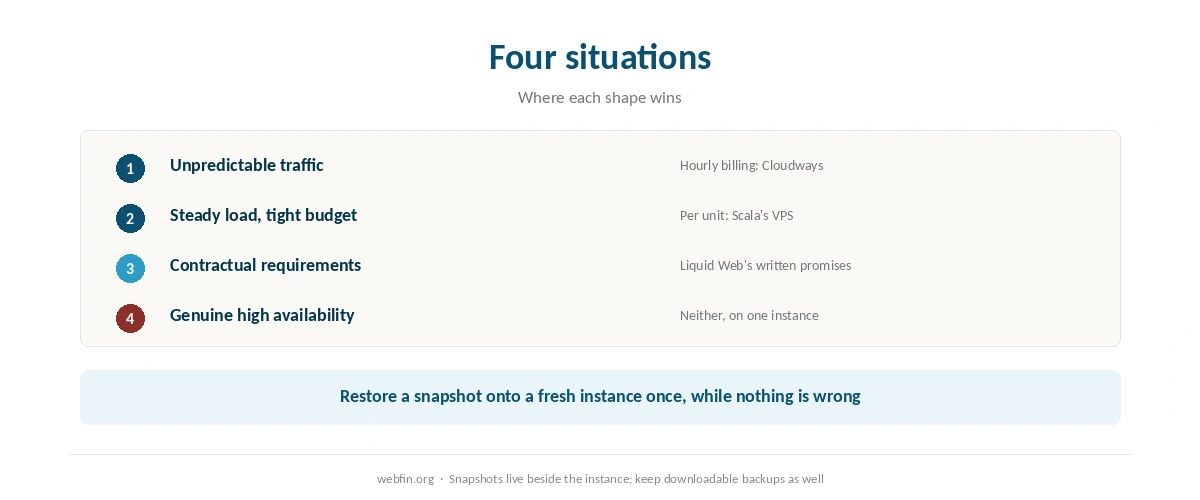
Unpredictable traffic. Hourly billing, so Cloudways. Sizing up for a week is a decision rather than a contract.
Steady load, tight budget. Per-unit pricing, so Scala’s VPS. You buy what the application needs and nothing else.
Contractual requirements. Liquid Web, for dedicated resources and written commitments, with the caveat that reviews this year dispute the response promise.
Genuine high availability. Neither, on one instance. That is an architecture project, and our roundup of hosting for high traffic covers the step before it.
One Thing to Test Whatever You Buy
Restore a snapshot onto a fresh instance once, while nothing is wrong. That single exercise tells you what an outage actually costs you in minutes, and it is the difference between a plan and a hope.
It also reveals which parts of the setup live outside the snapshot: DNS records, mail routing, certificates. Our guide to migrating web hosting covers that inventory, and our guide to moving from shared to VPS covers the sizing beforehand.
How We Research
We run no tests. Load and uptime figures come from Hostingstep’s 2026 benchmarks, each with its window. That includes the Cloudways range across five plans and Scala’s shared load result. Prices, resource units and support commitments come from the providers’ own pages, read on 20 September 2026, and sit in our tables.
Liquid Web has no measurement row because that project does not test servers, and its monthly price is recorded as disputed between sources. Cloud platforms priced per request or per So are the cloud tiers of hosts we price only on shared plans. The criteria behind our scores are on our about page.
VPS vs Cloud FAQ
In hosting marketing, often very little. A VPS is a virtual machine with reserved resources. Cloud hosting is normally the same thing on a platform that resizes and snapshots more easily, sometimes billed hourly.
Not by itself. One instance is one instance on the plans we price. Real high availability needs several instances behind a balancer, shared storage and a separate database, which none of them assembles for you.
It depends on the shape. Cloudways bills hourly from $14.00 a month, and Scala prices resources at $36.00 a year per core and $12.00 per gigabyte. Liquid Web starts at $33.00 a month on annual billing.
Billing granularity, whether you can resize without migrating, how snapshots and restores work, and what the provider commits to in writing. Those four have checkable answers.
No. Platforms priced per request or per instance are outside what we review, along with their managed services and automatic scaling. We say so rather than rank them from marketing pages.
The Verdict
Stop comparing the words and compare the four answers. Billing granularity, resizing without migration, snapshot mechanics and written commitments are the differences that show up on an invoice or during an outage.
On our figures Cloudways is the flexible default, and Scala’s VPS is the cheapest honest way to buy a known workload. Liquid Web is what you choose when a contract names a number. And no label on a single instance buys high availability, whatever the page says. Our page on what web hosting costs prices these across three years.