
Disclosure: WebFin is reader-supported. If you buy hosting through links on this page, we may earn a commission at no extra cost to you. Commissions vary between providers and our ratings do not — here’s our full disclosure.
WebFin runs on Hostinger, which appears below. We pay for the plan ourselves and have received no discount or other consideration, and that does not change how it scores.
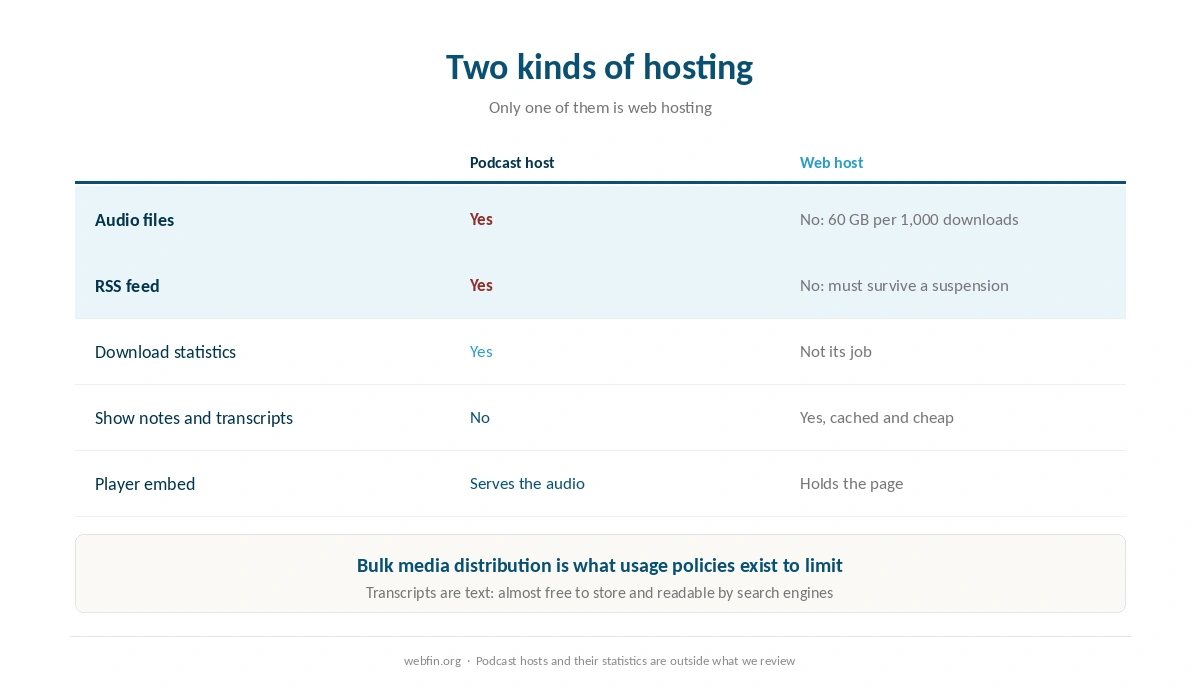
A podcast needs two kinds of hosting, and only one of them is web hosting. The audio files and the RSS feed belong with a podcast host, which distributes to the apps and counts the downloads. The website is for show notes, transcripts and the archive, and it can run on a cheap shared plan for years. Put the audio on your web host instead and the arithmetic turns ugly fast. One 60 MB episode downloaded a thousand times is about 60 GB of traffic.
Best Hosting for Podcasts: The Short Answer
InterServer for the website at the lowest fixed price: $2.50 a month, locked, with unlimited storage and email under its usage policy. Hostinger Business when listeners are spread across countries, because its content network records 223 ms globally against 495 ms without it. Bluehost when you want measured performance and a phone line. Keep the audio and the feed with a podcast host in every case.
The Arithmetic That Decides It
An hour of spoken audio at a sensible bitrate is roughly 60 MB. A show with a thousand listeners per episode moves about 60 GB each time. Four episodes a month come to roughly 240 GB. That is a worked example rather than a measurement, and it is the reason podcast hosts exist.
Unlimited bandwidth on a shared plan runs under an acceptable use policy, and bulk media distribution is what those policies exist to limit. A show that grows will meet that limit without warning, as our piece on what unlimited hosting means explains.
⚠️ The feed matters even more than the files. Apple and Spotify fetch your RSS feed on their own schedule. A hosting account suspended for resource abuse takes that feed down with the site. A podcast host keeps the feed separate from whatever your website is doing.
| Host and plan | Limit | Where it's stated |
|---|---|---|
| Bluehost shared | 50,000 inodes — soft limit | Hosting Inode Limit article |
| Bluehost shared | 200,000 inodes — AUP threshold | Server Resource Limitations |
| Bluehost shared | 1,000,000 inodes — TOS violation | Hosting Inode Limit article |
| Bluehost shared | 5,000 tables or 10 GB, all databases | Server Resource Limitations |
| Bluehost shared | 5 GB per single database | Server Resource Limitations |
| Bluehost Starter | 100 MB per mailbox | Shared hosting prices page |
| WP Engine Startup | 25,000 monthly visits, then overage handling | Plan pages |
| WP Engine, by tier | 25,000 to 400,000 monthly visits | Plan pages |
| Rocket.net Starter | 25,000 monthly visits, 1 site, 10 GB storage | Plan pages |
| Namecheap EasyWP | 50,000 / 200,000 / 500,000 monthly visits by tier | Plan pages |
| Kinsta Starter | 25,000 monthly visits | Plan pages |
| Scala Hosting VPS | Priced per unit: $3 per core, $1 per gigabyte | Plan pages; adjustable anytime |
| HostGator shared | Weekly backups described as a courtesy, not guaranteed | Hosting terms |
| Liquid Web | Dedicated resources at every tier; no shared plan | Plan pages |
| InterServer Standard | Unlimited storage, bandwidth, email and websites | One plan, no tiers |
| GreenGeeks Lite | One website only | Plan pages |
| IONOS Plus | One email account bundled per plan | Plan pages |
| Hostinger, all plans | Not published | Hostinger support article, 28 Aug 2026 |
| Bluehost Starter | 10 GB NVMe storage | Plan pages, as listed in a 2026 audit |
| InMotion Core | One site, 10 email accounts, SSD storage; NVMe from Launch | TechRadar and a 2026 review |
| SiteGround shared | Shell access by tier — not recorded | Not stated on the plan pages we read, 20 Sep 2026 |
| Bluehost shared | Shell access by tier — not recorded | Not stated on the plan pages we read, 20 Sep 2026 |
| Hostinger, all plans | Shell access by tier — not recorded | Not stated on the plan pages we read, 20 Sep 2026 |
| Cloudways servers | Search service (OpenSearch, Elasticsearch) — not recorded | Not stated on the plan pages we read, 20 Sep 2026 |
What the Website Actually Has to Do
Show notes, one page per episode. Text and links, cached like any other page. A hundred episodes is a hundred small pages, which no plan notices.
Transcripts. Useful and cheap. Text costs almost nothing to store, and it gives search engines something to read.
An embedded player. The audio streams from the podcast host, so the page stays light.
A signup form. Email lists outlive platforms, and the form needs delivery that works, which our guide to setting up email on your domain covers.
InterServer: The Cheapest Home for the Site
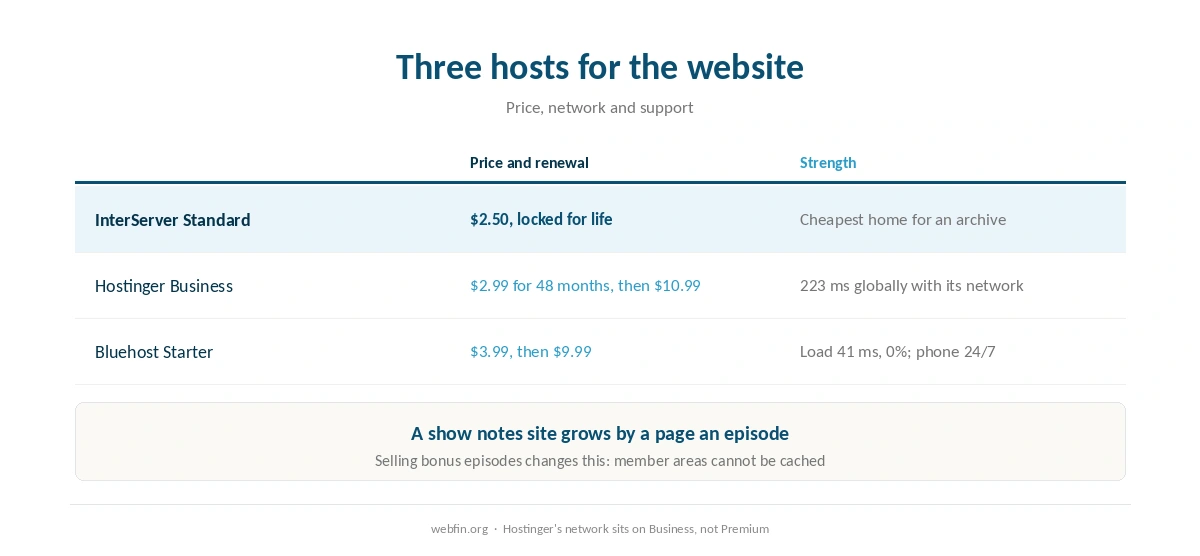
InterServer Standard costs $2.50 a month, with the price locked for the life of the account. One plan holds unlimited sites, storage and email under its usage policy. A show notes site grows by a page an episode, so nothing here will need upgrading. The bill in year ten is the bill today.
Strengths. The lowest long-run cost. Standard cPanel. Phone, chat and tickets around the clock.
Weaknesses. Its measured record is thinner than the larger brands’. No content network bundled.
Choose it if the site is the archive and the budget is fixed. Skip it if most listeners are abroad. Our InterServer review explains the lock.
Hostinger: For Listeners in Other Countries
Hostinger Premium holds $2.99 a month for 48 months and renews at $10.99. Its Business tier adds a content network. The benchmark project we cite records Business at 223 ms globally against 495 ms for Premium. A podcast audience is rarely in one country, and show notes pages cache well, so the network does useful work here.
Strengths. The longest promotion, four years. Measured uptime of 99.99% across 2025. Domain privacy included.
Weaknesses. No phone line, and support starts with an AI assistant. Resource limits are not published. The network sits on Business rather than Premium.
Choose it if listeners are spread widely. Skip it if you want published limits or a phone number. Our Hostinger review prices both tiers.
Bluehost: Measured, With a Phone Line
Bluehost Starter costs $3.99 a month for 36 months and renews at $9.99. Its published figures are the strongest among these picks: a load test at 41 ms with no errors, hardware at 9.6 of 10, 99.99% uptime and cached global delivery averaging 224 ms. It answers phone and chat around the clock, and it belongs to Newfold Digital.
Strengths. Figures a buyer can check. Phone support. A familiar dashboard.
Weaknesses. Starter caps each mailbox at 100 MB and keeps weekly backups, and the dashboard sells add-ons a podcast site does not need.
Choose it if you want measured performance and someone to call. Skip it if you run the show’s email from the same account. Our Bluehost review lists the extras to decline.
When the Show Sells Something
Bonus episodes behind a paywall change the picture, because a member area cannot be cached. Those pages reach the server on every click, which makes the load result matter in a way it does not for show notes. Our list of hosting for membership sites covers the hosts that handle it.
Merchandise and live tickets add a checkout, which is another uncached page. If either is planned, choose the host for that job rather than for the archive. Our list of hosting for ecommerce covers that job.
There is one case where the website does need to be quick: the day an episode is shared widely. Show notes pages are cached, so a spike lands on static copies rather than the database, which is why a modest plan copes. A store or a member area on the same site does not have that protection.
Keeping the Feed Alive
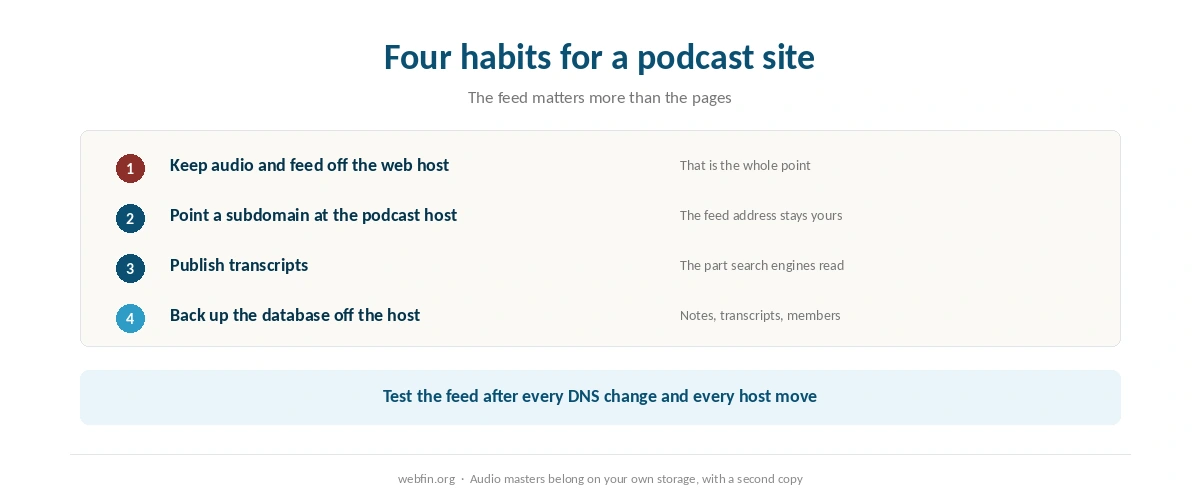
Point a subdomain at the podcast host if it supports one, so the feed address stays yours even if you change providers. Keep the domain at a registrar rather than bundled with hosting, which our guide to pointing a domain to a new host covers.
Then treat the feed as the thing that must never break. Test it after any DNS change, and check it again the day you move hosts. A website outage costs you readers for an afternoon; a broken feed can cost you a week of downloads. Our guide to fixing a website that is down covers the first checks.
The Archive Is an Asset
A show with two hundred episodes has two hundred pages of notes, and as many transcripts if you publish them. That archive keeps earning search traffic long after an episode leaves the charts. It costs almost nothing to host.
It is also the part of a podcast that a platform cannot take away. Keep it on your own domain, back it up off the host, and treat the hosting bill as the cheapest insurance in the whole production.
Backups for a Podcast Site
The audio masters belong on your own storage, with a second copy elsewhere. The website’s database holds the show notes, transcripts and any member records, and that is what needs automatic backups off the host.
Transcripts are worth protecting in particular: they are the part of the site search engines read, and rewriting them is expensive. Our guide to setting up automatic backups covers the schedules and the failure alerts.
One More Reason to Publish Transcripts
A transcript turns an audio episode into a page search engines can read, which is how a podcast earns search traffic of its own. It also gives listeners something to skim and quote, and it costs a few kilobytes.
That makes the website worth more than its hosting bill, and it is the part of a show that compounds. Our roundup of hosting for bloggers covers the same economics for text. Our guide to checking whether your host is throttling you covers the day an archive gets busy.
How We Research
We run no tests. Load, uptime and response figures come from Hostingstep’s 2026 benchmarks and reviews, each with its window. Prices, limits and backup terms come from the providers’ own pages, read on 20 September 2026, and sit in our tables.
The bandwidth example is arithmetic on a stated episode size rather than a measurement. Podcast hosts and their statistics are outside what we review; this guide covers the web hosting beside them. The criteria behind our scores are on our about page.
Podcast Hosting FAQ
It is the wrong place for it. One 60 MB episode downloaded a thousand times moves about 60 GB, and four episodes a month come to roughly 240 GB. Unlimited bandwidth runs under a policy that limits bulk media distribution.
Very little: show notes pages, transcripts, an embedded player and a signup form. Those cache well and cost almost nothing to store, which is why a locked $2.50 plan can serve a show for years.
InterServer for the lowest fixed price. Hostinger Business suits listeners spread across countries, and Bluehost a buyer who wants measured performance and a phone line. The audio and feed stay with a podcast host in each case.
Because the apps fetch it on their own schedule. A hosting account suspended for resource abuse takes the feed down with the site, and a broken feed costs downloads rather than pageviews.
A member area cannot be cached, so every click reaches the server. That makes the load result matter, and it moves the decision toward hosts measured under load rather than the cheapest plan.
The Verdict
Give the audio and the feed to a podcast host, then buy the cheapest reliable web hosting for the rest. InterServer at a locked $2.50 will carry a show notes archive indefinitely. Hostinger Business is the answer when listeners are scattered, and Bluehost the pick when you want figures you can check and a phone line.
Publish transcripts, keep the domain at a registrar, back up the database off the host, and test the feed after every change. What turns a podcast site into an expensive hosting problem is putting the audio on it. Our page on what web hosting costs prices each option across three years.