
Disclosure: WebFin is reader-supported. If you buy hosting through links on this page, we may earn a commission at no extra cost to you. Commissions vary between providers and our ratings do not — here’s our full disclosure.
Renewal prices are not fixed in the way a supermarket price is fixed. Hosts spend heavily to acquire customers, and a retention team would rather keep you at a discount than lose you at full price. The conversation takes ten minutes, works often enough to be worth having, and has one detail most people miss: at some hosts a renewal is refundable within 30 days of payment, which means you can pay, ask, and leave if the answer is no.
How to Negotiate a Renewal Discount: The Short Answer
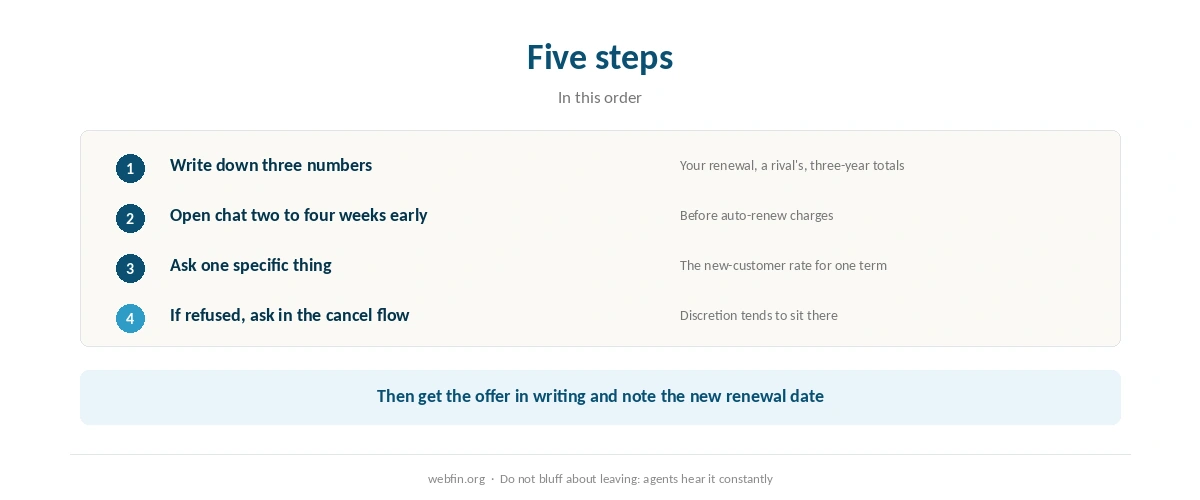
Two to four weeks before the renewal date, open a chat, and ask one specific question: will you match the current new-customer rate for the next term? Have your own numbers ready, give a reason, and stay pleasant. If refused, ask once more through the cancellation flow, where the discretion tends to sit. Get any offer in writing, then note the new renewal date.
Why This Works at All
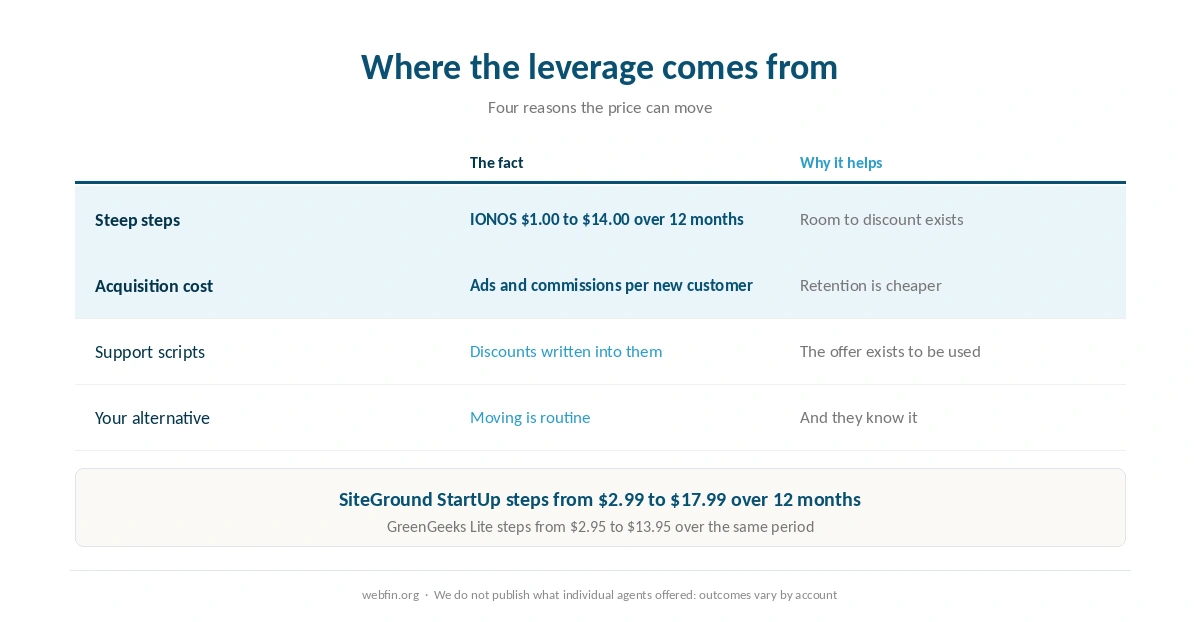
The step is often steep. Our table records IONOS Plus going from $1.00 to $14.00 across 12 months, SiteGround StartUp from $2.99 to $17.99, and GreenGeeks Lite from $2.95 to $13.95. A host holding a 14× increase over 12 months has room to move.
Acquisition costs more than retention. The affiliate commission and advertising behind a new customer dwarf a partial discount for an existing one.
Support staff have scripts with discounts in them. Not always, and not unlimited, but the offer exists to be used when a customer asks.
You have an alternative and they know it. Moving is a real option, which our guide to migrating web hosting makes routine.
| Host and plan | Intro → Renewal | Multiplier |
|---|---|---|
| IONOS Plus | $1.00 → $14.00 | 14.0× over 12 months |
| SiteGround StartUp | $2.99 → $17.99 | 6.0× over 12 months |
| SiteGround GrowBig | $4.99 → $29.99 | 6.0× over 12 months |
| SiteGround GoGeek | $7.99 → $44.99 | 5.6× over 12 months |
| ChemiCloud Starter | $2.49 → not published | Renewal shown at checkout only |
| Scala Hosting Mini | $2.95 → $11.95 | 4.1× over 12 months |
| DreamHost Launch, annual | $2.89 → $10.99 | 3.8× over 12 months |
| Hostinger Premium | $2.99 → $10.99 | 3.7× over 48 months |
| Bluehost Starter | $3.99 → $11.99 | 3.0× over 12 months |
| A2 Hosting Turbo Boost | $6.99 → $20.99 | 3.0× over 12 months |
| HostGator Hatchling | $3.75 → $10.99 | 2.9× over 36 months |
| GoDaddy Economy | $5.99 → $15.32 | 2.6× over 36 months |
| Bluehost Starter | $3.99 → $9.99 | 2.5× over 36 months |
| Namecheap Stellar | $1.98 → $4.88 | 2.5× over 12 or 24 months |
| Namecheap Stellar Plus | $2.98 → $6.88 | 2.3× over 12 or 24 months |
| Namecheap Stellar Business | $4.98 → $9.88 | 2.0× over 12 or 24 months |
| DreamHost Launch, 4-year | $2.89 → $7.99 | 2.8× over 48 months |
| DreamHost, eligible US nonprofits | One shared plan free for the account's life | 501(c)(3) or (c)(19); help article, checked 10 Jun 2026 by a nonprofit directory |
| Bluehost Business | $6.99 → $13.99 | 2.0× over 36 months |
| Bluehost Starter, second reading | $1.99 → $8.99 | Hostingstep, July 2026; conflicts with Bluehost's help page |
| Hostwinds Basic | $4.54 → $6.99 | 1.5× over 12 months |
| WP Engine Startup | $27.00 → $35.00 | 1.3× over 12 months |
| Rocket.net Starter | $25.00 → $30.00 | 1.2× over 12 months |
| InterServer Standard | $2.50 flat | 1.0×, price lock |
| Cloudways, from | $14.00 flat | no promotional term |
| Kinsta Starter | $35.00 flat | no promotional term |
| Liquid Web managed VPS, annual billing | $33.00, no promotional term | No increase described on annual billing |
| Liquid Web managed VPS, monthly billing | $36.00 → $72.00 reported | 2.0× over one month; one pricing guide, disputed |
| GreenGeeks Lite | $2.95 → $13.95 | 4.7× after one term; renewal was $12.95 before 2026 |
| ChemiCloud Starter, third-party figures | $9.95, $11.95 or $12.95 quoted | Sources disagree; 4.0× to 5.2× over 36 months |
| SiteGround StartUp, by term | $2.99 → $14.99, $17.99 or $24.99 | 5.0× over 24 months, 6.0× over 12, 8.4× month to month |
| ChemiCloud Kickstart, reseller | $8.99 → $29.95 | Term not stated in the source we read |
| InterServer reseller | $19.95, price locked | No increase described in sources |
| GreenGeeks reseller | $19.95 with WHMCS included | Promotional rate; renewal not published |
| Hostwinds white-label reseller | $10.00 with WHMCS included | Plain reseller plan excludes WHMCS |
| InMotion Core, 36-month term | $3.19 → $10.99 | 3.4× over 36 months; TechRadar, 2026 |
| InMotion Launch, 36-month term | $4.99 → $13.99 | 2.8× over 36 months; TechRadar and plan cards, 2026 |
| InMotion Core, by term | Renews at $10.99, $11.99 or $14.49 | Longest term lowest; one review, May 2026 |
Step 1: Know Your Three Numbers
Your renewal rate. From the invoice or the billing page, not from memory.
A competitor’s intro and renewal. Both, because an intro rate alone is not a comparison. Our page on hosting renewal prices lists them side by side.
Your three-year total either way. Staying at the renewal rate against moving and paying a new promotion. Our page on what web hosting costs runs those totals.
⚠️ Write the three numbers down before you open the chat. A negotiation where you are doing arithmetic in your head is a negotiation you lose.
Step 2: Time It Right
Two to four weeks before the renewal date. Early enough that nothing has been charged, late enough that the renewal is real rather than hypothetical.
Not on the day the invoice lands, because auto-renew has probably already taken the money, and not three months early, because the agent has no reason to act.
Step 3: Use Chat, and Ask One Thing
Chat gives you a transcript, which phone does not. Ask a single specific question rather than complaining about the price: will you match the current new-customer rate for the next term?
Then give a short reason. Comparing hosts, several sites in the account, a preference for staying: all three are true for most people, and none is a threat.
⚠️ Do not bluff about leaving if you will not. Agents hear it constantly, and it converts a negotiation into a script.
Step 4: If the Answer Is No, Ask Once More
Discretion tends to sit with the team that handles cancellations. Starting a cancellation is the point where a different script opens, and asking again there is normal rather than aggressive.
Be clear that you want to stay at a workable price. If the second answer is still no, you have learned something useful and lost nothing.
Step 5: The Refundable Renewal Route
This is the part most guides miss. Some hosts refund a renewal payment within a window: our table records SiteGround as refunding renewals within 30 days of payment, on top of 30 days on shared plans generally.
So if a renewal has already been charged, the money is not necessarily gone. Ask for the discount, and if the answer is no, request the refund inside the window and move. Our guide to canceling hosting and getting a refund covers the wording and the exclusions.
⚠️ Check your own host’s terms rather than assuming. Refund rules differ, domains are excluded almost everywhere, and two of our rows are disputed between sources.
What a Realistic Offer Looks Like
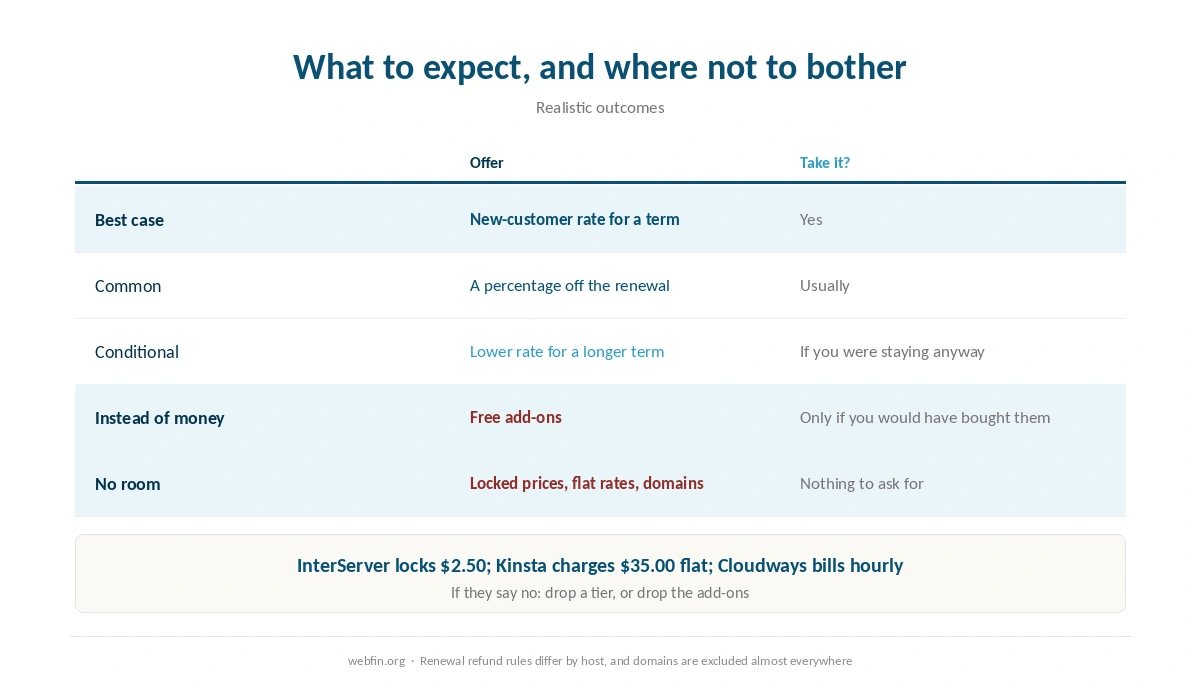
The new-customer rate for one term. This is the outcome to aim for, and the one to accept when offered.
A percentage off the renewal. Smaller, but it compounds if you stay for years.
A longer term at a lower rate. Fine if you were staying anyway, and our guide to choosing between annual and three-year terms covers the arithmetic.
Free extras instead of money. Decline unless you would have bought them. A year of a backup add-on is not a discount if you already back up elsewhere, as our page on hidden hosting fees explains.
One more lever exists if you have several sites in one account: ask about the whole account rather than one plan. An agent who cannot discount a single renewal can sometimes consolidate or reprice a group, and our list of hosting for multiple sites covers what those accounts look like elsewhere.
Where Negotiation Does Not Apply
Locked prices. InterServer holds $2.50 for the life of the account, so there is nothing to ask for.
Flat-rate platforms. Kinsta charges $35.00 in year one and year five, and Cloudways bills by the hour. Neither has a promotional cliff.
Domains. Registry costs pass through, so registrars have little room, which our page on domain renewal prices covers.
Month-to-month billing. There is no renewal event to negotiate around, only a decision each month.
If They Say No and You Stay Anyway
Two ways to spend less without a discount. Move down a tier if you are paying for resources you do not use, which our guide to downgrading a hosting plan covers. Or drop the add-ons: a backup service, a security scanner and a dedicated IP can cost more together than the plan.
And read what you are actually buying once, because a term you did not notice is often the real problem. Our guide to reading a hosting agreement covers the clauses that matter.
What to Do With the Answer
Whatever you are offered, ask for it in writing in the same chat, including the rate, the term it covers and the date it ends. A transcript is worth more than a promise, and the next renewal will come round faster than you expect.
Then put the new date in your calendar a month ahead, because a negotiated rate covers one term rather than every future one. And if you decide to move instead, our guide to pointing a domain to a new host covers the switch.
How We Research
We run no tests. Renewal rates, multipliers, refund windows and add-on prices come from the providers’ own pages and from our reviews, read on 20 September 2026, and sit in our tables. The SiteGround line about renewals being refundable within 30 days of payment is from its own refund terms.
We do not publish what any individual agent offered, because those outcomes vary by account, market and month, and a quoted anecdote would read as a promise. The criteria behind our scores are on our about page.
Renewal Discount FAQ
Often, yes. Acquisition costs more than retention, and support scripts include discounts at many hosts. Ask two to four weeks before the renewal date, in chat, with your own numbers to hand.
One specific thing: whether they will match the current new-customer rate for the next term. Vague complaints about price get vague answers, and a single clear request is easy for an agent to approve.
Check the refund terms. Our table records SiteGround refunding renewals within 30 days of payment, so ask for the discount and request a refund inside the window if the answer is no. Rules differ by host.
Only if it is true. Agents hear bluffs constantly. Saying you are comparing hosts and would rather stay is honest, effective and keeps the conversation friendly.
Ones with no promotional cliff. InterServer locks $2.50 for the life of the account, Kinsta charges $35.00 flat, and Cloudways bills by the hour. Domains have little room either, because registry costs pass through.
The Verdict
The asking is cheap and the arithmetic is on your side: our table holds steps of 14× over 12 months and 6.0× over the same period, and a host with that much promotional headroom can usually find some of it for a customer who asks politely.
Do it in chat, two to four weeks out, with three numbers written down and one clear request. If the answer is no, check whether the renewal is refundable before you accept it, and otherwise plan the move calmly rather than in the week the invoice lands. Our roundup of cheap web hosting lists where to land.