
Disclosure: WebFin is reader-supported. If you buy hosting through links on this page, we may earn a commission at no extra cost to you. Commissions vary between providers and our ratings do not — here’s our full disclosure.
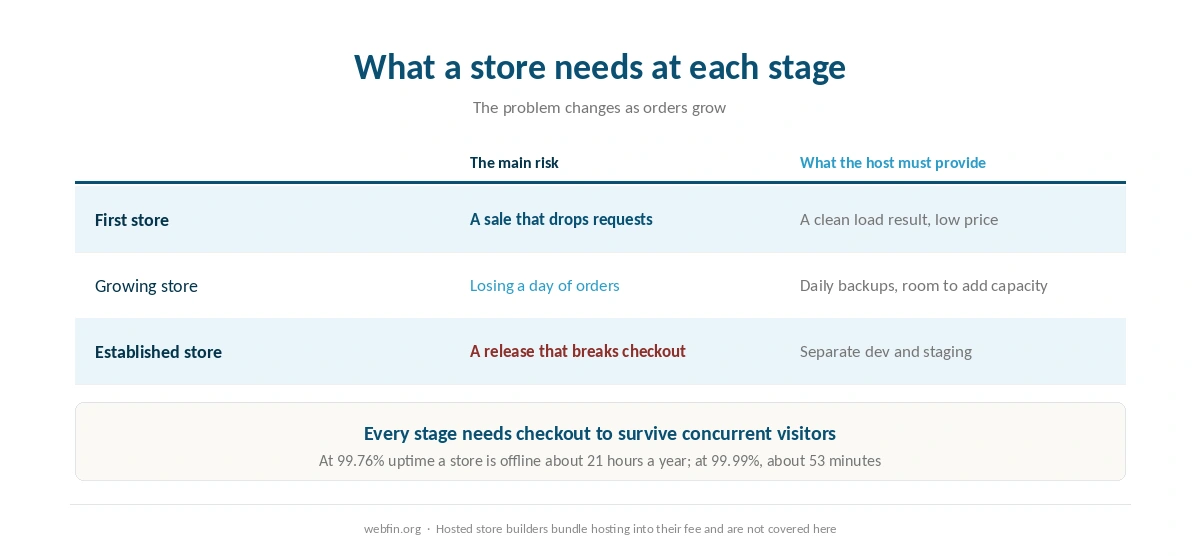
The best hosting for ecommerce depends on the stage the store is at, because a store’s hosting problem changes as it grows. A first store needs a host that survives a sale without dropping requests and costs little while orders are few. A growing store needs daily backups and room to add capacity. An established store needs a workflow for changes that never overwrites an order. This guide matches hosts to those stages, using the one measurement that matters most for a store: how the server behaves when many people check out at once. For selling courses specifically, see hosting for online courses.
Best Hosting for Ecommerce: The Short Answer
Bluehost for a first store: it passed the load test at 41 ms without an error and costs $3.99 a month for three years. Scala Hosting for a growing store: daily backups, a malware monitor and a VPS priced by the unit. WP Engine for an established store: separate development and staging environments and the strongest load result we cite.
What a Store Needs That a Blog Does Not
Performance on pages that cannot be cached. Carts, checkouts and account pages are built for each visitor, so an edge network or a page cache does little for them. The load test, which ramps to 100 concurrent visitors, is the closest published measure of how those pages behave in a sale. Our guide to WooCommerce hosting explains which pages bypass the cache and why.
Backups measured in hours, not weeks. A store records orders all day. Restored after a problem, a weekly backup can erase days of sales, so the schedule matters more here than on any other kind of site.
A safe way to change the site. Pushing a staging copy to production usually replaces the live database, which is where the orders are. A store needs either a files-only push or a routine that keeps the database out of it.
Uptime counted in lost sales. Every hour offline is an hour of orders that did not happen.
Email that arrives. Order confirmations and password resets are part of the checkout, and a store whose mail lands in spam loses customers quietly. Check SPF and DKIM before launch, and remember that some managed hosts include no email at all. Our guide to setting up email on your domain covers the records.
| Host | Measurement | Source and date |
|---|---|---|
| WP Engine | Global TTFB 65 ms, 1st of 34 hosts | Hostingstep, 2025 ranking, 40 locations |
| WP Engine | US TTFB 365 ms across 22 locations | Hostingstep, 2025 ranking |
| WP Engine | TTFB 355 ms, 349,920 checks | Hostingstep, Oct 2025 – May 2026 |
| WP Engine | Uptime 99.976%, 10th of 14 managed hosts | Study of 14 managed hosts, 2026 |
| WP Engine | Load 27 ms at 0% errors | Hostingstep, 2026 benchmarks |
| Rocket.net | Cached TTFB 85 ms globally | 12-month test, Mar 2025 – Mar 2026 |
| Rocket.net | Origin TTFB 310 ms; checkout bypasses cache | Same 12-month test |
| Rocket.net | Uptime 99.97%, seven outages in the window | Hostingstep, Oct 2025 – May 2026 |
| Rocket.net | Hardware score fell 8.5 → 7.5; not recommended | Hostingstep, 2026, tracked since Oct 2020 |
| Hostinger Business | Global TTFB 223 ms, 5th of 34 hosts | Hostingstep, 2026 |
| Hostinger Premium | Global TTFB 495 ms, 28th of 34; no CDN | Hostingstep, 2026 |
| Hostinger | TTFB 707 ms; server response 246 ms | Cybernews, June 2026 |
| Hostinger | Uptime 99.99%, 33 min down in 2025 | Hostingstep, continuous since 2021 |
| Hostinger | Uptime 99.93%, 6-month window | HostPro Reviews, 2026 |
| Hostinger | LCP 0.607 s, 2nd of 15 hosts | TechRadar, 10-week window, 2026 |
| Bluehost | Hardware score 9.6 of 10 | Hostingstep, 2026 |
| Bluehost | Load 41 ms at 0% errors after the Oracle move | Hostingstep changelog, 9 Jul 2026 |
| Bluehost | Response 411 ms; uptime 99.99% across 9 outages | Hostingstep, Nov 2025 – Aug 2026 |
| Bluehost | Global TTFB 224 ms across 40 locations, cached | Hostingstep Bluehost review, Jul 2026 |
| HostGator | Global TTFB 1.23 s; uptime 99.68%; 762 ms at 500 users | Hostingstep HostGator review, 2026 |
| HostGator | Hardware joint-highest in the field after the Oracle move | Hostingstep, 1 Sep 2026 update |
| ChemiCloud | US TTFB 531 ms; global 460 ms | Hostingstep, Oct 2025 – May 2026 |
| ChemiCloud | Load 1,068 ms at a 4.2% error rate | Hostingstep, same window |
| ChemiCloud | Uptime 99.76%; overall 6.1 of 10, degrading | Hostingstep, tracked since 2021 |
| GoDaddy shared | TTFB 751 ms; load test did not complete | Hostingstep, Nov 2025 – Jun 2026 |
| GoDaddy shared | Uptime 99.76% | Hostingstep, Nov 2025 – Jun 2026 |
| GoDaddy Managed WordPress | TTFB 344 ms; hardware 3.8 of 10 | Hostingstep, 2026 |
| GreenGeeks | TTFB 395 ms North America, 447 ms Europe | Long-term independent testing, 2026 |
| GreenGeeks | TTFB 580–610 ms Asia and Australia | Same testing window |
| GreenGeeks | Load 26 ms at 0% errors; WPBench 5.0 of 10 | Hostingstep, 2026 |
| GreenGeeks | 25 outages in the window; no integrated CDN found | Hostingstep, 2026 |
| Kinsta | Origin TTFB 525 ms; edge figures differ | Hostingstep, 2026 |
| Kinsta | Load 40 ms at 0% errors; WPBench 8.8 of 10 | Hostingstep, 2026 reviews |
| DreamHost | TTFB 450–500 ms band | Hostingstep, 2026 benchmarks |
| Scala Hosting | Uptime 99.97% across twelve months | Live site, 40,000 monthly visitors, UptimeRobot |
| Scala Hosting | 29 ms at the 95th percentile, 50 users | k6 load test, 2026 |
| InterServer | Uptime 99.98% across eighteen months | Six production sites, UptimeRobot |
| InterServer | Load under 700 ms; under 1.5 s by another source | Two 2026 reviews |
| A2 Hosting | TTFB 150–198 ms | 2026 studies; LiteSpeed on Turbo tiers |
| IONOS | Global TTFB 480 ms; WPBench 7.2 of 10 | Hostingstep, 2026 benchmarks |
| IONOS | Uptime 99.99%; load test failed at 65.4% errors | Hostingstep, 2026 benchmarks |
| Namecheap | TTFB 461 ms; global 448 ms; WPBench 5.0 | Hostingstep, Q4 2025; monitoring paused 30 Jun 2026 |
| InMotion | TTFB 300–500 ms shared | Published measurement, 2026 |
| InMotion | Uptime 99.97–99.99%; one account near 99.5% | Several 2026 sources |
| Hostwinds | No independent measurement found | 99.9999% is the company's own claim |
| Liquid Web | Not covered by the benchmarks we cite | VPS and dedicated are outside their scope |
| SiteGround | TTFB 632 ms; 22nd of 34 hosts | Hostingstep, 2026 benchmarks |
| SiteGround | Uptime 99.96% in 2025; 193 min over 44 outages | Hostingstep, full year 2025 |
| SiteGround | WPBench 8.4 of 10; load 170 ms at 0% errors | Hostingstep, Oct 2025 – May 2026 |
| Scala Hosting | TTFB 465 ms; global 501 ms | Hostingstep, 2026 benchmarks |
| Scala Hosting | WPBench 8.8 of 10; load 48 ms at 0% errors | Hostingstep, 2026 benchmarks |
| Scala Hosting | Uptime 99.98% across the year | Hostingstep, 2026 benchmarks |
| Cloudways | Vultr HF: load 288 ms at 1.7% errors; WPBench 7.6 | Hostingstep Cloudways review, 2026 |
| Cloudways | Uptime 99.996% to 99.999% across five plans | Hostingstep, Oct 2025 – May 2026 |
What Downtime Costs a Store
A year holds 525,600 minutes. At 99.99% uptime a site is offline for about 53 minutes a year; at 99.76% it is offline for about 21 hours. In the benchmark project we cite, Bluehost records the first figure and ChemiCloud the second. For a blog that gap is an inconvenience. For a store it is most of a day of lost orders, spread across the year.
Frequency matters as much as the total, because each outage breaks carts in progress. Our guide to reading an uptime report explains why the count of outages deserves as much attention as the percentage.
Bluehost: A First Store on a Budget
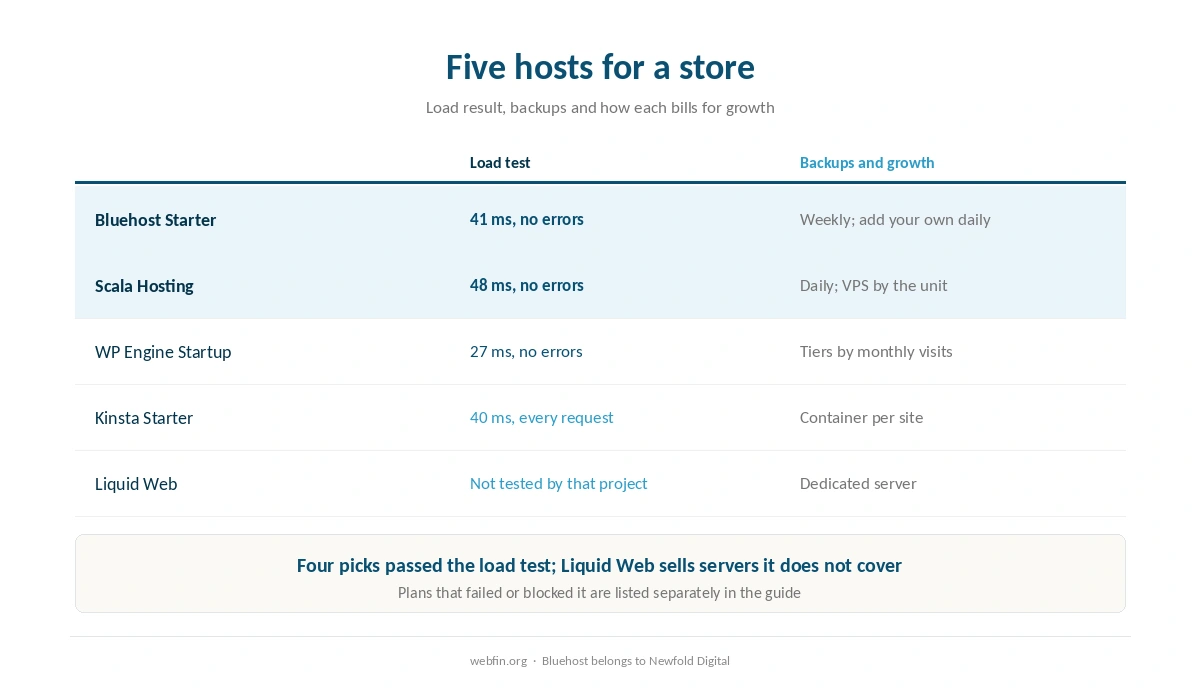
Bluehost Starter costs $3.99 a month for 36 months and renews at $9.99. After its move to Oracle Cloud it served the load test at 41 ms without an error, its hardware scores 9.6 of 10, and it recorded 99.99% uptime over 9 outages between November 2025 and August 2026. Bluehost belongs to Newfold Digital.
Strengths. The cheapest host here with a clean load result. Phone and chat around the clock, which matters when a checkout breaks during a sale.
Weaknesses. Starter keeps weekly rather than daily backups according to the benchmark project, so a store should add its own daily backup. The dashboard sells add-ons most stores do not need.
Choose it if you are opening your first store and orders are still counted in a handful a day. Skip it if you cannot run your own backups. Our Bluehost review lists the extras to decline.
Scala Hosting: A Growing Store
Scala’s shared plan served the load test at 48 ms without an error and scores 8.8 of 10 on hardware. Its panel includes daily backups and a real-time malware monitor, and its VPS prices a processor core at $36.00 a year and a gigabyte of memory at $12.00, adjustable for a busy season.
Strengths. Daily backups and malware monitoring in the plan, not on the menu. Capacity you can add for a sale and remove afterward. Pro-rated refunds of the unused term after 30 days.
Weaknesses. No phone line. The shared plan renews at $11.95 after $2.95, which is 4.1× over 12 months. Its own panel means moving a site away is a rebuild rather than an export.
Choose it if the store has seasons or is outgrowing shared hosting. Skip it if you need phone support. Our Scala Hosting review covers the VPS line.
WP Engine: An Established Store
WP Engine gives every site a production, staging and development environment, and it served the load test at 27 ms without an error, the strongest result we cite. Startup opens at $27.00 and renews at $35.00, which is 1.3× over 12 months, with 25,000 monthly visits and tiers above that.
Strengths. A workflow built for testing changes away from live orders. The best published load result. Monthly billing.
Weaknesses. Price, and a visit allowance a busy store can outgrow. No phone line on Startup and no email hosting at all.
Choose it if the store earns enough that a broken release costs more than the plan. Skip it if you need email with your hosting. Our WP Engine review prices the higher tiers.
Kinsta and Liquid Web: Two Specialist Routes
Kinsta runs each site in its own container and served the load test at 40 ms with every request answered. Its dashboard includes application performance monitoring, which finds the slow database queries that stores accumulate. Starter is $35.00 a month flat, and there is no phone line. Our Kinsta review has the detail.
Liquid Web sells managed servers with dedicated resources from $33.00 a month on annual billing, and commits in writing to answering support within 59 seconds. The benchmark project we cite does not test servers, so there is no load figure to compare. It suits a store that needs isolation or a support contract. Our Liquid Web review covers the range.
Plans to Avoid for a Store
Several entry plans failed or skipped the load test in the 2026 benchmarks. The IONOS entry plan failed with a 65.4% error rate. ChemiCloud answered at 1,068 ms with 4.2% of requests failing. GoDaddy’s shared plan did not complete the test. Rocket.net blocks it, and its edge network helps least on checkout, which bypasses the cache. The other uncached case is covered in hosting for membership sites.
None of these is a bad host for every site. For a store, though, a plan that drops requests under load drops them on the checkout page. Our roundup of hosting for high traffic ranks hosts by the same result.
If your store already runs on one of these plans, there is no need to panic. Watch the checkout during your next busy day, check the error log afterward, and plan a move before the next sale rather than during it. Our guide to migrating web hosting covers the order that keeps a store online while it moves.
Three Store Operations That Need a Plan
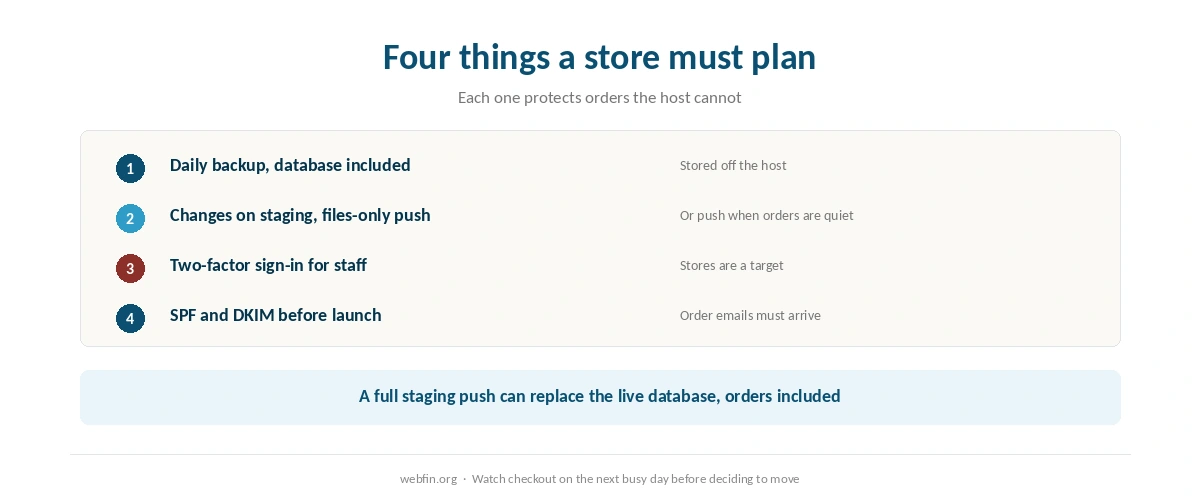
Backups. Run a daily backup that includes the database, stored off the host, whatever the plan includes. Our guide to backing up a WordPress site covers the routine.
Changes. Test updates on a staging copy, then push files only, or schedule the push when orders are quiet. Our guide to setting up a staging site explains why a full push can erase orders.
Security. A store holds customer data, which makes it a target. Keep plugins updated, require two-factor sign-in for staff, and know the recovery order before you need it, as our guide to recovering a hacked website sets out.
How We Research
We run no tests. Load, hardware and uptime figures come from Hostingstep’s 2026 benchmarks, reviews and changelog, each with its window. Prices, backups and plan terms come from the providers’ own pages, read on 20 September 2026. This guide covers stores on their own hosting, most often WooCommerce; hosted store builders bundle hosting into their platform fee and fall outside what we review.
Every host named here appears in our review section. The criteria behind our scores are on our about page, and the step from shared hosting to a server is covered in our guide to moving from shared to VPS.
Ecommerce Hosting FAQ
How the server behaves under concurrent visitors, because carts and checkouts cannot be cached. The published load test is the closest measure. After that, daily backups that include the database, and a way to change the site without overwriting orders.
Bluehost, on price and load: it served the 2026 load test at 41 ms without errors and costs $3.99 a month for 36 months. Add your own daily backup, because Starter keeps weekly copies according to the benchmark project.
When the busiest hour slows the checkout, when a sale produces errors, or when the store needs isolation from other accounts. Scala’s VPS adds capacity by the unit, and WP Engine and Kinsta offer managed WordPress with strong load results.
In the 2026 benchmarks the IONOS entry plan failed the load test with 65.4% errors, ChemiCloud answered at 1,068 ms with 4.2% failing, GoDaddy’s shared plan did not complete it, and Rocket.net blocks it. For a store, those are the plans to question first.
No. Hosted store builders include hosting in their platform fee, so they are a different purchase from the hosting we review. This guide covers stores on their own hosting, most often WooCommerce.
The Verdict
Match the host to the stage of the store. Bluehost for a first store that needs a clean load result at a low price, with your own daily backups added. Scala Hosting for a growing store that wants backups and malware monitoring included and capacity to add for a season. WP Engine for an established store where a broken release costs more than the plan.
Whatever the stage, read the load result before the price, and treat the backup schedule and the staging workflow as part of the purchase. A store loses money in the minutes it is down and in the orders a careless push erases, and neither shows on a pricing page. Our page on what web hosting costs prices each option across three years.