
Disclosure: WebFin is reader-supported. If you buy hosting through links on this page, we may earn a commission at no extra cost to you. Commissions vary between providers and our ratings do not — here’s our full disclosure.
The best hosting for online courses has to survive three things a normal site never meets: launch day, lesson pages that cannot be cached, and a database that records every student’s progress. It does not have to deliver the video. That single decision, to put the lessons on a video platform rather than the web host, removes most of the load a course would otherwise create, and it changes which plan you need. Podcasts split the same way, as hosting for podcasts explains.
Best Hosting for Online Courses: The Short Answer
Cloudways if you run launches: you can enlarge the server for the week and shrink it after, billed by the hour, from $14.00 a month. Scala Hosting for a steady course business: it served the load test at 48 ms without an error and includes daily backups. Kinsta when lesson pages drag, because its plan includes performance monitoring.
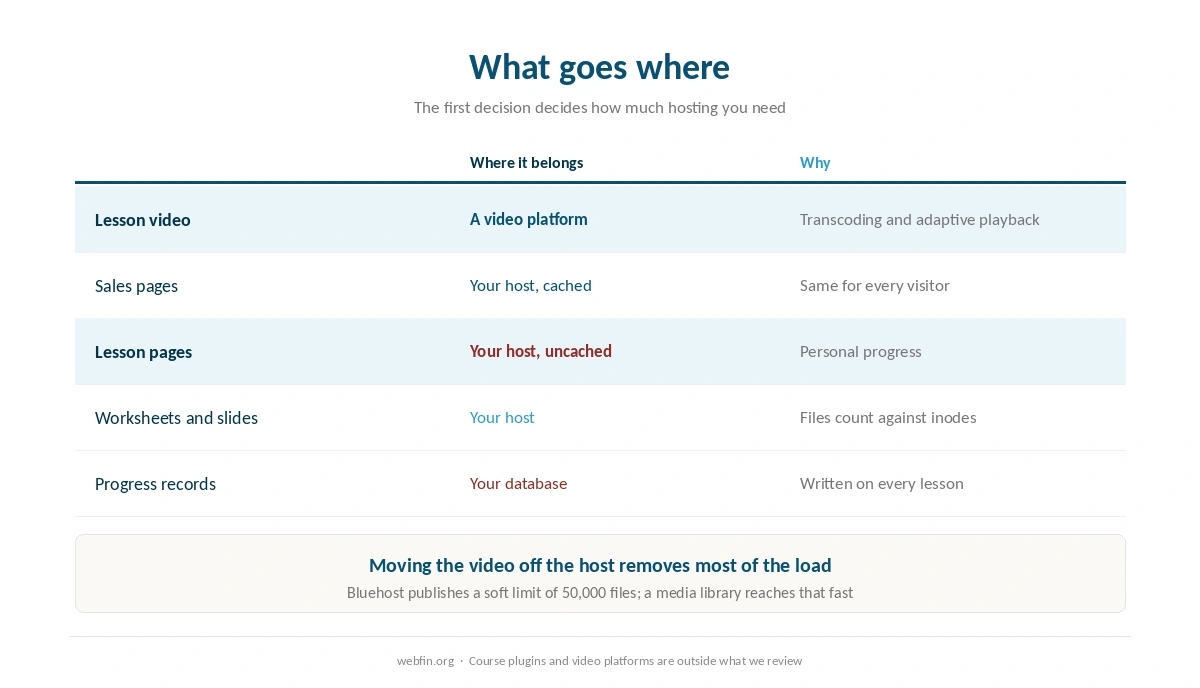
Do Not Serve the Video From Your Host
A single course video can be larger than an entire brochure site, and every student who watches it pulls that file through your hosting. Unlimited bandwidth on a shared plan runs under an acceptable use policy, and media distribution is exactly the use those policies exist to limit. Our piece on what unlimited hosting means covers the terms.
Video platforms also do things a web host does not: they transcode a file into several qualities, adapt to a student’s connection, and resume where the student stopped. Host the course site, embed the lessons, and let the platform carry the weight.
⚠️ Downloadable material still lives with you. Worksheets, slides and transcripts are files, and files count against a plan’s inode limit. Bluehost publishes 50,000 inodes as a soft limit, and our list of hosting for portfolio sites shows how quickly a media library reaches a ceiling like that.
| Host | Measurement | Source and date |
|---|---|---|
| WP Engine | Global TTFB 65 ms, 1st of 34 hosts | Hostingstep, 2025 ranking, 40 locations |
| WP Engine | US TTFB 365 ms across 22 locations | Hostingstep, 2025 ranking |
| WP Engine | TTFB 355 ms, 349,920 checks | Hostingstep, Oct 2025 – May 2026 |
| WP Engine | Uptime 99.976%, 10th of 14 managed hosts | Study of 14 managed hosts, 2026 |
| WP Engine | Load 27 ms at 0% errors | Hostingstep, 2026 benchmarks |
| Rocket.net | Cached TTFB 85 ms globally | 12-month test, Mar 2025 – Mar 2026 |
| Rocket.net | Origin TTFB 310 ms; checkout bypasses cache | Same 12-month test |
| Rocket.net | Uptime 99.97%, seven outages in the window | Hostingstep, Oct 2025 – May 2026 |
| Rocket.net | Hardware score fell 8.5 → 7.5; not recommended | Hostingstep, 2026, tracked since Oct 2020 |
| Hostinger Business | Global TTFB 223 ms, 5th of 34 hosts | Hostingstep, 2026 |
| Hostinger Premium | Global TTFB 495 ms, 28th of 34; no CDN | Hostingstep, 2026 |
| Hostinger | TTFB 707 ms; server response 246 ms | Cybernews, June 2026 |
| Hostinger | Uptime 99.99%, 33 min down in 2025 | Hostingstep, continuous since 2021 |
| Hostinger | Uptime 99.93%, 6-month window | HostPro Reviews, 2026 |
| Hostinger | LCP 0.607 s, 2nd of 15 hosts | TechRadar, 10-week window, 2026 |
| Bluehost | Hardware score 9.6 of 10 | Hostingstep, 2026 |
| Bluehost | Load 41 ms at 0% errors after the Oracle move | Hostingstep changelog, 9 Jul 2026 |
| Bluehost | Response 411 ms; uptime 99.99% across 9 outages | Hostingstep, Nov 2025 – Aug 2026 |
| Bluehost | Global TTFB 224 ms across 40 locations, cached | Hostingstep Bluehost review, Jul 2026 |
| HostGator | Global TTFB 1.23 s; uptime 99.68%; 762 ms at 500 users | Hostingstep HostGator review, 2026 |
| HostGator | Hardware joint-highest in the field after the Oracle move | Hostingstep, 1 Sep 2026 update |
| ChemiCloud | US TTFB 531 ms; global 460 ms | Hostingstep, Oct 2025 – May 2026 |
| ChemiCloud | Load 1,068 ms at a 4.2% error rate | Hostingstep, same window |
| ChemiCloud | Uptime 99.76%; overall 6.1 of 10, degrading | Hostingstep, tracked since 2021 |
| GoDaddy shared | TTFB 751 ms; load test did not complete | Hostingstep, Nov 2025 – Jun 2026 |
| GoDaddy shared | Uptime 99.76% | Hostingstep, Nov 2025 – Jun 2026 |
| GoDaddy Managed WordPress | TTFB 344 ms; hardware 3.8 of 10 | Hostingstep, 2026 |
| GreenGeeks | TTFB 395 ms North America, 447 ms Europe | Long-term independent testing, 2026 |
| GreenGeeks | TTFB 580–610 ms Asia and Australia | Same testing window |
| GreenGeeks | Load 26 ms at 0% errors; WPBench 5.0 of 10 | Hostingstep, 2026 |
| GreenGeeks | 25 outages in the window; no integrated CDN found | Hostingstep, 2026 |
| Kinsta | Origin TTFB 525 ms; edge figures differ | Hostingstep, 2026 |
| Kinsta | Load 40 ms at 0% errors; WPBench 8.8 of 10 | Hostingstep, 2026 reviews |
| DreamHost | TTFB 450–500 ms band | Hostingstep, 2026 benchmarks |
| Scala Hosting | Uptime 99.97% across twelve months | Live site, 40,000 monthly visitors, UptimeRobot |
| Scala Hosting | 29 ms at the 95th percentile, 50 users | k6 load test, 2026 |
| InterServer | Uptime 99.98% across eighteen months | Six production sites, UptimeRobot |
| InterServer | Load under 700 ms; under 1.5 s by another source | Two 2026 reviews |
| A2 Hosting | TTFB 150–198 ms | 2026 studies; LiteSpeed on Turbo tiers |
| IONOS | Global TTFB 480 ms; WPBench 7.2 of 10 | Hostingstep, 2026 benchmarks |
| IONOS | Uptime 99.99%; load test failed at 65.4% errors | Hostingstep, 2026 benchmarks |
| Namecheap | TTFB 461 ms; global 448 ms; WPBench 5.0 | Hostingstep, Q4 2025; monitoring paused 30 Jun 2026 |
| InMotion | TTFB 300–500 ms shared | Published measurement, 2026 |
| InMotion | Uptime 99.97–99.99%; one account near 99.5% | Several 2026 sources |
| Hostwinds | No independent measurement found | 99.9999% is the company's own claim |
| Liquid Web | Not covered by the benchmarks we cite | VPS and dedicated are outside their scope |
| SiteGround | TTFB 632 ms; 22nd of 34 hosts | Hostingstep, 2026 benchmarks |
| SiteGround | Uptime 99.96% in 2025; 193 min over 44 outages | Hostingstep, full year 2025 |
| SiteGround | WPBench 8.4 of 10; load 170 ms at 0% errors | Hostingstep, Oct 2025 – May 2026 |
| Scala Hosting | TTFB 465 ms; global 501 ms | Hostingstep, 2026 benchmarks |
| Scala Hosting | WPBench 8.8 of 10; load 48 ms at 0% errors | Hostingstep, 2026 benchmarks |
| Scala Hosting | Uptime 99.98% across the year | Hostingstep, 2026 benchmarks |
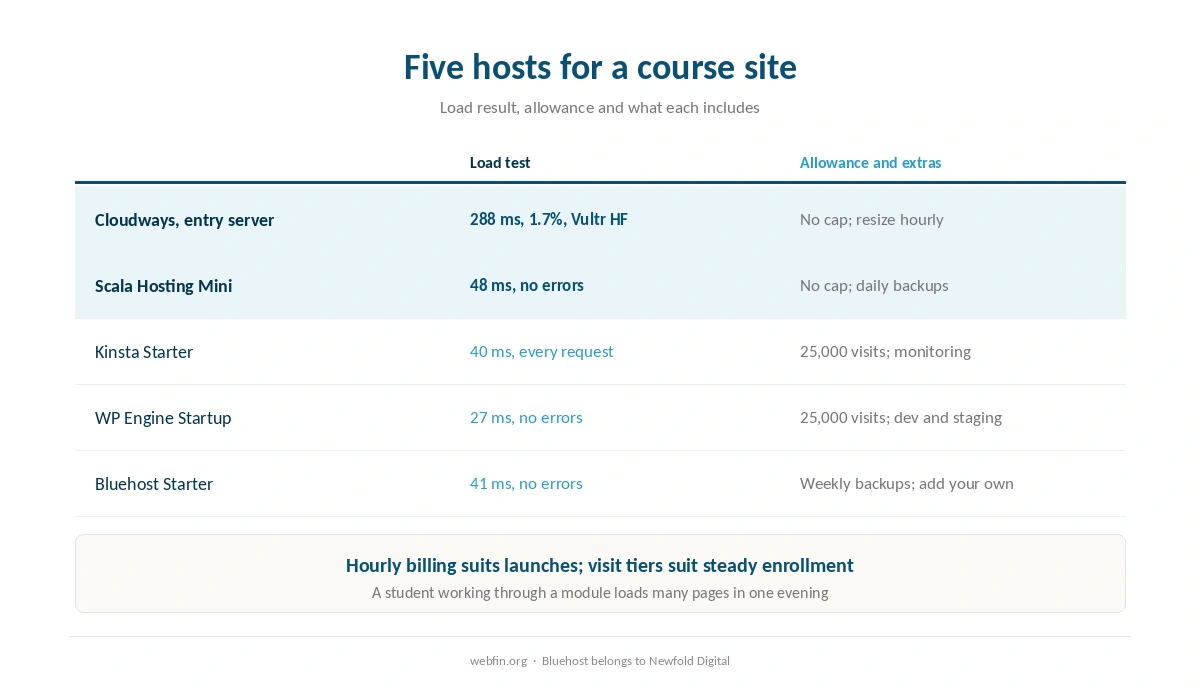
| Cloudways | Vultr HF: load 288 ms at 1.7% errors; WPBench 7.6 | Hostingstep Cloudways review, 2026 |
| Cloudways | Uptime 99.996% to 99.999% across five plans | Hostingstep, Oct 2025 – May 2026 |
What a Course Site Asks of a Server
Lesson pages cannot be cached. Each one shows a student their own progress, so it is built on request. The load test, which ramps to 100 concurrent visitors, is the closest published measure of that work. Our list of hosting for membership sites covers the same problem for communities.
Progress is a write, not a read. Every completed lesson, quiz answer and certificate is written to the database. Course plugins add tables, and a slow query shows up as a lesson page that takes seconds to load.
Launch day is a spike. An email to a list produces more traffic in an hour than the course sees all month, and it lands on the sales page and the checkout at the same time.
Enrollment email must arrive. Receipts, logins and lesson reminders are part of the product, and our guide to setting up email on your domain covers the records that keep them out of spam.
Cloudways: Built for Launch Weeks
Cloudways runs a managed server on the cloud you choose, from $14.00 a month with no promotional term, and bills by the hour. For a course business that runs launches, that is the feature: move to a larger server for the launch, then shrink it when the cohort settles. It held uptime between 99.996% and 99.999% across five plans in the benchmark project we cite.
Strengths. Capacity that follows the calendar. No visit caps. Staging, SSH and Git on every tier.
Weaknesses. Its weakest published load result, on the Vultr High Frequency plan, was 288 ms with a 1.7% error rate, so pick the cloud and the size deliberately. No email, and phone support costs extra.
Choose it if your revenue arrives in bursts. Skip it if you never want to think about a server. Our Cloudways review covers each cloud.
Scala Hosting: Steady and Backed Up
Scala’s shared plan served the load test at 48 ms with no errors and scores 8.8 of 10 on hardware. Its own panel includes daily backups, staging and cloning, and a malware monitor. Mini opens at $2.95 and renews at $11.95, and its VPS prices a processor core at $36.00 a year and a gigabyte of memory at $12.00.
Strengths. Strong uncached performance for the price. Daily backups of student progress included. A VPS path for a growing course library.
Weaknesses. No phone line. SPanel is proprietary, so leaving means moving the site. Its ownership is not documented in anything we read.
Choose it if enrollment is steady rather than seasonal. Skip it if you want a phone number. Our Scala Hosting review covers the VPS line.
Kinsta: When Lesson Pages Drag
Kinsta runs each site in its own container and served the load test at 40 ms with every request answered. Its dashboard includes application performance monitoring, which is the fastest way to find the course plugin query that makes a lesson page slow. Starter is $35.00 a month flat and includes 25,000 monthly visits.
Strengths. Built-in monitoring. Isolation between sites. A flat price with no promotional term.
Weaknesses. The visit allowance counts students, who visit often. WordPress only, no email, no phone line.
Choose it if students complain about speed and you need the cause. Skip it if the cohort is large and the budget tight. Our Kinsta review has the scoring.
WP Engine and Bluehost: Two Other Routes
WP Engine posted the strongest load result we cite, 27 ms with no errors, and gives every site production, staging and development environments. For a course that changes between cohorts, that workflow prevents the release that locks students out. Startup costs $27.00 renewing to $35.00, with 25,000 monthly visits. Our WP Engine review prices the tiers.
Bluehost is the low-cost start with evidence behind it: a load test at 41 ms without errors, hardware at 9.6 of 10 and 99.99% uptime, at $3.99 a month for 36 months renewing to $9.99. Starter keeps weekly backups, so add your own daily copies of student progress. Bluehost belongs to Newfold Digital, and our Bluehost review lists the extras to decline.
Planning for Launch Day
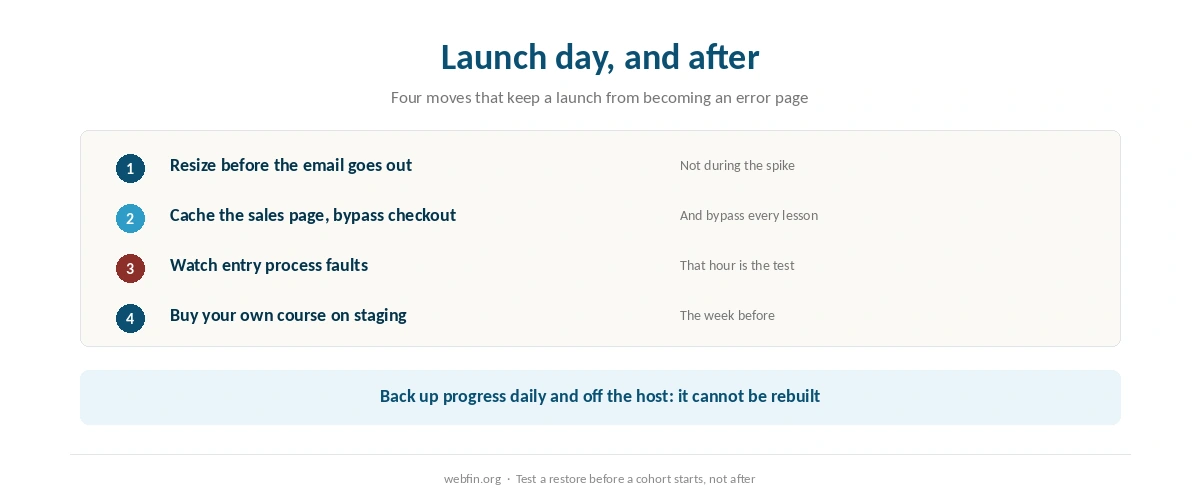
Resize before, not during. If your host sells capacity by the hour, buy it the day before the email goes out. If it sells tiers, move up for the month.
Cache the sales page, bypass the rest. The page that takes the traffic can be cached; the checkout and the lessons cannot. Our guide to setting up a CDN covers the rules.
Watch the resource faults during the hour. Entry process faults are what turn a launch into an error page. Our guide to checking whether your host is throttling you shows where they appear.
Rehearse on staging. Buy your own course on a staging copy the week before, from sales page to first lesson. Our guide to setting up a staging site covers the copy.
Which Course Business Needs Which
A first course, sold to a small list. Bluehost or Scala Hosting: both completed the load test cleanly, and the price leaves room for the video platform.
A course business with seasonal launches. Cloudways, where the server follows the calendar and the bill follows the hours.
A library of courses with steady enrollment. Scala’s VPS, sized by processor core and memory, or a Kinsta tier matched to the visits.
A course that changes between cohorts. WP Engine, for the separate development and staging environments. Our list of hosting for ecommerce covers the checkout side of selling a course.
Protecting Student Progress
Progress records are the part of a course business that cannot be rebuilt. A student who loses their completed lessons loses trust in the product, not just the data. So back up the database daily at least, keep copies off the host, and know how to restore one.
Automate it rather than remembering it, and test a restore before a cohort starts. Our guide to setting up automatic backups covers the schedules, the rotation and the failure alerts that make automation trustworthy.
How We Research
We run no tests. Load, hardware and uptime figures come from Hostingstep’s 2026 benchmarks and reviews, each with its window. Prices, visit allowances and backup terms come from the providers’ own pages, read on 20 September 2026, and features are those documented in our reviews.
Course plugins and video platforms are outside what we review; this guide covers the hosting under them. The criteria behind our scores are on our about page, and our roundup of hosting for high traffic ranks hosts by the load result that launch day tests.
Online Course Hosting FAQ
You can, and it is the wrong place for them. Unlimited bandwidth runs under an acceptable use policy that limits media distribution, and a web host does not transcode or adapt video. Use a video platform and embed the lessons.
Cloudways, because it bills by the hour: enlarge the server before the email goes out and shrink it afterward. Hosts that price by monthly visits, such as Kinsta and WP Engine, need a tier that covers the spike instead.
Lesson pages cannot be cached, because each one shows a student their own progress. They reach the server and the database every time. Kinsta’s included performance monitoring is the quickest way to find the query responsible.
The database daily at least, because it holds student progress, and the files weekly plus once before each release. Keep the copies off the host and test a restore before a cohort starts.
Yes. A student working through a module loads many pages in an evening, and plans with monthly visit allowances count all of them. Kinsta Starter and WP Engine Startup each include 25,000 visits; Cloudways and VPS plans price by server size.
The Verdict
Put the video on a video platform, then choose hosting for the three things that remain: uncached lesson pages, a database full of progress, and launch day. Cloudways suits a business that launches, because capacity follows the calendar and the bill follows the hours. Scala Hosting suits a steady course with daily backups included. Kinsta suits the moment students start complaining that pages drag.
Whichever you pick, rehearse a launch on staging, back up progress daily and off the host, and read a visit allowance as visits rather than students. A course fails in the most expensive way a site can: while people are paying to get in. Our page on what web hosting costs prices each option across three years.