
Disclosure: WebFin is reader-supported. If you buy hosting through links on this page, we may earn a commission at no extra cost to you. Commissions vary between providers and our ratings do not — here’s our full disclosure.
WebFin runs on Hostinger. We pay for the plan ourselves and have received no discount or other consideration, and that does not change how it scores. This page is a use-case answer rather than a review; the full workings are in our Hostinger review.
Drupal sits between WordPress and Magento in what it asks of a host. It runs on ordinary shared hosting, and it caches anonymous traffic well, which is the case Hostinger’s published figures describe. The condition is Composer. Drupal expects modules and core updates to be managed from the command line. So the first question is not about the host at all: it is whether your plan gives you a shell.
Is Hostinger Right for Drupal? The Short Answer
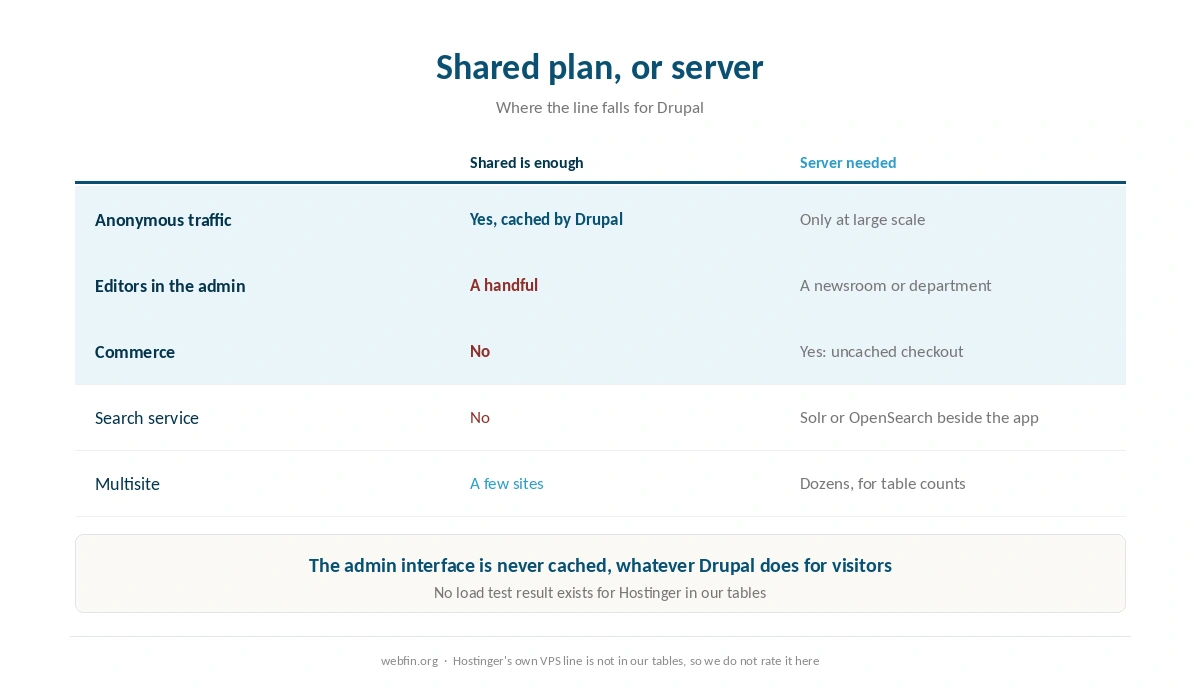
Yes for a brochure, institutional or community site, on Business rather than Premium, provided the plan includes SSH so Composer works. Drupal’s own caching handles anonymous visitors, which is what the 223 ms global figure on Business measures. Look at a server instead if the site has many editors, runs Drupal Commerce, or needs a search service beside it.
What Drupal Asks For
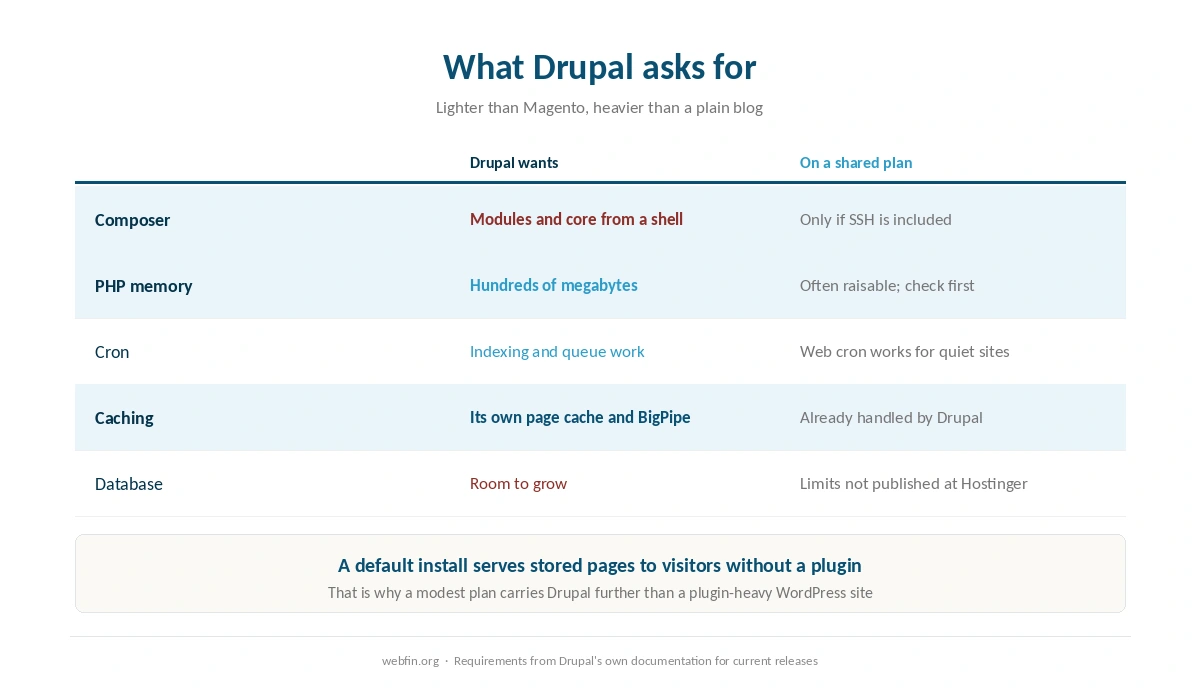
Composer, from a shell. Modern Drupal treats Composer as the way to install modules and apply core updates. A file manager alone leaves you patching by hand.
PHP memory in the hundreds of megabytes. Drupal’s own guidance is measured in megabytes rather than the gigabytes Magento wants, but the default on a cheap plan can still be too low for installing modules.
Cron. Drupal runs maintenance, search indexing and queue work on a schedule. A web-triggered cron works for a quiet site; real cron is better.
A cache it controls. Drupal’s internal page cache and BigPipe do most of the work for anonymous visitors. That is why it behaves well on modest hosting. Our guide to configuring caching covers the layers around it.
| Host and plan | Limit | Where it's stated |
|---|---|---|
| Bluehost shared | 50,000 inodes — soft limit | Hosting Inode Limit article |
| Bluehost shared | 200,000 inodes — AUP threshold | Server Resource Limitations |
| Bluehost shared | 1,000,000 inodes — TOS violation | Hosting Inode Limit article |
| Bluehost shared | 5,000 tables or 10 GB, all databases | Server Resource Limitations |
| Bluehost shared | 5 GB per single database | Server Resource Limitations |
| Bluehost Starter | 100 MB per mailbox | Shared hosting prices page |
| WP Engine Startup | 25,000 monthly visits, then overage handling | Plan pages |
| WP Engine, by tier | 25,000 to 400,000 monthly visits | Plan pages |
| Rocket.net Starter | 25,000 monthly visits, 1 site, 10 GB storage | Plan pages |
| Namecheap EasyWP | 50,000 / 200,000 / 500,000 monthly visits by tier | Plan pages |
| Kinsta Starter | 25,000 monthly visits | Plan pages |
| Scala Hosting VPS | Priced per unit: $3 per core, $1 per gigabyte | Plan pages; adjustable anytime |
| HostGator shared | Weekly backups described as a courtesy, not guaranteed | Hosting terms |
| Liquid Web | Dedicated resources at every tier; no shared plan | Plan pages |
| InterServer Standard | Unlimited storage, bandwidth, email and websites | One plan, no tiers |
| GreenGeeks Lite | One website only | Plan pages |
| IONOS Plus | One email account bundled per plan | Plan pages |
| Hostinger, all plans | Not published | Hostinger support article, 28 Aug 2026 |
| Bluehost Starter | 10 GB NVMe storage | Plan pages, as listed in a 2026 audit |
| InMotion Core | One site, 10 email accounts, SSD storage; NVMe from Launch | TechRadar and a 2026 review |
| SiteGround shared | Shell access by tier — not recorded | Not stated on the plan pages we read, 20 Sep 2026 |
| Bluehost shared | Shell access by tier — not recorded | Not stated on the plan pages we read, 20 Sep 2026 |
| Hostinger, all plans | Shell access by tier — not recorded | Not stated on the plan pages we read, 20 Sep 2026 |
| Cloudways servers | Search service (OpenSearch, Elasticsearch) — not recorded | Not stated on the plan pages we read, 20 Sep 2026 |
Why Hostinger’s Record Fits This Case Better
Its measured figures describe cached delivery, and Drupal caches anonymous pages by design. Uptime of 99.99% across 2025 from continuous monitoring since 2021. Cached global delivery of 223 ms on Business against 495 ms on Premium. A front-end paint figure of 0.607 seconds.
The gaps are the same as everywhere. There is no load test result in our tables, and a support article dated 28 August 2026 confirms the resource limits are not published. For a mostly anonymous Drupal site those matter less than they would for a store, because the pages that carry traffic are served from cache.
⚠️ They matter again the moment the site has many logged-in editors. An editorial team works in an admin interface that no cache serves, which is the same problem our list of hosting for news sites describes.
Business, Not Premium
The tier choice is the same as for any content site. Premium has no content network and records 495 ms globally; Business adds one and records 223 ms. Drupal’s cached pages are exactly what a network copies well.
If you stay on Premium and your readers are spread out, add a network yourself. Our guide to setting up a CDN covers that, including the routes that must bypass it.
Check These Before Buying
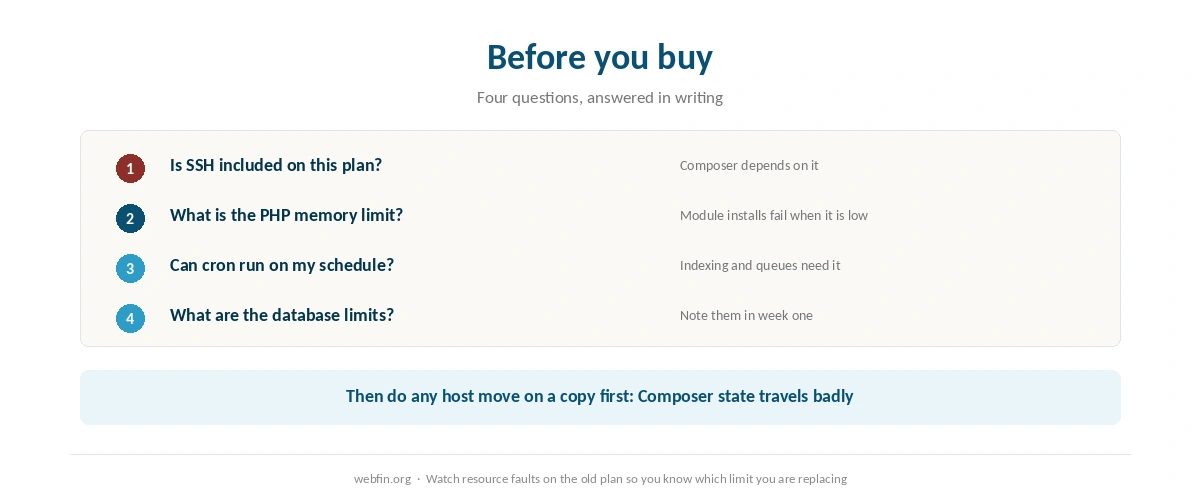
Does the plan include SSH? Without it, Composer is awkward at best. Ask support in writing rather than assuming, because this is the one feature that decides whether Drupal is maintainable on the plan.
What is the PHP memory limit, and can you raise it? Installing modules is the step that fails when it is too low.
Can cron run on a schedule you choose? Search indexing and queue work depend on it.
What are the database limits? Not published at Hostinger, so note them in the dashboard in week one, as our piece on what unlimited hosting means explains.
Where Drupal Outgrows Shared Hosting
Drupal Commerce. A store is the uncached case, and the missing load result becomes the deciding gap, as our page on Hostinger for WooCommerce explains for the WordPress equivalent.
A search service. Sites that add Solr or OpenSearch need it running beside the application, which means a server.
Many editors at once. The admin interface is uncached, so a newsroom or a university department with twenty people publishing needs hardware rather than caching.
A multisite network. Dozens of sites in one install press on database table counts. Our guide to setting up WordPress Multisite works through that arithmetic, and it is similar here.
What to Buy Instead, When You Need To
Cloudways. A managed server from $14.00 a month, billed by the hour, with SSH, Composer and staging on every tier. Uptime between 99.996% and 99.999% across five plans in the project we cite. Our Cloudways review covers each cloud.
Scala Hosting’s VPS. Root access, priced at $36.00 a year per processor core and $12.00 per gigabyte of memory, adjustable at any time. Its shared plan also completed the 2026 load test at 48 ms without an error. Our Scala Hosting review covers the line.
Our list of hosting for developers records which hosts keep shell access and version control low in the range, which is the feature Drupal cares about most.
Moving a Drupal Site Later
A Drupal site moves as files, a database and a settings file. The awkward parts are the Composer state and any modules installed by hand, so do the move on a copy before you commit to it. Our guide to migrating web hosting covers the order that keeps the site online.
Watch the resource faults on the old plan first, so you know which limit you are replacing. Our guide to checking whether your host is throttling you shows where they appear.
One Thing Drupal Does Better Than Most
Drupal ships with caching that assumes anonymous traffic, which is unusual. A default install serves stored pages to visitors without a plugin, and BigPipe streams the personalised parts afterward for logged-in users.
That is why a modest plan carries a Drupal site further than the same plan carries a plugin-heavy WordPress site. It also means the tuning that matters lives in Drupal rather than in the panel, and our guide to fixing a slow database covers the layer underneath when it stops helping.
How We Research
We run no tests. Hostinger’s figures come from Hostingstep, continuous since 2021, with global first-byte rankings from its 2026 benchmarks. A ten-week TechRadar window supplies the paint figure. There is no load test result for Hostinger in our tables, and we say so rather than borrow one.
Drupal’s requirements come from its own documentation for current releases, and module behavior is outside what we review. Hostinger’s VPS line is not in our tables, so the plans we price are its shared plans. We host this site on Hostinger and pay for the plan, as disclosed above. The criteria are on our about page.
Hostinger for Drupal FAQ
Yes, for a brochure, institutional or community site, and Business rather than Premium if readers are spread out. The condition is SSH, because Drupal expects Composer to manage modules and core updates.
Because Drupal caches anonymous pages itself and needs megabytes of PHP memory rather than gigabytes. Magento needs a separate search service and a compile step that a shared account cannot provide.
Business. Its content network records 223 ms globally against 495 ms on Premium, and Drupal’s cached anonymous pages are exactly what a network copies well.
When it runs Drupal Commerce or adds a search service such as Solr. Also when many editors work in the admin interface at once, or when a multisite network holds dozens of sites.
SSH availability in writing, the PHP memory limit and whether you can raise it, cron scheduling, and the database limits, which Hostinger does not publish in advance.
The Verdict
Drupal is the case where Hostinger’s published record lines up with the workload. The site caches its own anonymous pages, the measured figures describe cached delivery, and Business puts a network in front of them. For a brochure or institutional site, that is a cheap and sensible home for four years.
Two things change the answer: a shell you do not have, and a workload that is mostly logged-in. Confirm SSH before you buy, and move to a server when editors or commerce become the main traffic. Our page on what web hosting costs prices both routes across three years.