
Disclosure: WebFin is reader-supported. If you buy hosting through links on this page, we may earn a commission at no extra cost to you. Commissions vary between providers and our ratings do not — here’s our full disclosure.
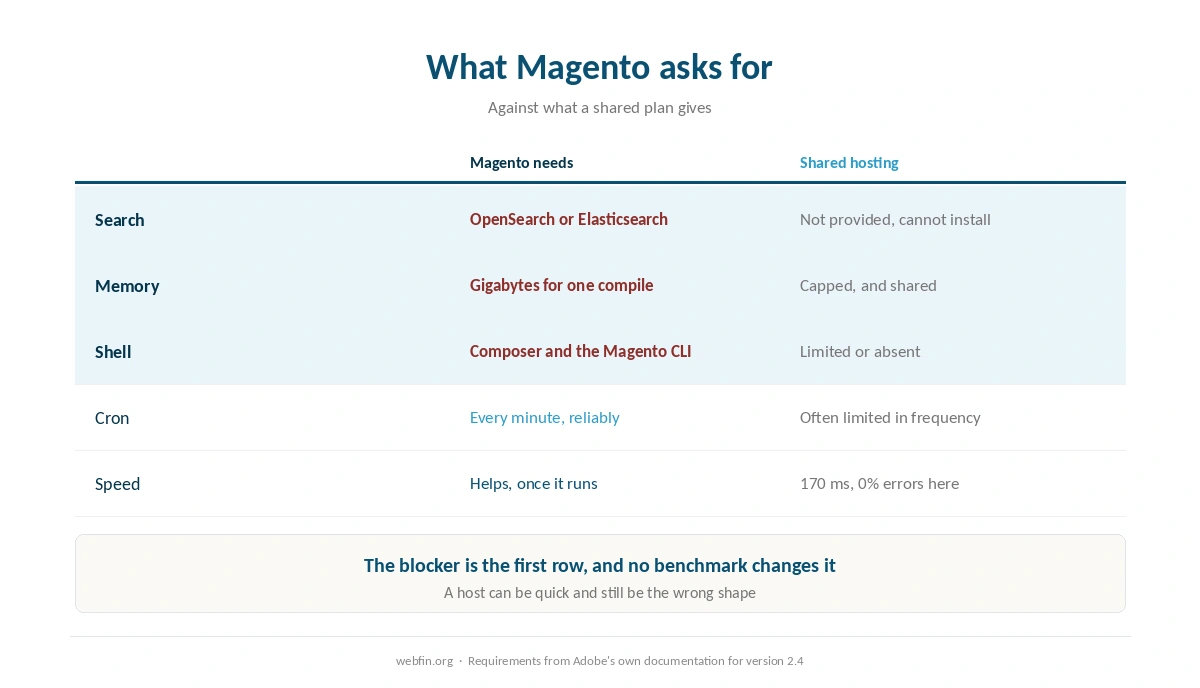
SiteGround measures better than most shared hosts we price. Its plan finished the 2026 load test at 170 ms with a 0% error rate and scores 8.4 of 10 on that project’s WordPress benchmark. None of that helps with Magento, and this is the useful part of the answer: Magento is not blocked by speed. It is blocked by architecture. It needs a separate search service, gigabytes of memory for one compile, Composer on the command line and cron every minute.
Is SiteGround Right for Magento? The Short Answer
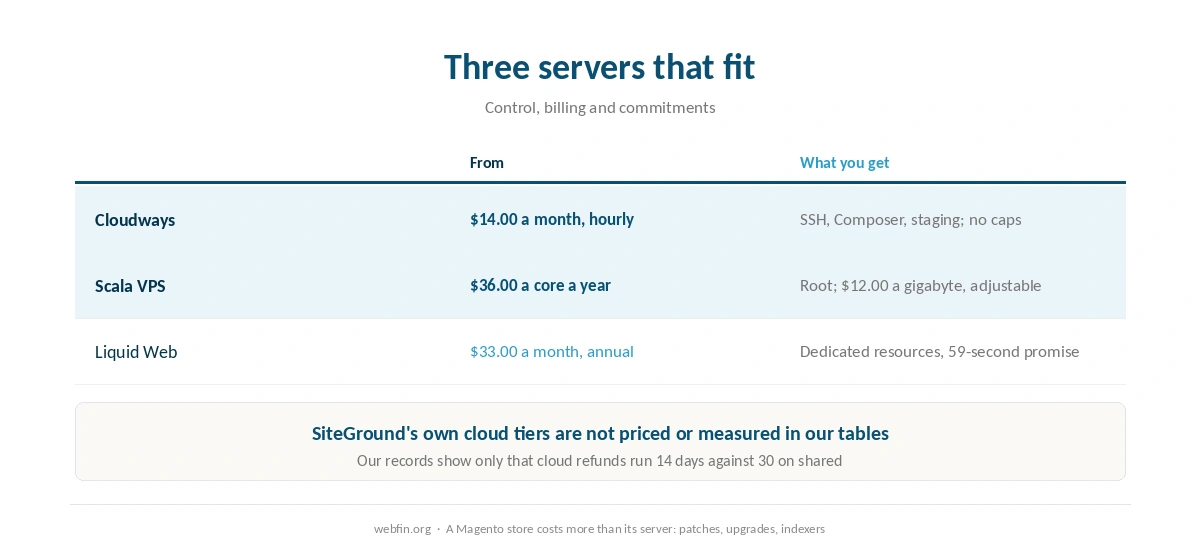
No, on its shared plans, and the reason is structural rather than about performance. Magento needs a server: memory you own, a search service running beside the store and root access. Cloudways from $14.00 a month, Scala’s VPS at $36.00 a year per processor core or Liquid Web from $33.00 a month are the shapes that fit. If your store is small, SiteGround plus WooCommerce is a better plan than Magento on a server nobody maintains.
What Magento Requires
A search service. Magento 2.4 requires OpenSearch or Elasticsearch. That is a separate service with its own memory, and a shared account cannot install it.
Gigabytes of memory for a compile. Adobe’s own guidance for building static content is measured in gigabytes, not megabytes.
The command line. Composer, the Magento CLI, reindexing and cache flushes all run from a shell.
Cron every minute. Indexers, emails and scheduled imports depend on it.
⚠️ Read that list again against any shared plan, at any price. The blocker is the first item, and no benchmark result changes it.
Why Good Figures Do Not Help Here
SiteGround’s load result describes a shared platform serving uncached pages well. That is exactly the figure that matters for WooCommerce, which is why our page on SiteGround for WooCommerce reaches the opposite conclusion.
Magento asks a different question. Before any page is served, the platform has to compile, index and search, and those steps need services a shared account does not run. A host can be quick and still be the wrong shape.
⚠️ This is worth remembering when reading marketing. “Optimized for ecommerce” means caching and a clean load result, both real. Neither satisfies Magento’s requirements.
What About SiteGround Cloud?
SiteGround sells cloud plans as well as shared ones. Our tables record them in exactly one place: the refund window runs 14 days on cloud against 30 on shared. We do not price its cloud tiers and no benchmark project we cite measures them.
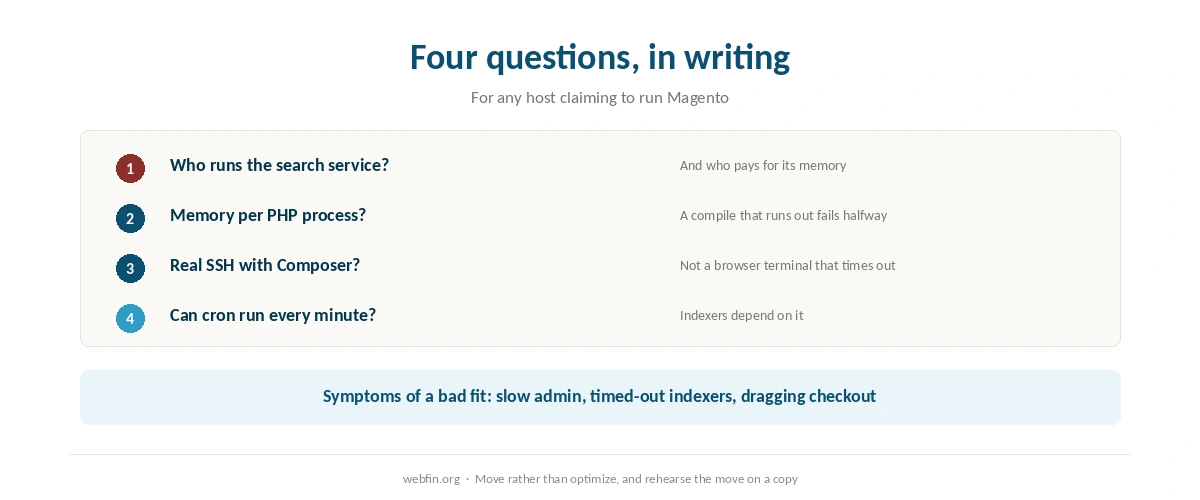
So we do not rate them here. If you are considering that route, ask the same four questions this page asks, in writing, before paying: search service, memory per process, real SSH, cron frequency. Our guide to reading a hosting agreement covers getting answers that count.
| Host | Refund window | What's excluded |
|---|---|---|
| DreamHost | 97 days by four sources, 30 by another | Disputed; confirm at checkout |
| InMotion | 90 days on 6-month terms and longer | 30 days monthly, VPS and reseller; no monthly billing on shared |
| ChemiCloud | 45 days | Domains and add-ons |
| HostGator | 45 days, all plans | Domains and add-ons |
| Hostinger | 30 days | Domain registration |
| SiteGround | 30 days on shared, 14 on cloud; renewals within 30 days of payment | Domains and third-party services; monthly plans reported excluded |
| Bluehost | 30 days | Add-ons, domains and professional services; $15.99 deducted for the free domain |
| Scala Hosting | 30 days, then a pro-rated refund of unused term | Domains and licenses |
| Namecheap | 30 days; EasyWP adds a 30-day trial with no card | Domains |
| InterServer | 30 days | Domains |
| GreenGeeks | 30 days | Domains and add-ons |
| IONOS | 30 days | Domains |
| Rocket.net | 30 days | Domains |
| GoDaddy | 30 days | Domains and some services |
| Kinsta | 30 days | Domains |
| WP Engine | Monthly billing; cancel before the next cycle | Not a refund window in the usual sense |
| Liquid Web | Monthly billing, no contract | Not a refund window in the usual sense |
| Cloudways | Pay-as-you-go; stop and the billing stops | Not a refund window in the usual sense |
| A2 Hosting | Disputed: anytime guarantee, or standard terms | Two 2026 sources in conflict |
| Hostwinds | Disputed: 30 days by one source, 3 by two others | Confirm in writing before paying |
What to Buy Instead
Cloudways. A managed server from $14.00 a month, billed by the hour, with SSH, Composer and staging on every tier. Uptime between 99.996% and 99.999% across five plans in the project we cite. Our Cloudways review covers each cloud.
Scala Hosting’s VPS. Root access, priced at $36.00 a year per processor core and $12.00 per gigabyte of memory, adjustable at any time. That is the clearest way to buy the memory a compile needs. Our Scala Hosting review covers the line.
Liquid Web. Managed VPS from $33.00 a month on annual billing, with dedicated resources on every managed tier and root. It commits to a 59-second support response and 100% network uptime backed by credits. Our Liquid Web review covers the disputes around those promises.
Our list of hosting for SaaS startups covers the same three from the application side.
The Honest Alternative: Stay and Change Platform
If you are on SiteGround and want to sell, WooCommerce runs on the plan you already have, and the load result is the reason to trust it with a checkout. Magento’s advantages are large catalogs, complex pricing rules and several storefronts.
With fifty products and one currency, those advantages cost more to host than they return. Our list of hosting for ecommerce ranks hosts by the test a checkout depends on. Our page on Hostinger for Magento reaches the same conclusion about a cheaper shared host.
Four Questions for Any Magento Host
Who runs the search service, and who pays for its memory? Either the host provides it or you run it on your own server.
How much memory per PHP process, and can it be raised? Get the figure in writing, because a compile that runs out of memory fails halfway.
Is there real SSH with Composer? Not a browser terminal that times out.
Can cron run every minute? Indexers depend on it, and shared panels often limit the frequency.
If a Store Is Already Half-Working
A Magento store forced onto shared hosting shows three symptoms: a slow admin panel, indexers that time out, and a checkout that drags under any load. None of those is a Magento bug.
Move rather than optimize, and size the server from the compile and the checkout rather than from a tier name. Our guide to moving from shared to VPS covers the sizing, and test the migration on a copy first, as our guide to setting up a staging site describes.
The Cost After the Server
Magento on a server is a commitment to maintenance: security patches, upgrades rehearsed on a copy, and indexers that need watching. That work does not exist on a shared plan, because the platform never ran there.
So price the time alongside the plan. If nobody on the team wants to maintain a server, the store is better served by simpler software on a host with a measured load result, and our guide to fixing a slow database covers the other half of what a growing store meets.
How We Research
We run no tests. SiteGround’s load result and WordPress benchmark come from Hostingstep’s October 2025 to May 2026 window. Refund terms, prices and support channels come from the providers’ own pages and from reviews published this year, read on 20 September 2026.
Magento’s requirements come from Adobe’s own documentation for version 2.4. SiteGround’s cloud tiers are not priced or measured in our tables, so we do not rate them, and we say so rather than guess. The criteria behind our scores are on our about page, and the full workings for this host are in our SiteGround review.
SiteGround for Magento FAQ
Not usefully. Magento 2.4 needs OpenSearch or Elasticsearch as a separate service, gigabytes of memory for a compile, Composer from a shell and cron every minute. A shared account provides none of those.
Because Magento is not blocked by speed. Its load result of 170 ms with no errors describes serving uncached pages well, which matters for WooCommerce. Magento needs services the platform does not run.
Our tables record them only through the refund window, which is 14 days on cloud against 30 on shared. We do not price or measure those tiers, so we do not rate them here. Ask the four questions in writing instead.
A server. Cloudways from $14.00 a month billed by the hour, or Scala’s VPS at $36.00 a year per core and $12.00 per gigabyte. Liquid Web starts at $33.00 a month with dedicated resources and root.
For a small store, usually yes. It runs on the plan you already have, and the load result covers the checkout. Magento earns its keep on large catalogs, complex pricing and multiple storefronts.
The Verdict
This is a recommendation against, and not a criticism of the host. SiteGround serves uncached pages better than most shared plans we price, and Magento still does not belong there, because the requirement it fails is a search service rather than a millisecond.
Buy a server sized to the compile and the checkout, or keep SiteGround and sell through WooCommerce instead. Both are sensible; installing Magento on a shared account is not. Our page on what web hosting costs prices the alternatives across three years.