
Disclosure: WebFin is reader-supported. If you buy hosting through links on this page, we may earn a commission at no extra cost to you. Commissions vary between providers and our ratings do not — here’s our full disclosure.
The usual framing is that a VPS is faster than shared hosting, and our own tables contradict it. In the 2026 load test GreenGeeks’ shared plan finished at 26 ms without an error, and Bluehost, a Newfold Digital brand, at 41 ms. The entry Cloudways server posted 288 ms with a 1.7% error rate on one cloud. Shared hosting is not slow. What you buy with a VPS is predictability, control and the right to run things a shared account forbids.
Shared vs VPS: The Short Answer
Stay on shared while your pages are mostly cacheable and the resource screen is quiet. Move to a VPS when you need root, background processes or a service beside the site. Move when uncached pages are most of your traffic, or when faults appear at peak hours. Expect to pay four to six times more: shared plans open at $2.50 to $3.99, and managed servers start at $14.00 a month.
What Actually Differs
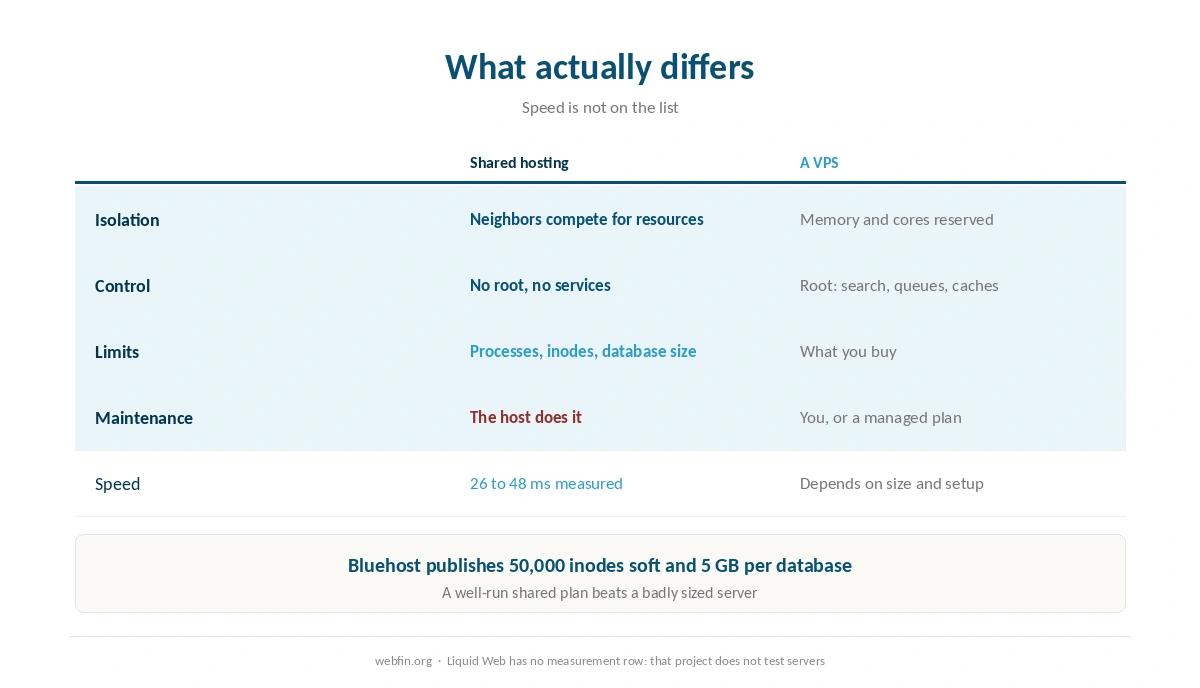
Isolation. On shared hosting your neighbors’ traffic competes with yours. A VPS reserves memory and processor share for your account alone.
Control. Root access means services: a search engine, a queue worker, a cache server, a cron schedule you choose. A shared account gives none of those.
Limits. Shared plans cap concurrent processes, inodes, database size and sometimes mail volume. Bluehost publishes 50,000 inodes soft and 5 GB per database, which our piece on what unlimited hosting means covers.
Responsibility. Somebody has to patch a server. On an unmanaged VPS that is you, and on a managed one it is the host, which is most of the price difference.
| Host and plan | Limit | Where it's stated |
|---|---|---|
| Bluehost shared | 50,000 inodes — soft limit | Hosting Inode Limit article |
| Bluehost shared | 200,000 inodes — AUP threshold | Server Resource Limitations |
| Bluehost shared | 1,000,000 inodes — TOS violation | Hosting Inode Limit article |
| Bluehost shared | 5,000 tables or 10 GB, all databases | Server Resource Limitations |
| Bluehost shared | 5 GB per single database | Server Resource Limitations |
| Bluehost Starter | 100 MB per mailbox | Shared hosting prices page |
| WP Engine Startup | 25,000 monthly visits, then overage handling | Plan pages |
| WP Engine, by tier | 25,000 to 400,000 monthly visits | Plan pages |
| Rocket.net Starter | 25,000 monthly visits, 1 site, 10 GB storage | Plan pages |
| Namecheap EasyWP | 50,000 / 200,000 / 500,000 monthly visits by tier | Plan pages |
| Kinsta Starter | 25,000 monthly visits | Plan pages |
| Scala Hosting VPS | Priced per unit: $3 per core, $1 per gigabyte | Plan pages; adjustable anytime |
| HostGator shared | Weekly backups described as a courtesy, not guaranteed | Hosting terms |
| Liquid Web | Dedicated resources at every tier; no shared plan | Plan pages |
| InterServer Standard | Unlimited storage, bandwidth, email and websites | One plan, no tiers |
| GreenGeeks Lite | One website only | Plan pages |
| IONOS Plus | One email account bundled per plan | Plan pages |
| Hostinger, all plans | Not published | Hostinger support article, 28 Aug 2026 |
| Bluehost Starter | 10 GB NVMe storage | Plan pages, as listed in a 2026 audit |
| InMotion Core | One site, 10 email accounts, SSD storage; NVMe from Launch | TechRadar and a 2026 review |
| SiteGround shared | Shell access by tier — not recorded | Not stated on the plan pages we read, 20 Sep 2026 |
| Bluehost shared | Shell access by tier — not recorded | Not stated on the plan pages we read, 20 Sep 2026 |
| Hostinger, all plans | Shell access by tier — not recorded | Not stated on the plan pages we read, 20 Sep 2026 |
| Cloudways servers | Search service (OpenSearch, Elasticsearch) — not recorded | Not stated on the plan pages we read, 20 Sep 2026 |
Speed Is Not the Reason
The 2026 load test ramps to 100 concurrent visitors. Among shared plans it recorded GreenGeeks at 26 ms, Bluehost at 41 ms and Scala Hosting at 48 ms, all without dropping a request.
Among servers the picture is mixed, because a server is only as good as its size and configuration. Cloudways held uptime between 99.996% and 99.999% across five plans. Its weakest published load result was 288 ms with a 1.7% error rate, on the Vultr High Frequency plan.
⚠️ So the honest summary is that a well-run shared plan beats a badly sized server. The Our guide to testing your site speed properly covers measuring that.
Four Signals It Is Time to Move
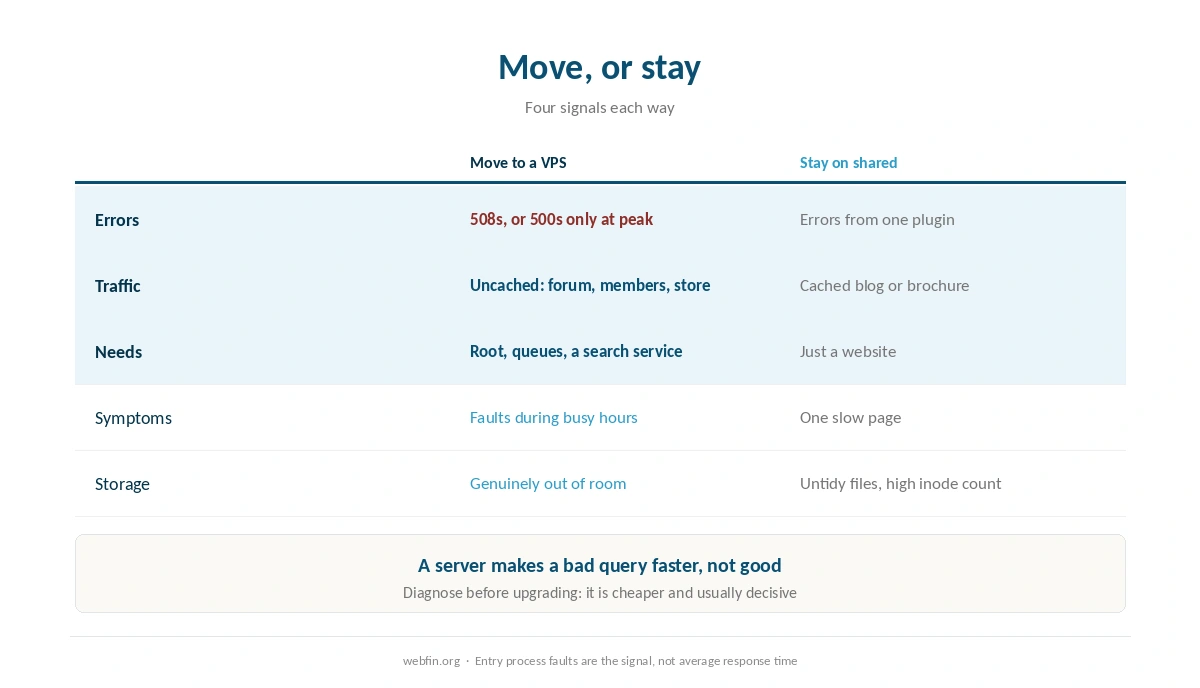
Resource faults at peak. Entry process limits reached during busy hours, which our guide to checking whether your host is throttling you shows how to confirm.
508 errors, or 500s only when busy. That is the plan talking rather than the code, which our guide to fixing a 500 error explains.
Uncached traffic dominates. A forum, a membership site or a busy store spends its day on pages no cache serves. Our list of hosting for forums covers that case.
You need a service, not a site. A search engine, a queue, a container: those are server features, and our list of hosting for SaaS startups covers them.
Three Signals to Stay
A cached site that feels slow. Fix caching and the front end first, which our guide to configuring caching covers in order.
One slow page or plugin. A server makes a bad query faster, not good. Our guide to fixing a slow database covers finding it.
Storage anxiety. Clean up, and check whether the real limit is file count rather than gigabytes.
What a VPS Costs, Three Ways
Per unit. Scala Hosting prices a processor core at $36.00 a year and a gigabyte of memory at $12.00, adjustable at any time, with root. That is the clearest way to buy exactly what you need.
By the hour. Cloudways runs a managed server on the cloud you choose from $14.00 a month, billed hourly. A busy week costs the hours it uses.
By the month, with commitments. Liquid Web from $33.00 a month on annual billing, with dedicated resources on every managed tier. It promises a 59-second support response and 100% network uptime backed by credits. Reviews this year dispute the response promise, and its monthly pricing is reported two ways in our sources.
Managed or Unmanaged
An unmanaged VPS is cheaper and assumes you will patch the operating system, configure the web server, install certificates and watch the logs. That is a real job, roughly an hour a month when nothing is wrong and a weekend when something is.
A managed VPS bundles that work. Cloudways, Scala and Liquid Web all sell managed servers, which is why their prices sit above a bare cloud instance. For most small businesses the managed version is the honest choice, and our guide to reading a hosting agreement covers checking exactly what “managed” includes.
The Move Itself
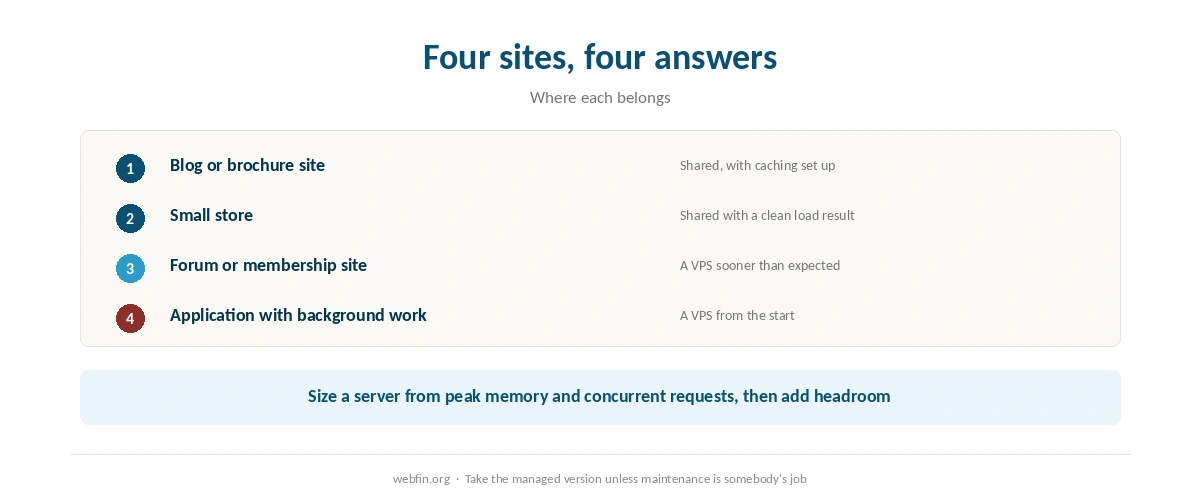
Size the server from two numbers: the memory your application needs at peak, and the concurrent requests your busiest hour produces. Then add headroom rather than buying the cheapest tier that fits.
Keep the old plan running for a week, move email deliberately, and test an uncached page before canceling anything. Our guide to moving from shared to VPS covers the order in detail.
Four Sites, Four Answers
A blog or brochure site. Shared, with caching set up properly. A VPS adds cost and homework, not speed.
A small store. Shared with a clean load result works; move when checkouts queue at peak, as our list of hosting for ecommerce covers.
A forum or membership site. A VPS sooner than you expect, because nothing caches for logged-in members.
An application with background work. A VPS from the start, because shared hosting forbids the parts that matter.
The Middle Option People Forget
Between a cheap shared plan and a server there is a bigger shared plan, and sometimes that is the right answer for a year. Higher tiers raise the process limits that were causing faults, without adding a maintenance job.
It is worth pricing that against a small VPS before deciding, because the tier upgrade is usually cheaper and always simpler. Our roundup of hosting for high traffic ranks the plans that hold up, and our guide to handling a traffic spike covers the day the decision becomes urgent.
How We Research
We run no tests. Load and uptime figures come from Hostingstep’s 2026 benchmarks, each with its window, including the Cloudways figures across five plans. Prices, resource units, published limits and support commitments come from the providers’ own pages, read on 20 September 2026, and sit in our tables.
Liquid Web has no measurement row because that project does not test servers, and its monthly price is recorded as disputed. Bare cloud providers priced per instance are outside what we review. The criteria behind our scores are on our about page.
Shared vs VPS FAQ
Not necessarily. In the 2026 load test GreenGeeks’ shared plan finished at 26 ms and Bluehost at 41 ms, both without errors. The entry Cloudways server posted 288 ms with 1.7% failures on one cloud. A VPS buys consistency and control.
When resource faults appear at peak hours, or when 508 errors show up. Also when uncached pages are most of your traffic, or when you need root for a service such as a search engine or a queue.
Roughly four to six times a cheap shared plan. Shared opens at $2.50 to $3.99 a month, while managed servers start at $14.00 at Cloudways and $33.00 at Liquid Web on annual billing.
Managed, unless somebody on the team wants to patch the operating system, configure the web server and watch the logs. That work is about an hour a month when nothing is wrong, and a weekend when something is.
Only if the bottleneck is capacity. A bad query, a heavy page or missing caching stays bad on a bigger server, which is why diagnosing first is cheaper than upgrading first.
The Verdict
Buy a VPS for control and predictability, not for milliseconds. Our own load figures show cheap shared plans finishing ahead of an entry-level server. Anyone moving purely for speed is likely to be disappointed by the bill.
The signals that justify the move are specific: faults at peak, uncached traffic, services that need root. When those appear, size the server from your own numbers and take the managed version unless maintenance is somebody’s job. Our page on what web hosting costs prices both sides across three years.