
Disclosure: WebFin is reader-supported. If you buy hosting through links on this page, we may earn a commission at no extra cost to you. Commissions vary between providers and our ratings do not — here’s our full disclosure.
What is cloud hosting? It is hosting that runs on a pool of servers rather than on one machine, so you can add or remove capacity as you need it and pay for what you use. That, at least, is the idea. In practice, hosts attach the word “cloud” to products that meet only part of it.
This guide uses the standard definition to test those products and shows what cloud hosting costs once you count three years.
What Is Cloud Hosting, by the Standard Definition
The most widely used definition comes from the US National Institute of Standards and Technology. Its Special Publication 800-145 describes cloud computing through five essential characteristics, three service models and four deployment models.
The five characteristics are on-demand self-service, broad network access, resource pooling, rapid elasticity and measured service. In other words, you provision capacity yourself, reach it over the network, share a pool, scale quickly and pay for measured use.
Testing a Hosting Plan Against the Definition
Run any “cloud” plan through the five characteristics. Can you resize it yourself, in minutes, without a ticket? Does billing follow use, or a fixed term? If the answer to both is no, the product is a server with a cloud label.
That is not necessarily bad. A fixed plan on cloud hardware can still be fast and reliable. However, the flexibility that justifies the word may be missing, so read the plan page rather than the product name.

Cloud Hosting Against a VPS and a Dedicated Server
A VPS is a fixed slice of one physical server, as our guide to VPS hosting explains. Cloud hosting, by contrast, draws on a pool, so the provider can move your server or grow it without tying it to one machine.
Our VPS vs cloud comparison sets out that line in detail. For the step beyond both, our dedicated vs cloud guide compares a whole machine with a cloud server.
Managed Cloud Hosting
Raw cloud servers leave the operating system and the stack to you. Managed cloud hosts, such as Cloudways, put a control panel and a support team on top, so you choose a server size without running the server yourself.
That trade is the same one our managed vs unmanaged guide describes for any server. Our Cloudways review covers one managed cloud host in depth.
What Cloud Hosting Costs
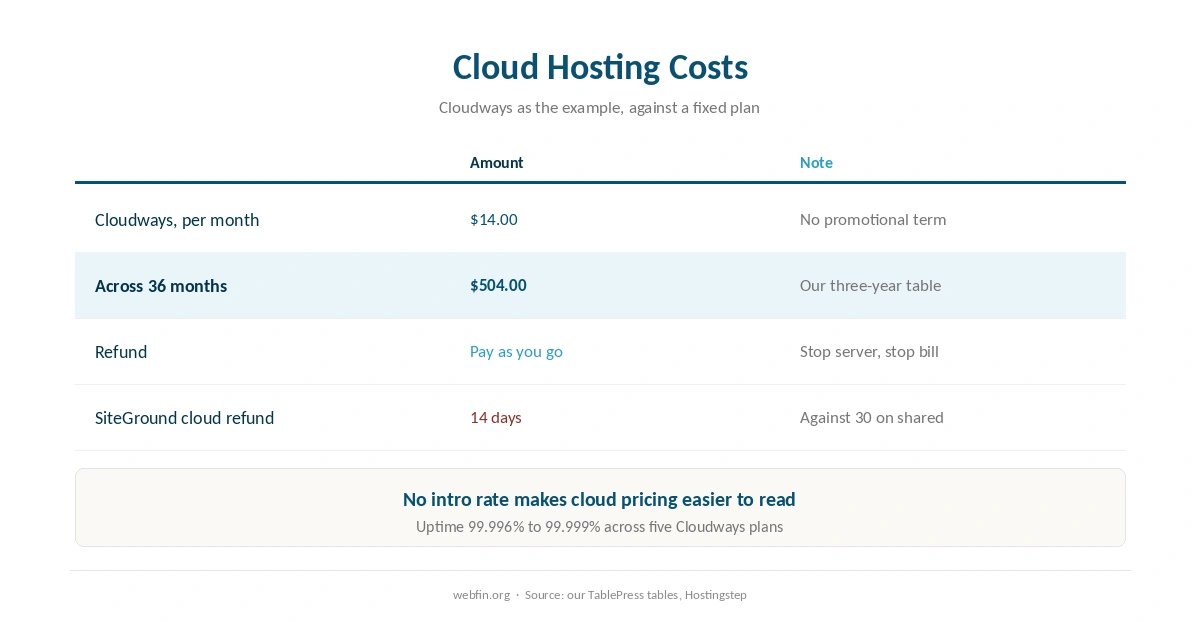
Cloudways’ pricing has no promotional term, which makes it easier to read. Cloudways starts at $14.00 a month with no intro rate, which is $504.00 across 36 months in our three-year table.
Billing also works differently. Cloudways bills as you go, so stopping the server stops the bill, rather than offering a refund window in the usual sense. SiteGround, meanwhile, gives 30 days on shared hosting but 14 on cloud. Our renewal price guide compares this with shared plans that rise at renewal.
| Host and plan | How it builds | 36-month total |
|---|---|---|
| ChemiCloud Starter, 36-month term | 36 prepaid months at $2.49 | $89.64 |
| InterServer Standard | 36 months at $2.50, price locked | $90.00 |
| DreamHost Launch, 48-month term | 36 of 48 prepaid months at $2.89 | $104.04 |
| Namecheap Stellar, 24-month term | 24 at $1.98, then 12 at $4.88 | $106.08 |
| Hostinger Premium, 48-month term | 36 of 48 prepaid months at $2.99 | $107.64 |
| HostGator Hatchling, 36-month term | 36 months at $3.75, renewal not reached | $135.00 |
| HostGator Hatchling, with daily backups | 36 at $3.75, plus CodeGuard at $35.88 a year | $242.64 |
| Bluehost Starter, 36-month term | 36 months at $3.99, renewal not reached | $143.64 |
| GoDaddy Economy, 36-month term | 36 months at $5.99, renewal not reached | $215.64 |
| GoDaddy Economy, with SSL from year two | 36 at $5.99, plus $119.99 in years two and three | $455.62 |
| Hostwinds Basic, annual | 12 at $4.54, then 24 at $6.99 | $222.24 |
| SiteGround StartUp, 24-month term | 24 at $2.99, then 12 at $14.99 | $251.64 |
| DreamHost Launch, annual | 12 at $2.89, then 24 at $10.99 | $298.44 |
| Scala Hosting Mini, annual | 12 at $2.95, then 24 at $11.95 | $322.20 |
| Bluehost Starter, 12-month term | 12 at $3.99, then 24 at $11.99 | $335.64 |
| IONOS Plus, annual | 12 at $1.00, then 24 at $14.00 | $348.00 |
| GreenGeeks Lite, 36-month prepay | 36 months at $2.95 | $106.20 |
| GreenGeeks Lite, annual | 12 at $2.95, then 24 at $13.95 | $370.20 |
| SiteGround StartUp, 12-month term | 12 at $2.99, then 24 at $17.99 | $467.64 |
| Cloudways, from | 36 months at $14.00, flat | $504.00 |
| A2 Hosting Turbo Boost, annual | 12 at $6.99, then 24 at $20.99 | $587.64 |
| Rocket.net Starter, annual | 12 at $25.00, then 24 at $30.00 | $1,020.00 |
| WP Engine Startup, annual | 12 at $27.00, then 24 at $35.00 | $1,164.00 |
| Liquid Web managed VPS | 36 months at $33.00 | $1,188.00 |
| Kinsta Starter | 36 months at $35.00, flat | $1,260.00 |
| InMotion Core, 36-month term | 36 months at $3.19, renewal not reached | $114.84 |
| InMotion Launch, 36-month term | 36 months at $4.99, renewal not reached | $179.64 |
| Cloudways email, five mailboxes, a month | 5 × $1.50 Rackspace / 5 × $1.99 Titan Pro | $7.50 / $9.95 |
| DreamHost Email, 5 mailboxes, annual | $1.67 × 5 × 12 | $100.20 a year |
| GoDaddy Economy, next 36-month term | Renewal shown in the cart at $15.32 a month | $551.63 |
| Google Workspace or Microsoft 365 middle plan, ten users | $14.00 a user × 10 × 12 months | $1,680 |
| Hostinger Business Starter, five mailboxes, one year after the trial | 5 × $1.59 × 12 | $95.40 |
| Hostinger VPS KVM 1, 24-month term | 24 at $6.49, then 12 at $11.99 | $299.64 |
| Hostinger VPS KVM 2, 24-month term | 24 at $8.99, then 12 at $14.99 | $395.64 |
| Hostinger Website Builder Premium, 48-month term | 36 of 48 prepaid months at $2.99 | $107.64 |
| IONOS VPS L, 1-year term | 6 at $10.00, then 30 at $15.00 | $510.00 |
| IONOS VPS M, 1-year term | 6 at $6.00, then 30 at $8.00 | $276.00 |
| IONOS VPS XS | 36 at $2.00 | $72.00 |
| Suite middle plan, five users | $14.00 a user × 5, a month | $70.00 |
| Zoho Mail Lite, five users | $1.00 a user × 5, a month | $5.00 |
Uptime on Cloud Plans
Pooling should help uptime, because a failed machine can hand its work to another. Hostingstep’s figures for Cloudways show 99.996% to 99.999% uptime across five plans between October 2025 and May 2026.
Those are strong results, but they cover one host’s plans in one window. Our guide on reading a hosting uptime report explains why the window matters as much as the figure.
Who Cloud Hosting Suits
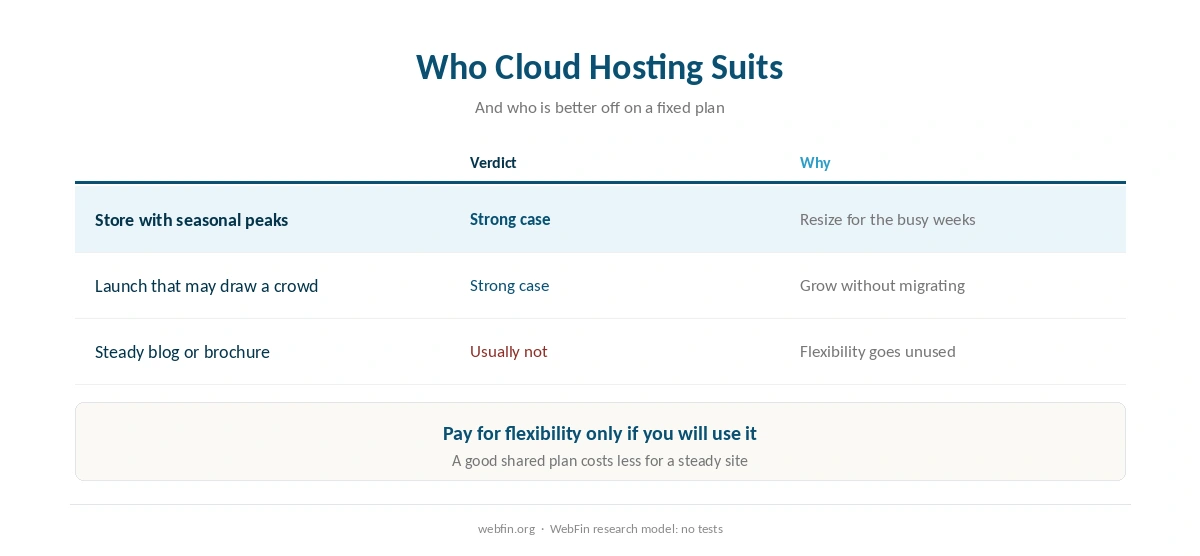
Cloud hosting suits sites whose load changes a lot, such as a store with seasonal peaks or a launch that may draw a crowd. It also suits teams that want to resize without migrating. Our guides on handling a traffic spike and high-traffic hosting cover those cases.
For a steady blog or brochure site, though, the flexibility goes unused. A good shared plan, as our guide to choosing a hosting plan explains, will usually cost less for the same result.
Moving to the Cloud
Treat the move as a migration. Copy the site, test it on the new server and only then point the domain. Our guide on migrating web hosting walks through it.
After the move, set up monitoring so you learn about problems first. Our guide to uptime monitoring covers the tools, and our guide to website speed test tools shows how to compare before and after.
Moreover, this guide covers related questions: What Is Web Hosting.
How We Research
We run no tests. The definition comes from NIST Special Publication 800-145. Prices, refunds and uptime figures come from our TablePress tables, which we last checked against the hosts’ pages in September 2026.
Where a figure covers only one host or one window, we say so. The criteria behind our scores are on our about page.
What Is Cloud Hosting: FAQ
Hosting that runs on a pool of servers, so you can add or remove capacity as needed and pay for what you use.
A VPS is a fixed slice of one server, while cloud hosting draws on a pool and can grow or move without being tied to one machine.
No. NIST defines cloud computing by five characteristics, and a plan without self-service resizing or usage billing meets only part of it.
Cloudways starts at $14.00 a month with no promotional term, which is $504.00 across 36 months.
Terms differ. Cloudways bills as you go, so stopping the server stops the bill, while SiteGround gives 14 days on cloud.
The Verdict
Cloud hosting means a pool of servers that you can resize and pay for by use, at least by the NIST definition. Many products carry the name while offering only some of that, so test the plan against the definition.
It is worth paying for when your load changes and you want to resize quickly. Otherwise, a fixed plan, shared or VPS, usually delivers the same result for less.