
Disclosure: WebFin is reader-supported. If you buy hosting through links on this page, we may earn a commission at no extra cost to you. Commissions vary between providers and our ratings do not — here’s our full disclosure.
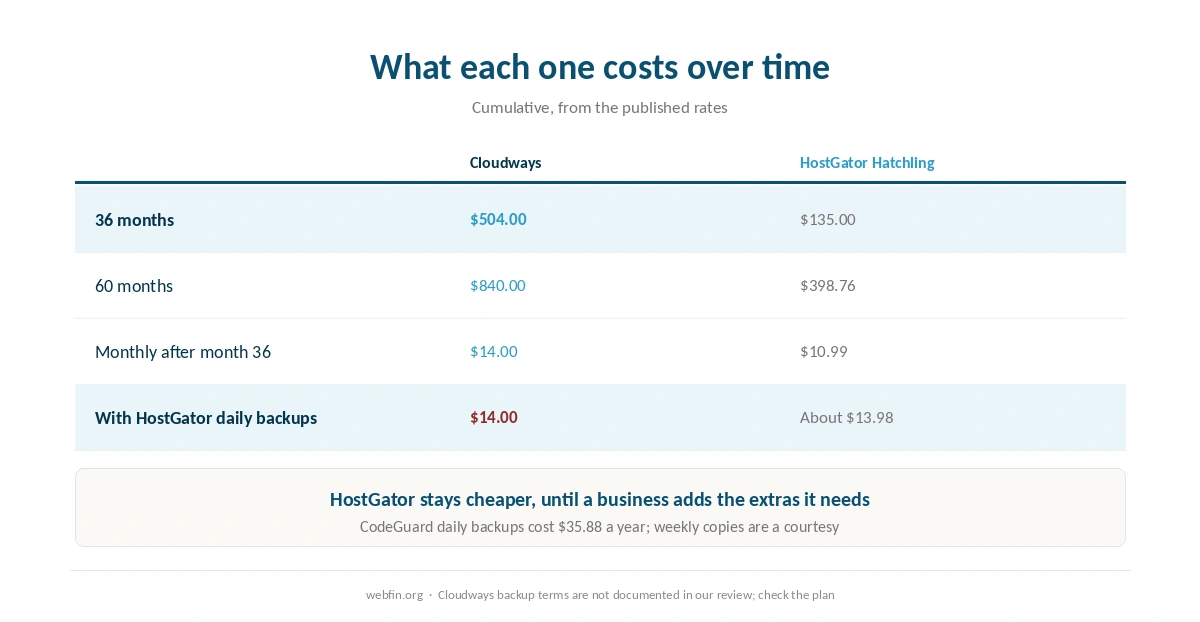
Cloudways vs HostGator sets a managed cloud server against one of the cheapest shared plans from a large hosting group. HostGator Hatchling costs $135.00 across 36 months and renews at $10.99; Cloudways costs $504.00 over the same stretch at a flat $14.00. That is nearly four times the price for the first three years. What the difference buys shows up in uptime. Cloudways held 99.996% or better across five plans in the benchmark project we cite. HostGator recorded 99.68%, which is more than a day of downtime a year. The same HostGator figures against Kinsta are in our Kinsta and HostGator comparison.
Cloudways vs HostGator: The Short Answer
Cloudways, at 4.1 against 3.2 in our reviews, for any site where downtime costs something. HostGator is the choice for a budget site that wants a phone line, a 45-day refund window and the lowest three-year bill, and can live with weaker uptime.
Head to Head
| Criterion | Cloudways | HostGator Hatchling |
|---|---|---|
| Product | Managed cloud server | Shared hosting |
| Price | $14.00/mo flat | $3.75/mo for 36 months, then $10.99 |
| 36 months | $504.00 | $135.00 |
| Uptime | 99.996% to 99.999% | 99.68% |
| Global time to first byte | Varies by cloud | 1.23 s |
| Under load | 288 ms at 1.7% errors, 100 users | 762 ms at 500 users |
| Daily backups | Not documented in our review | CodeGuard, $35.88 a year |
| Billing | Hourly, no contract | Prepaid term |
| Refund window | Billing stops when you stop | 45 days |
| Support | Chat and tickets; phone as a paid add-on | Phone, chat and tickets |
| Owner | DigitalOcean, 2022 | Newfold Digital, 2021 |
| Our score | 4.1 | 3.2 |
Nearly Four Times the Price, at First
HostGator Hatchling bills 36 months at $3.75, which is $135.00, and renews at $10.99, which is 2.9× over 36 months. Cloudways bills $14.00 from the first month to the last with no promotional term, which is $504.00 across the same stretch. For three years the shared plan is the far cheaper buy.
After that the gap narrows sharply. HostGator’s renewal of $10.99 sits three dollars below Cloudways, and HostGator describes its weekly backups as a courtesy rather than a guarantee. Add its CodeGuard daily backups at $35.88 a year and the monthly figure lands within two cents of Cloudways’ flat rate. Our page on hidden hosting fees lists HostGator’s extras.
⚠️ HostGator also places SiteLock in the cart pre-selected at $23.88, so read the checkout before paying. Cloudways’ backup terms are not documented in our review, so check what its plan includes rather than assume parity. Our page on hosting renewal prices puts both renewals beside the field.
| Host and plan | How it builds | 36-month total |
|---|---|---|
| ChemiCloud Starter, 36-month term | 36 prepaid months at $2.49 | $89.64 |
| InterServer Standard | 36 months at $2.50, price locked | $90.00 |
| DreamHost Launch, 48-month term | 36 of 48 prepaid months at $2.89 | $104.04 |
| Namecheap Stellar, 24-month term | 24 at $1.98, then 12 at $4.88 | $106.08 |
| Hostinger Premium, 48-month term | 36 of 48 prepaid months at $2.99 | $107.64 |
| HostGator Hatchling, 36-month term | 36 months at $3.75, renewal not reached | $135.00 |
| HostGator Hatchling, with daily backups | 36 at $3.75, plus CodeGuard at $35.88 a year | $242.64 |
| Bluehost Starter, 36-month term | 36 months at $3.99, renewal not reached | $143.64 |
| GoDaddy Economy, 36-month term | 36 months at $5.99, renewal not reached | $215.64 |
| GoDaddy Economy, with SSL from year two | 36 at $5.99, plus $119.99 in years two and three | $455.62 |
| Hostwinds Basic, annual | 12 at $4.54, then 24 at $6.99 | $222.24 |
| SiteGround StartUp, 24-month term | 24 at $2.99, then 12 at $14.99 | $251.64 |
| DreamHost Launch, annual | 12 at $2.89, then 24 at $10.99 | $298.44 |
| Scala Hosting Mini, annual | 12 at $2.95, then 24 at $11.95 | $322.20 |
| Bluehost Starter, 12-month term | 12 at $3.99, then 24 at $11.99 | $335.64 |
| IONOS Plus, annual | 12 at $1.00, then 24 at $14.00 | $348.00 |
| GreenGeeks Lite, 36-month prepay | 36 months at $2.95 | $106.20 |
| GreenGeeks Lite, annual | 12 at $2.95, then 24 at $13.95 | $370.20 |
| SiteGround StartUp, 12-month term | 12 at $2.99, then 24 at $17.99 | $467.64 |
| Cloudways, from | 36 months at $14.00, flat | $504.00 |
| A2 Hosting Turbo Boost, annual | 12 at $6.99, then 24 at $20.99 | $587.64 |
| Rocket.net Starter, annual | 12 at $25.00, then 24 at $30.00 | $1,020.00 |
| WP Engine Startup, annual | 12 at $27.00, then 24 at $35.00 | $1,164.00 |
| Liquid Web managed VPS | 36 months at $33.00 | $1,188.00 |
| Kinsta Starter | 36 months at $35.00, flat | $1,260.00 |
| InMotion Core, 36-month term | 36 months at $3.19, renewal not reached | $114.84 |
| InMotion Launch, 36-month term | 36 months at $4.99, renewal not reached | $179.64 |
What the Uptime Gap Means
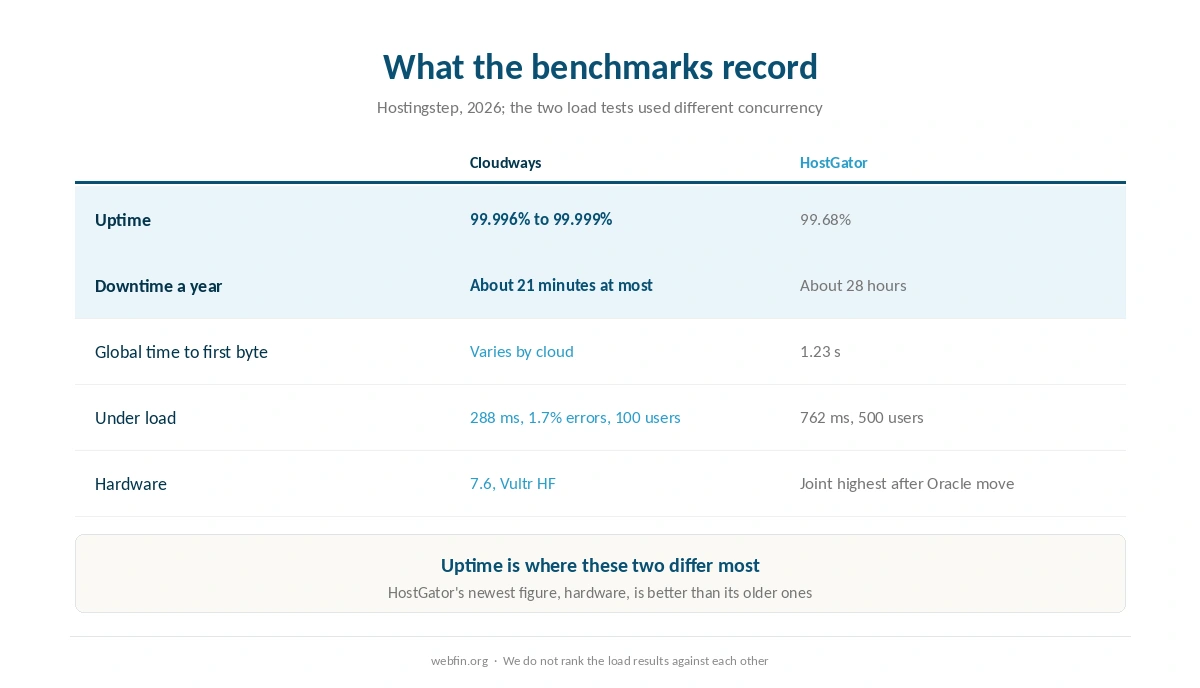
We run no tests, so these figures belong to Hostingstep. Cloudways held between 99.996% and 99.999% across five plans from October 2025 to May 2026. HostGator recorded 99.68% in its 2026 review. A year holds 525,600 minutes, so 99.68% allows about 28 hours of downtime, against about 21 minutes at 99.996%.
That is the clearest difference between these hosts, and it matters for any site that takes orders, bookings or leads. For a hobby blog, a day of downtime spread across a year may be an acceptable price for a much lower bill. For a business, it rarely is. Our guide to reading an uptime report explains how to weigh figures like these.
Which Sites Can Live With 99.68%
A personal blog, a hobby project or a portfolio that is rarely visited can absorb a day of downtime spread across a year. Nobody loses money, and a visitor who finds the site down at an odd hour may simply try again. For sites like these, the lower bill is a fair trade.
A shop, a booking page or a site that brings in leads is different. Downtime there is counted in orders and enquiries that went elsewhere, and it can be noticed by exactly the people you most want to impress. For those sites the uptime record is the first line to read, as our list of hosting for ecommerce explains.
Speed and Load, With Different Tests
HostGator records a global time to first byte of 1.23 seconds, slow for a page that must load before anything else. Under load, its review reports 762 ms at 500 concurrent users. Cloudways on its Vultr High Frequency plan served the standard test of 100 users at 288 ms with a 1.7% error rate.
⚠️ Those load figures come from tests at different concurrency, so they are not a direct comparison, and we do not rank one above the other on load. One more HostGator finding points the other way. The same project’s September 2026 update puts its hardware joint highest in the field after a move to Oracle Cloud, a recent improvement worth watching. Our guide to reducing TTFB explains what drives the first-byte figure.
A Recent Change at HostGator
HostGator’s uptime and first-byte figures come from its 2026 review, while its hardware result comes from the project’s September update, after Newfold moved Bluehost and HostGator onto Oracle Cloud. Its sister brand Bluehost improved sharply in the same move, passing the load test at 41 ms without an error. Our comparison of SiteGround against HostGator covers another managed rival.
So HostGator is a host whose newest figure is better than its older ones. A buyer who can wait a few months will see whether the uptime follows the hardware. A buyer choosing today should weigh the uptime that has been counted rather than the improvement that is expected.
What Cloudways Is, and What It Leaves Out
Cloudways runs a managed server on the cloud provider you choose, and handles the operating system, patches and security. SSH, WP-CLI, Git deployment, staging and PHP version selection ship on every tier, and billing runs by the hour, so stopping the server stops the bill. DigitalOcean has owned it since 2022.
It leaves out things a shared host includes. There is no cPanel and no email; mailboxes come through Rackspace at about a dollar each per month. Phone support is a paid add-on. For a first site those gaps matter, and our list of hosting for beginners weighs them.
What HostGator Includes, and What It Sells
HostGator runs cPanel, answers phone, chat and tickets around the clock, and refunds for 45 days on all plans, excluding domains and add-ons. For a non-technical owner, a phone line and six weeks to change your mind are real advantages that Cloudways does not match.
It also sells a long list of extras: daily backups, SiteLock, a dedicated IP at $59.40 and professional migration at $149.99. None are required, and each one moves the real price toward Cloudways. Our guide to understanding cPanel covers the panel side.
The Five-Year View
Over five years HostGator stays the cheaper host even after it renews, because its $10.99 sits below Cloudways’ $14.00. At sixty months Hatchling totals less than half of what Cloudways does. The difference shrinks only as you add extras. A business that needs daily backups at HostGator ends up paying close to the Cloudways rate every month after the promotion.
Moving From One to the Other
The common path runs from shared hosting to a cloud server as a site grows. Cloudways provides a migration plugin that automates the transfer from a WordPress site, and HostGator sells professional migration in the other direction at $149.99. Either way, the domain can stay where it is and simply point at the new server.
Our guide to moving from shared to VPS covers the signals that it is time. Our guide to migrating web hosting covers the order that keeps the site online, and the domain never has to move with it.
The 45-day window deserves a note of its own. It is longer than the usual 30, which gives time to move a real site, run it through a normal month and decide. Domains and add-ons sit outside it. A buyer who ticks SiteLock or CodeGuard at checkout should expect those charges to stay even if the hosting is refunded. Our guide to canceling hosting and getting a refund covers the order.
Who Owns Them
DigitalOcean acquired Cloudways in 2022, putting a managed layer on top of one of the clouds it sells. HostGator has belonged to Newfold Digital since 2021, alongside Bluehost and Yoast SEO, and who owns Bluehost traces that group.
Neither ownership decides service quality. It does shape how each earns: DigitalOcean from the servers underneath, Newfold from a portfolio of shared brands and the extras sold alongside them.
Where Each One Is Weakest
HostGator is weakest on uptime and first-byte time. A record of 99.68% and a global figure of 1.23 seconds are the numbers that most separate it from the cloud option. Its extras also erode the price advantage once you add the ones a business needs.
Cloudways is weakest on price in the first three years and on what it leaves out: no email, no cPanel, and phone support only as an add-on. Its weakest load result, on one cloud, showed a 1.7% error rate. Our Cloudways review covers each cloud.
Winners by Category
Three-year price: HostGator, at $135.00 against $504.00. Uptime: Cloudways, at 99.996% or better against 99.68%. First-byte time: Cloudways, against 1.23 seconds. Billing flexibility: Cloudways, hourly. Refund window: HostGator, at 45 days. Phone support: HostGator, included. Email: HostGator, as a shared host; Cloudways needs a separate provider.
When to Choose HostGator Instead
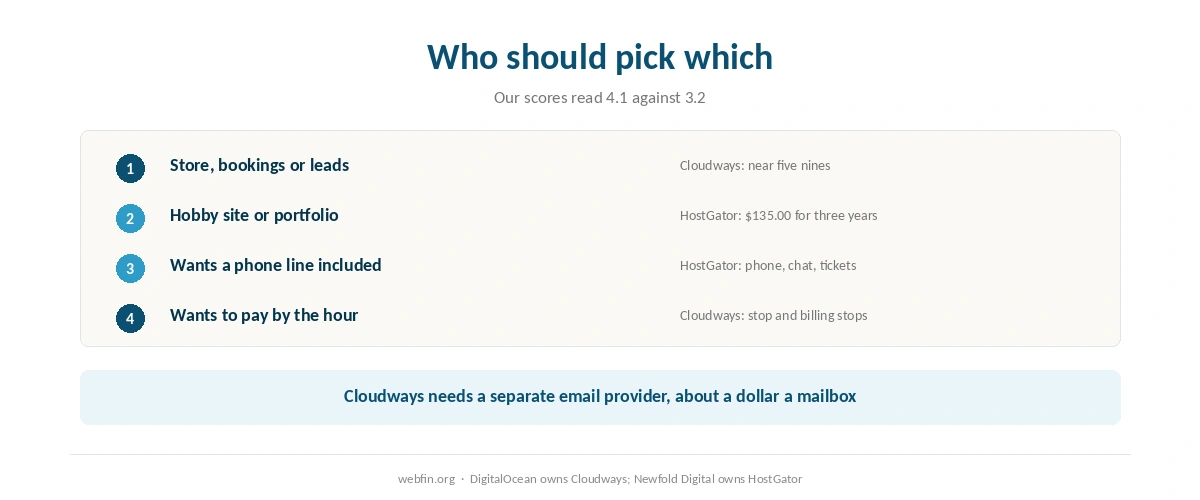
Take HostGator for a personal site or a small project where the lowest three-year bill and a phone line matter more than uptime. It works best if you decline the extras. Watch whether its recent hardware improvement shows up in the uptime figures. Our comparison of Bluehost against HostGator weighs it against its sister brand, which records far stronger uptime.
Take Cloudways for a business site, a store, or anything where a day of downtime a year is too much. Our comparison of Cloudways against GoDaddy sets it against another budget brand.
How We Research
We run no tests. Uptime, response and load figures come from Hostingstep’s 2026 benchmarks, reviews and its September update, each with its window. We note where two load tests used different concurrency. Prices and extras come from the providers’ own pages, read on 20 September 2026.
Where our review does not document a feature, as with Cloudways backups, we say so rather than assume it. The criteria behind our scores are on our about page, and the full workings are in our HostGator review.
Cloudways vs HostGator FAQ
HostGator, by a wide margin for three years: $135.00 against $504.00 on Hatchling’s 36-month term. After that it renews at $10.99 against Cloudways’ flat $14.00, and adding its daily backup service brings it within two cents of Cloudways.
It recorded 99.68% uptime in the 2026 review we cite, about 28 hours of downtime a year. Cloudways held 99.996% to 99.999% across five plans. The same project reports a recent hardware improvement at HostGator after a move to Oracle Cloud.
No. Mailboxes come through Rackspace at about a dollar each per month, billed separately. HostGator, as a shared host with cPanel, handles email within the account.
HostGator on channels, with phone, chat and tickets around the clock included. Cloudways answers chat and tickets and sells phone support as an add-on. Neither publishes a measured response time.
DigitalOcean has owned Cloudways since 2022. HostGator has belonged to Newfold Digital since 2021, alongside Bluehost and Yoast SEO.
The Verdict
Cloudways takes this, at 4.1 against 3.2, because uptime is where these hosts differ most and where the difference costs a business money. Near five nines against 99.68% is the gap between minutes and more than a day of downtime a year.
HostGator is the cheaper buy for three years and the friendlier one for a non-technical owner, with a phone line and 45 days to decide. For a hobby site that trade can make sense. For anything that earns, the cloud server is worth the difference. Our page on what web hosting costs runs both totals further.