
Disclosure: WebFin is reader-supported. If you buy hosting through links on this page, we may earn a commission at no extra cost to you. Commissions vary between providers and our ratings do not — here’s our full disclosure.
Cloudways vs GreenGeeks has two facts that decide most of it. GreenGeeks’ shared plan served the benchmark load test at 26 ms without an error, while Cloudways’ weakest published cloud served it at 288 ms with a 1.7% error rate. And GreenGeeks renews at $13.95, five cents below the flat $14.00 Cloudways charges from month one. So the whole price difference sits in the first term: $106.20 against $504.00 across 36 months. After that, the two cost almost exactly the same. For the same host against Hostinger, see Hostinger vs GreenGeeks.
Cloudways vs GreenGeeks: The Short Answer
Cloudways, at 4.1 against 3.7 in our reviews, on uptime, hardware and flexibility. GreenGeeks is the better buy for the first three years, handled the load test better, includes email and a shell on shared hosting, and backs a documented environmental commitment. From month 37 the monthly bills are level.
Head to Head
| Criterion | Cloudways | GreenGeeks Lite |
|---|---|---|
| Product | Managed cloud server | Shared hosting with cPanel |
| Price | $14.00/mo flat | $2.95/mo, then $13.95 |
| 36 months, prepaid term | $504.00 | $106.20 |
| Renewal | $14.00 | $13.95, five cents less |
| Load test | 288 ms at 1.7% errors | 26 ms, no errors |
| Server hardware | 7.6, Vultr HF | 5.0 of 10 |
| Uptime | 99.996% to 99.999%, five plans | 25 outages counted |
| Not included | Included with cPanel | |
| Developer tools | SSH, WP-CLI, Git, staging | SSH, Git, WP-CLI on shared |
| Billing | Hourly, no contract | Prepaid term |
| Owner | DigitalOcean, 2022 | Founder-led, independent |
| Our score | 4.1 | 3.7 |
All the Price Difference Is in the First Term
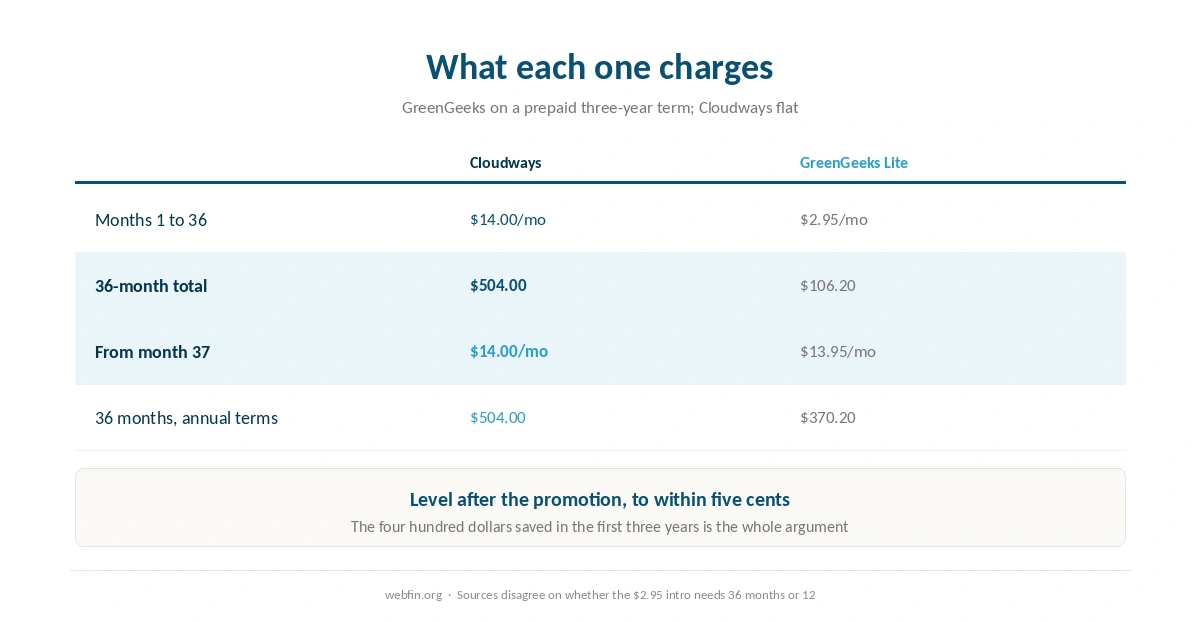
GreenGeeks Lite opens at $2.95 and renews at $13.95, which is 4.7× after one term. On a three-year prepayment the first 36 months come to $106.20. Cloudways charges $14.00 from the first month with no promotional term, which is $504.00 over the same stretch.
From month 37 the two are level: $13.95 against $14.00. So a buyer staying for years is not choosing on the monthly bill at all after the promotion, and the four hundred dollars saved in the first three years is the whole financial argument. Our page on hosting renewal prices records both.
⚠️ Two cautions. GreenGeeks raised its Lite renewal to $13.95 this year, and sources disagree on whether the $2.95 intro needs a 36-month or a 12-month term. On annual terms the three-year total is $370.20, because 24 of those months are billed at the renewal rate. Check the term in the cart.
| Host and plan | How it builds | 36-month total |
|---|---|---|
| ChemiCloud Starter, 36-month term | 36 prepaid months at $2.49 | $89.64 |
| InterServer Standard | 36 months at $2.50, price locked | $90.00 |
| DreamHost Launch, 48-month term | 36 of 48 prepaid months at $2.89 | $104.04 |
| Namecheap Stellar, 24-month term | 24 at $1.98, then 12 at $4.88 | $106.08 |
| Hostinger Premium, 48-month term | 36 of 48 prepaid months at $2.99 | $107.64 |
| HostGator Hatchling, 36-month term | 36 months at $3.75, renewal not reached | $135.00 |
| HostGator Hatchling, with daily backups | 36 at $3.75, plus CodeGuard at $35.88 a year | $242.64 |
| Bluehost Starter, 36-month term | 36 months at $3.99, renewal not reached | $143.64 |
| GoDaddy Economy, 36-month term | 36 months at $5.99, renewal not reached | $215.64 |
| GoDaddy Economy, with SSL from year two | 36 at $5.99, plus $119.99 in years two and three | $455.62 |
| Hostwinds Basic, annual | 12 at $4.54, then 24 at $6.99 | $222.24 |
| SiteGround StartUp, 24-month term | 24 at $2.99, then 12 at $14.99 | $251.64 |
| DreamHost Launch, annual | 12 at $2.89, then 24 at $10.99 | $298.44 |
| Scala Hosting Mini, annual | 12 at $2.95, then 24 at $11.95 | $322.20 |
| Bluehost Starter, 12-month term | 12 at $3.99, then 24 at $11.99 | $335.64 |
| IONOS Plus, annual | 12 at $1.00, then 24 at $14.00 | $348.00 |
| GreenGeeks Lite, 36-month prepay | 36 months at $2.95 | $106.20 |
| GreenGeeks Lite, annual | 12 at $2.95, then 24 at $13.95 | $370.20 |
| SiteGround StartUp, 12-month term | 12 at $2.99, then 24 at $17.99 | $467.64 |
| Cloudways, from | 36 months at $14.00, flat | $504.00 |
| A2 Hosting Turbo Boost, annual | 12 at $6.99, then 24 at $20.99 | $587.64 |
| Rocket.net Starter, annual | 12 at $25.00, then 24 at $30.00 | $1,020.00 |
| WP Engine Startup, annual | 12 at $27.00, then 24 at $35.00 | $1,164.00 |
| Liquid Web managed VPS | 36 months at $33.00 | $1,188.00 |
| Kinsta Starter | 36 months at $35.00, flat | $1,260.00 |
| InMotion Core, 36-month term | 36 months at $3.19, renewal not reached | $114.84 |
| InMotion Launch, 36-month term | 36 months at $4.99, renewal not reached | $179.64 |
The Cheaper Plan Handled Load Better
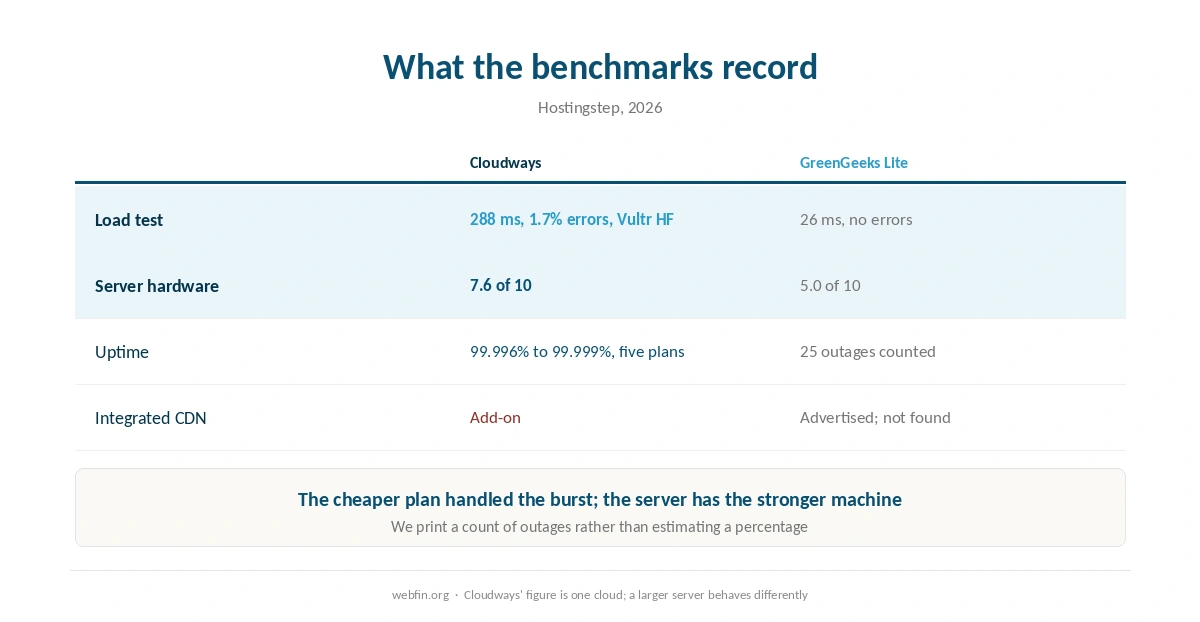
We run no tests, so these figures belong to Hostingstep. Its load test ramps to 100 concurrent visitors over 60 seconds. GreenGeeks finished at 26 ms without an error, a shade quicker than the 27 ms WP Engine posted. Cloudways on its Vultr High Frequency plan finished at 288 ms with a 1.7% error rate, its weakest published result.
Hardware reverses that. Cloudways scores 7.6 of 10 on the plan tested, and GreenGeeks scores 5.0, which limits heavy uncached work even when a burst of visitors is handled well. Uptime favors Cloudways too: 99.996% to 99.999% across five plans, against 25 outages counted for GreenGeeks in its window, with no percentage in our table to pair with them.
⚠️ The Cloudways figure is for one cloud, and a larger server on another would behave differently. That is the Cloudways argument as well as its caveat: you can buy more capacity by the hour. Our guide to reading an uptime report explains why a count of outages matters alongside a percentage.
What GreenGeeks Includes
GreenGeeks runs cPanel, so email lives in the account and every tutorial matches the screen. It also includes SSH, Git and WP-CLI on shared plans, which is more than the price tier suggests and the reason it appears in our list of hosting for developers. Lite allows one website.
Its environmental claim is documented rather than decorative: wind energy credits equal to three times its electricity use through the Bonneville Environmental Foundation, and EPA Green Power Partner records since 2009. It is an offset, not a green power source, and our GreenGeeks review explains the difference.
⚠️ One finding cuts the other way. The benchmark project reports finding no integrated content network on GreenGeeks, although GreenGeeks advertises Cloudflare integration on all plans. Check your own dashboard, and our guide to setting up a CDN covers adding one.
What Cloudways Includes, and Leaves Out
Cloudways runs a managed server on the cloud you choose. SSH, WP-CLI, Git deployment, staging and PHP version selection ship on every tier, and it runs any PHP application rather than WordPress alone. Billing is by the hour, so stopping the server stops the bill, and you can resize it when traffic grows.
It leaves out email and cPanel. Mailboxes come through Rackspace at about a dollar each per month, and phone support is a paid add-on. For a small business those are real costs on top of the $14.00; for a developer they are minor.
The Same Monthly Bill, Two Different Products
From month 37 the interesting question is not price but shape. For $13.95 GreenGeeks gives a shared account with email, cPanel and one site, on hardware that scores 5.0. For $14.00 Cloudways gives a server you size yourself, on a cloud you choose, with no visit caps and stronger measured uptime. A shared plan against the same server is priced in Hostinger vs Cloudways.
A brochure site or a blog behind a page cache will not feel the hardware gap, and the email included at GreenGeeks is worth more than the difference. A store, a membership site or an application will feel it, and the server is the better home. Our list of hosting for ecommerce covers the uncached case.
Commitment and Leaving
GreenGeeks asks for a prepaid term for its best rate and refunds within 30 days, excluding domains and add-ons. Cloudways asks for nothing in advance. For a project that may end within months, hourly billing is worth part of the difference.
Leaving is easier from GreenGeeks, because a cPanel account exports in a standard format that another cPanel host can import. Cloudways has its own console, so moving away means moving each site. Our guide to migrating web hosting covers both routes.
Growing Past the Entry Plan
GreenGeeks Lite allows one website, so a second site means a higher tier and a higher renewal. Cloudways puts several applications on one server, and the limit is what the server can serve rather than a count. Our list of hosting for multiple sites compares the two shapes across the field.
A single site that stays single never meets the tier limit. Anyone who adds projects meets it within a year, and it decides the bill, so check it before the prepayment rather than after.
A First Site, Specifically
For someone building a first site, GreenGeeks is the gentler start: email in the same account, cPanel that matches every tutorial, and a bill small enough to make mistakes on. Our list of hosting for beginners weighs the same trade across more hosts.
Cloudways assumes you are comfortable choosing a cloud, sizing a server and arranging email elsewhere. Our guide to understanding cPanel covers the panel you would be leaving behind.
Who Owns Them
DigitalOcean acquired Cloudways in 2022 and sells the cloud underneath many of its servers. GreenGeeks was founded by Trey Gardner, who still runs it, and describes itself as independent.
Independence is not a promise of stable prices: GreenGeeks raised its own renewal this year under the same owner. What it does mean is that the decision was made by the people who run the host rather than by a portfolio owner.
Which Site Belongs Where
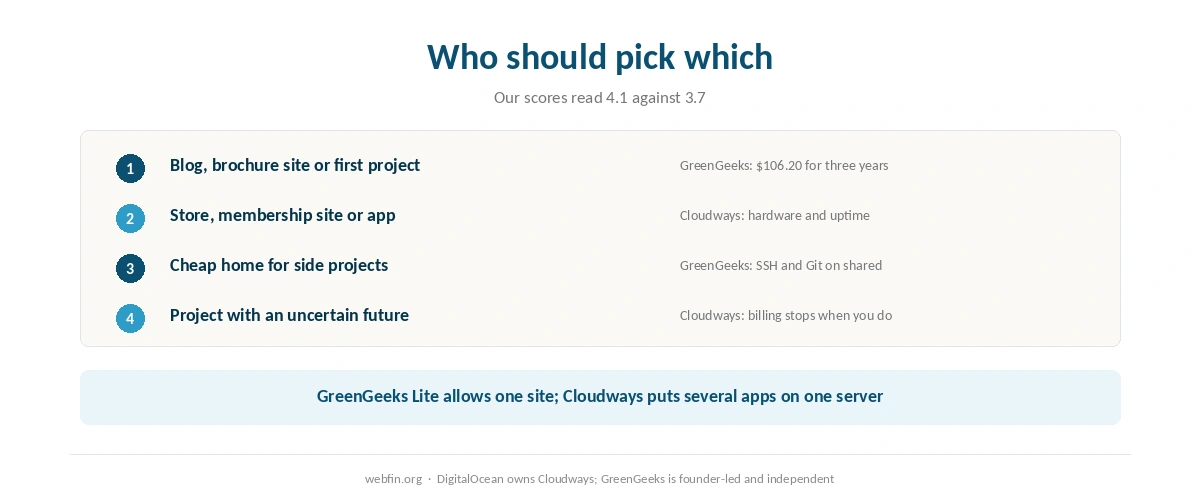
A blog, brochure site or first project. GreenGeeks, for three years at $106.20 with email and a shell included.
A store, a membership site or an app. Cloudways, for stronger hardware, measured uptime and capacity you can resize.
A developer wanting a cheap place for side projects. GreenGeeks, since SSH, Git and WP-CLI come with shared hosting.
A project with an uncertain future. Cloudways, for billing that stops when you do.
Where Each One Is Weakest
GreenGeeks is weakest on hardware and on the renewal. A score of 5.0 limits uncached work, the step to $13.95 is steep in percentage terms, and the integrated content network the benchmark could not find is a further point to verify.
Cloudways is weakest on its load result and on what it leaves out. A 1.7% error rate on one cloud is not clean, there is no email or cPanel, and phone support costs extra. Our Cloudways review covers each cloud.
Winners by Category
First three years: GreenGeeks, at $106.20 against $504.00. From month 37: level, five cents apart. Load test: GreenGeeks, at 26 ms without errors. Hardware: Cloudways, at 7.6 against 5.0. Uptime: Cloudways, measured across five plans. Email and cPanel: GreenGeeks. Billing flexibility: Cloudways, hourly.
How We Research
We run no tests. Load, hardware and outage figures come from Hostingstep’s 2026 benchmarks and reviews, each with its window, and we say where a percentage is missing rather than estimating one. Prices, inclusions and the environmental records come from the providers’ own pages and public partner listings, read on 20 September 2026.
Where sources disagree, as they do on the GreenGeeks intro term, we print both readings. The criteria behind our scores are on our about page, and our comparison of Bluehost against GreenGeeks sets it beside a shared rival from Newfold Digital.
Cloudways vs GreenGeeks FAQ
GreenGeeks for the first three years, at $106.20 on a prepaid term against $504.00. After that they are level: GreenGeeks renews at $13.95 and Cloudways charges $14.00, so only the first term separates them on price.
On the published figures, GreenGeeks: its shared plan served the 2026 load test at 26 ms without an error. Cloudways’ weakest cloud served it at 288 ms with 1.7% failing, and a larger Cloudways server would behave differently.
Cloudways, on the evidence we can name: 99.996% to 99.999% uptime across five plans. For GreenGeeks our table holds 25 counted outages with no percentage beside them.
As an offset, yes. It buys wind energy credits equal to three times its electricity use through the Bonneville Environmental Foundation and has been an EPA Green Power Partner since 2009. The servers still draw ordinary grid power.
GreenGeeks does, through cPanel. Cloudways does not; mailboxes come through Rackspace at about a dollar each per month, billed separately.
The Verdict
Cloudways takes this on score, at 4.1 against 3.7, because its uptime is measured across five plans and its hardware is stronger, and because a server you can resize suits anything that grows. For a store or an application, that is the deciding difference.
GreenGeeks is the better purchase for the first three years, and it is not a compromise on load: 26 ms without an error is the quicker result of the two. Take it for a blog, a brochure site or side projects, price the renewal at $13.95 before you buy, and remember that from month 37 the bills are level. Our page on what web hosting costs runs both totals further.