
Disclosure: WebFin is reader-supported. If you buy hosting through links on this page, we may earn a commission at no extra cost to you. Commissions vary between providers and our ratings do not — here’s our full disclosure.
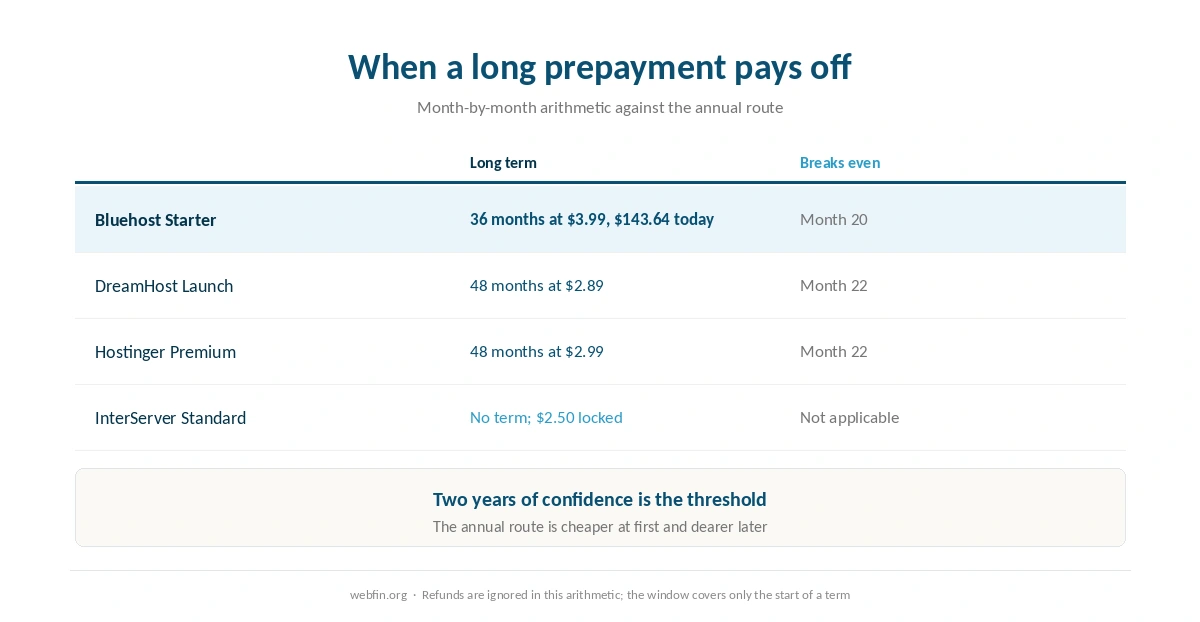
The choice between an annual term and a three-year one has a number behind it, and it is more stable than you might expect. On the plans we price, a long prepayment pays for itself at around month 20. Bluehost Starter breaks even in month 20, DreamHost Launch and Hostinger Premium in month 22. So the question is simple to answer once you turn it around: are you confident this site will still exist in two years? If yes, take the long term. If not, pay annually and keep the cash.
Annual or Three Years: The Short Answer
Take the long term if the site will outlive two years and the money is available today. Check that the host publishes the renewal you will pay afterward. Take the annual term if the project is untested, if cash matters more than the discount, or if the host has just changed owner. Check whether the term also changes the renewal price, because at several hosts it does.
Where the Break-Even Comes From
A long term charges the whole period up front at a low monthly rate. An annual term charges twelve months at the same intro rate, then renews higher. So the annual route is cheaper at first and dearer later. The crossing point is what matters.
Bluehost Starter prices 36 months at $3.99, which is $143.64 due today. On annual terms the first year costs $3.99 a month and renewals cost $11.99. Month by month, the annual route passes $143.64 in month 20. DreamHost Launch prepays 48 months at $2.89, and its annual route passes that sum in month 22. Hostinger Premium prepays 48 months at $2.99, and its annual route passes that in month 22 as well.
⚠️ Those crossings assume the intro rate applies for the first year on both routes, which is how these hosts price them today. They also ignore refunds, which is the risk we cover below. Our page on hosting renewal prices lists every rate used here.
| Host and plan | Intro → Renewal | Multiplier |
|---|---|---|
| IONOS Plus | $1.00 → $14.00 | 14.0× over 12 months |
| SiteGround StartUp | $2.99 → $17.99 | 6.0× over 12 months |
| SiteGround GrowBig | $4.99 → $29.99 | 6.0× over 12 months |
| SiteGround GoGeek | $7.99 → $44.99 | 5.6× over 12 months |
| ChemiCloud Starter | $2.49 → not published | Renewal shown at checkout only |
| Scala Hosting Mini | $2.95 → $11.95 | 4.1× over 12 months |
| DreamHost Launch, annual | $2.89 → $10.99 | 3.8× over 12 months |
| Hostinger Premium | $2.99 → $10.99 | 3.7× over 48 months |
| Bluehost Starter | $3.99 → $11.99 | 3.0× over 12 months |
| A2 Hosting Turbo Boost | $6.99 → $20.99 | 3.0× over 12 months |
| HostGator Hatchling | $3.75 → $10.99 | 2.9× over 36 months |
| GoDaddy Economy | $5.99 → $15.32 | 2.6× over 36 months |
| Bluehost Starter | $3.99 → $9.99 | 2.5× over 36 months |
| Namecheap Stellar | $1.98 → $4.88 | 2.5× over 12 or 24 months |
| Namecheap Stellar Plus | $2.98 → $6.88 | 2.3× over 12 or 24 months |
| Namecheap Stellar Business | $4.98 → $9.88 | 2.0× over 12 or 24 months |
| DreamHost Launch, 4-year | $2.89 → $7.99 | 2.8× over 48 months |
| DreamHost, eligible US nonprofits | One shared plan free for the account's life | 501(c)(3) or (c)(19); help article, checked 10 Jun 2026 by a nonprofit directory |
| Bluehost Business | $6.99 → $13.99 | 2.0× over 36 months |
| Bluehost Starter, second reading | $1.99 → $8.99 | Hostingstep, July 2026; conflicts with Bluehost's help page |
| Hostwinds Basic | $4.54 → $6.99 | 1.5× over 12 months |
| WP Engine Startup | $27.00 → $35.00 | 1.3× over 12 months |
| Rocket.net Starter | $25.00 → $30.00 | 1.2× over 12 months |
| InterServer Standard | $2.50 flat | 1.0×, price lock |
| Cloudways, from | $14.00 flat | no promotional term |
| Kinsta Starter | $35.00 flat | no promotional term |
| Liquid Web managed VPS, annual billing | $33.00, no promotional term | No increase described on annual billing |
| Liquid Web managed VPS, monthly billing | $36.00 → $72.00 reported | 2.0× over one month; one pricing guide, disputed |
| GreenGeeks Lite | $2.95 → $13.95 | 4.7× after one term; renewal was $12.95 before 2026 |
| ChemiCloud Starter, third-party figures | $9.95, $11.95 or $12.95 quoted | Sources disagree; 4.0× to 5.2× over 36 months |
| SiteGround StartUp, by term | $2.99 → $14.99, $17.99 or $24.99 | 5.0× over 24 months, 6.0× over 12, 8.4× month to month |
| ChemiCloud Kickstart, reseller | $8.99 → $29.95 | Term not stated in the source we read |
| InterServer reseller | $19.95, price locked | No increase described in sources |
| GreenGeeks reseller | $19.95 with WHMCS included | Promotional rate; renewal not published |
| Hostwinds white-label reseller | $10.00 with WHMCS included | Plain reseller plan excludes WHMCS |
| InMotion Core, 36-month term | $3.19 → $10.99 | 3.4× over 36 months; TechRadar, 2026 |
| InMotion Launch, 36-month term | $4.99 → $13.99 | 2.8× over 36 months; TechRadar and plan cards, 2026 |
| InMotion Core, by term | Renews at $10.99, $11.99 or $14.49 | Longest term lowest; one review, May 2026 |
The Term Often Changes the Renewal Too
This is the part buyers miss. At several hosts, the term you choose sets the renewal rate you pay for the rest of the account’s life, not just the price today.
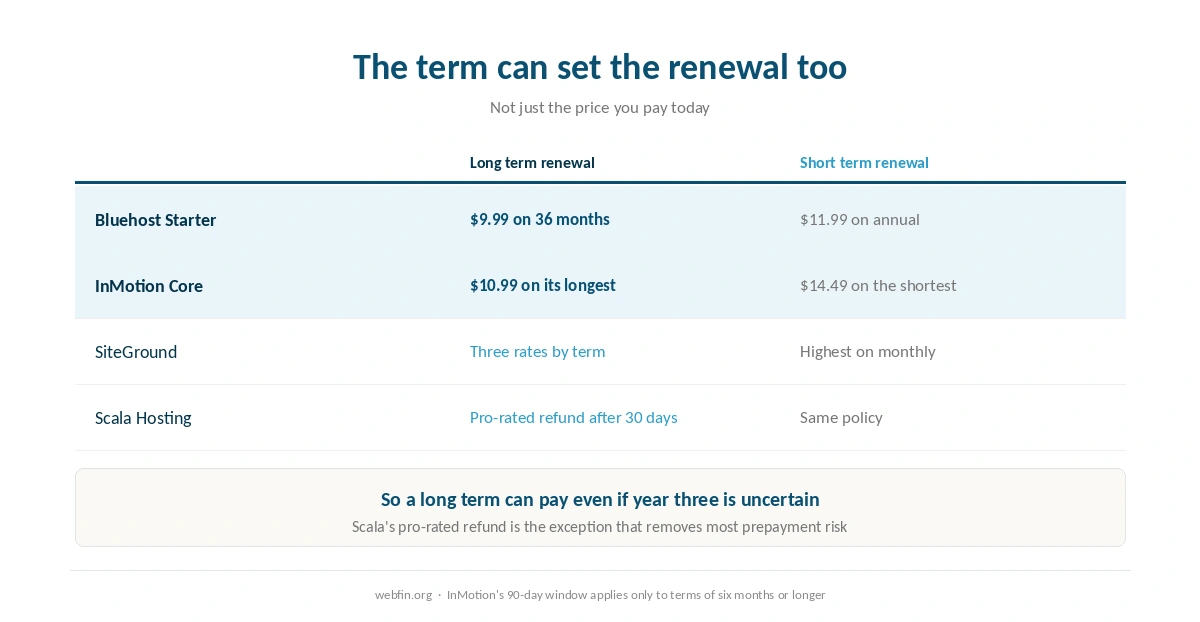
Bluehost Starter, a Newfold Digital brand, renews at $9.99 on a 36-month term and $11.99 on an annual one. InMotion Core renews at $10.99 on its longest term and $14.49 on the shortest. SiteGround publishes three different renewal rates for one plan, depending on whether you signed for 24 months, 12 or one.
So a long term can be worth taking even if you are unsure about year three, because it buys a lower renewal forever. That is the opposite of the usual advice, and it comes straight from the price tables.
What the Prepayment Actually Risks
The refund window covers the start of a term, not the middle. A 30-day window on a three-year prepayment means that from day 31 you are committed to 35 more months. If the project closes in year two, that money is spent.
Two hosts change that arithmetic. Scala Hosting refunds the unused part of the term after its first 30 days, pro-rated, which removes most of the risk from a long prepayment. InMotion gives 90 days rather than 30, but only on terms of six months or longer. Its window is built for the long term.
⚠️ Our guide to canceling hosting and getting a refund covers what comes back and what does not. Domains are excluded at every host with a window in our table, and add-ons at several.
Six Questions That Decide It
Will the site exist in two years? Below that, annual. Above it, the long term pays.
Is the cash available now? Three years of hosting is a small bill for a business and a real one for a side project.
Does the term change the renewal? If it does, as at Bluehost, InMotion and SiteGround, the long term keeps paying after the discount ends.
What is the refund window, and does it pro-rate? Thirty days on a three-year term is a month of protection. Scala’s pro-rated refund is the exception.
Has the host just changed hands? Renewal policy tends to follow ownership, and prepaying three years bets on the new owner.
Could you outgrow the plan? A prepaid shared plan you outgrow in year one is money spent on the wrong product. Our guide to moving from shared to VPS covers the signals.
Two Cases Where the Long Term Is Wrong
A host that has just changed owner. Namecheap gained a majority owner in September 2025, and A2 Hosting became hosting.com in 2025 after a sale. Renewal policy follows ownership, as our page on who owns Bluehost and the sales we have tracked show. Three years is a long bet on a new owner.
A plan you may outgrow. A prepaid shared plan is not refunded because your store grew, so a site on a clear growth path is better served by an annual term or a host that bills by the month. Our list of hosting for ecommerce covers the growth cases, and our InterServer review covers the price lock that avoids the question.
Hosts Where the Question Does Not Arise
Some hosts have no term to choose. InterServer charges $2.50 a month with the price locked for the life of the account, so there is no discount to buy and no renewal to fear. Cloudways bills by the hour at a flat $14.00, and Kinsta bills monthly at a flat $35.00.
For a project with an uncertain future, that shape is worth real money even when the monthly rate looks higher. You are buying the option to stop, which a prepayment removes. Our comparison of Cloudways against InterServer covers two of those hosts directly.
If You Are Already Locked In
A term you have already paid is not wasted, it is just fixed. Set the renewal date in your calendar, and decide a month before it whether to stay, switch term or move. That is also the moment to compare the plan against the field, which our list of cheap web hosting makes quick.
If you decide to move, time it for the end of the term rather than the middle, and keep the domain where it is. Our guide to migrating web hosting covers the order that keeps the site online.
A Worked Example, Both Ways
A settled business site. Three years at Bluehost costs $143.64 prepaid against $335.64 on annual terms. The renewal afterward is $9.99 rather than $11.99, so the long term wins twice and the business can absorb the cash.
An untested idea. The same three-year prepayment is $143.64 committed to a site that may not exist next spring. Annual costs more per month and less in total if you leave in month 14. The money not spent is available for something else.
A client site you may hand over. Annual, or monthly, because a prepaid term is awkward to transfer and the client may want their own account.
Before You Click Buy
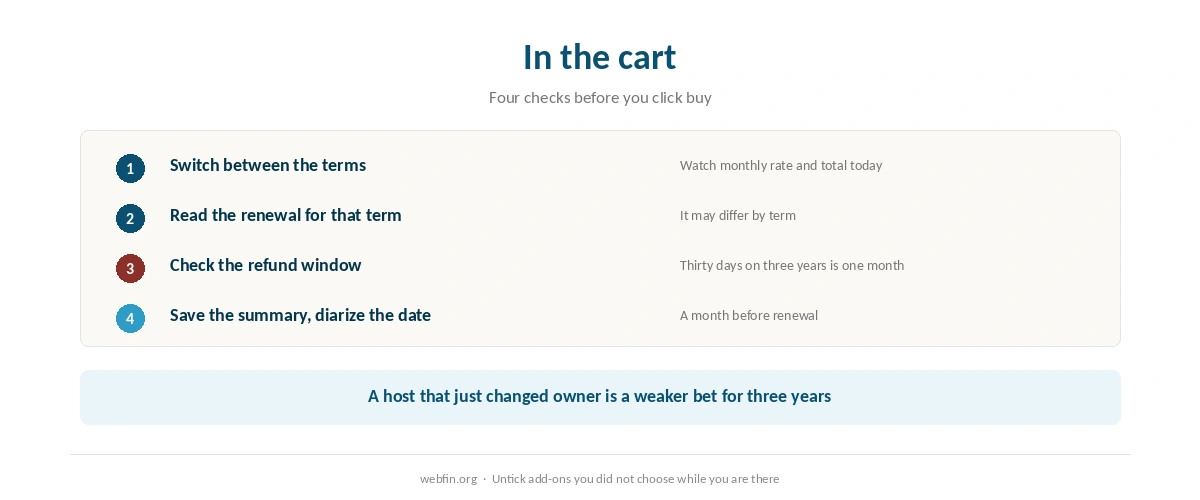
The cart is where the term is decided, and the term shown first may be the longest. Switch between them and watch two numbers: the monthly rate and the total due today. Then read the renewal line for the term you picked.
Save the checkout summary, set a calendar reminder a month before the renewal, and turn off any add-on you did not choose. Our guide to avoiding checkout upsells covers the rest of the cart, and our page on hidden hosting fees lists what arrives later.
How We Research
We run no tests. Prices, terms, renewal rates and refund windows come from the providers’ own pages and from reviews published this year, read on 20 September 2026, and they sit in our tables. The break-even months come from month-by-month arithmetic on those published rates rather than from any host’s calculator.
Where a host prices differently by term, we use the rates our tables record for each term. The criteria behind our scores are on our about page, and our page on what web hosting costs runs three-year totals for every plan we price.
Hosting Terms FAQ
If the site will outlive about two years, yes. On the plans we price, a long prepayment breaks even against the annual route at around month 20: month 20 at Bluehost, month 22 at DreamHost and Hostinger.
At several hosts it does. Bluehost Starter renews at $9.99 on a 36-month term and $11.99 on an annual one. InMotion Core ranges from $10.99 to $14.49 by term, and SiteGround publishes three renewal rates for one plan.
Usually nothing comes back after the refund window, which is 30 days at most hosts in our table. Scala Hosting is the exception: after 30 days it refunds the unused part of the term, pro-rated.
Rarely. The discount is real, but so is the risk: from day 31 you are committed to the rest of the term. An annual term, or a host that bills monthly or hourly, keeps the option to stop.
InterServer locks $2.50 a month for the life of the account, Cloudways bills by the hour at $14.00 flat, and Kinsta bills monthly at $35.00 flat. None of them sells a discount for committing years in advance.
The Verdict
Turn the question around and it answers itself. A long prepayment pays for itself at about month 20, so the real question is whether the site will still be here in two years. If it will, the long term wins, and at several hosts it also buys a lower renewal for good.
If the project is untested, pay annually or pick a host with no term at all. Treat the extra dollars a month as the price of being able to stop. Either way, read the renewal line for the term you chose, save the summary, and diarize the date. Our guide to reading a hosting agreement covers the clauses behind all of it.