
Disclosure: WebFin is reader-supported. If you buy hosting through links on this page, we may earn a commission at no extra cost to you. Commissions vary between providers and our ratings do not — here’s our full disclosure.
We price hosting rather than networks, so this page does not rate Cloudflare’s plans as a product. What it does is answer the question a site owner actually has: does the free tier do the job, and what does paying change? Plus the part most comparisons miss. Two hosts in our tables include Cloudflare Enterprise in plans costing $35.00 and less, which is a cheaper route to those features than buying them.
Cloudflare Free vs Paid: The Short Answer
For a blog, brochure site or small business site, the free tier covers what you need: caching for static files, TLS, DNS and basic attack protection. Pay when you specifically want the security rules, image handling or analytics that sit on higher tiers. And check your host first, because Kinsta and Rocket.net bundle the Enterprise tier and Hostinger includes a network on Business.
What the Free Tier Does for a Website
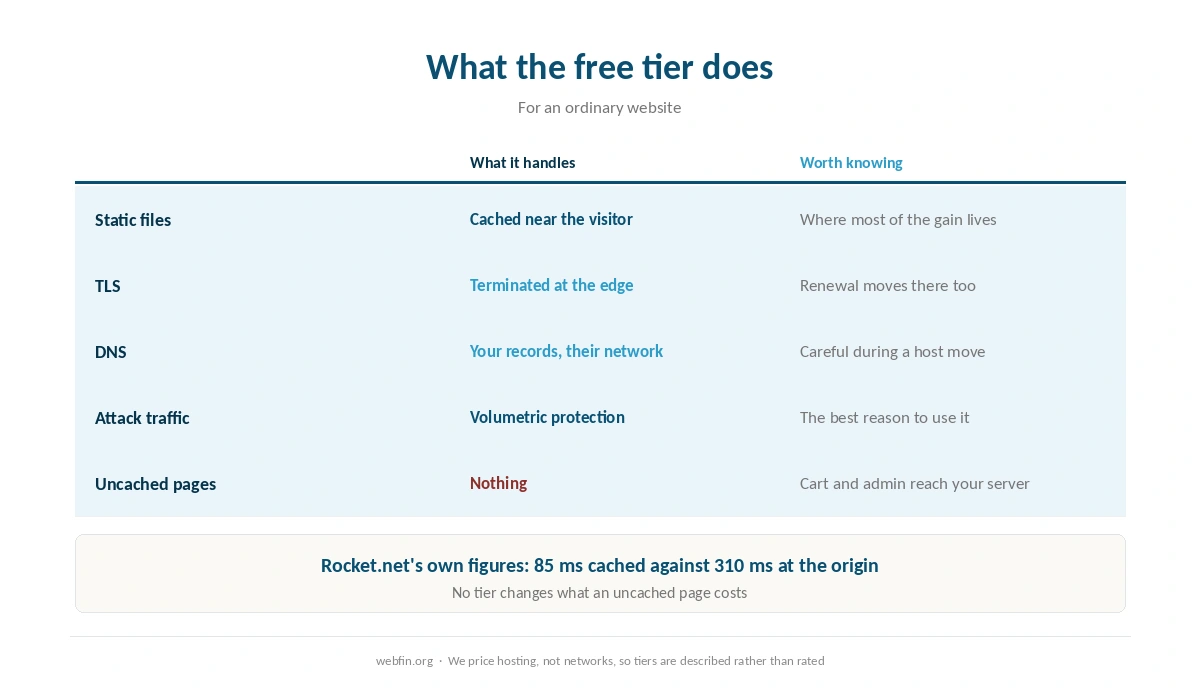
Caches static files at the edge. Images, stylesheets and scripts get served near the visitor, which is where most of the measurable gain lives.
Terminates TLS. The certificate moves to the network, and our page on free against paid SSL covers why renewal matters more than the certificate you choose.
Runs your DNS. Useful on its own, and the thing to be careful with during a move. Our guide to pointing a domain to a new host covers the order.
Absorbs ordinary attack traffic. Volumetric protection is on the free tier, which is the single best argument for using it at all.
What Paying Changes
Rather than print a feature matrix that will be out of date within months, the categories are the useful part. Higher tiers add web application firewall rules, image optimization, more detailed analytics and more configuration rules; the top tier adds account management, custom certificate handling and contractual commitments.
Check the current comparison on Cloudflare’s own pages before buying, because the tiers move and the names change. What does not change is the shape: the free tier is about delivery and basic protection, and paid tiers are about rules, reporting and contracts.
⚠️ Nothing on any tier makes an uncached page faster. A checkout, a cart and an admin screen all reach your server. Our page on content delivery networks shows it with Rocket.net’s own figures: 85 ms cached against 310 ms at the origin.
| Host | Measurement | Source and date |
|---|---|---|
| WP Engine | Global TTFB 65 ms, 1st of 34 hosts | Hostingstep, 2025 ranking, 40 locations |
| WP Engine | US TTFB 365 ms across 22 locations | Hostingstep, 2025 ranking |
| WP Engine | TTFB 355 ms, 349,920 checks | Hostingstep, Oct 2025 – May 2026 |
| WP Engine | Uptime 99.976%, 10th of 14 managed hosts | Study of 14 managed hosts, 2026 |
| WP Engine | Load 27 ms at 0% errors | Hostingstep, 2026 benchmarks |
| Rocket.net | Cached TTFB 85 ms globally | 12-month test, Mar 2025 – Mar 2026 |
| Rocket.net | Origin TTFB 310 ms; checkout bypasses cache | Same 12-month test |
| Rocket.net | Uptime 99.97%, seven outages in the window | Hostingstep, Oct 2025 – May 2026 |
| Rocket.net | Hardware score fell 8.5 → 7.5; not recommended | Hostingstep, 2026, tracked since Oct 2020 |
| Hostinger Business | Global TTFB 223 ms, 5th of 34 hosts | Hostingstep, 2026 |
| Hostinger Premium | Global TTFB 495 ms, 28th of 34; no CDN | Hostingstep, 2026 |
| Hostinger | TTFB 707 ms; server response 246 ms | Cybernews, June 2026 |
| Hostinger | Uptime 99.99%, 33 min down in 2025 | Hostingstep, continuous since 2021 |
| Hostinger | Uptime 99.93%, 6-month window | HostPro Reviews, 2026 |
| Hostinger | LCP 0.607 s, 2nd of 15 hosts | TechRadar, 10-week window, 2026 |
| Bluehost | Hardware score 9.6 of 10 | Hostingstep, 2026 |
| Bluehost | Load 41 ms at 0% errors after the Oracle move | Hostingstep changelog, 9 Jul 2026 |
| Bluehost | Response 411 ms; uptime 99.99% across 9 outages | Hostingstep, Nov 2025 – Aug 2026 |
| Bluehost | Global TTFB 224 ms across 40 locations, cached | Hostingstep Bluehost review, Jul 2026 |
| HostGator | Global TTFB 1.23 s; uptime 99.68%; 762 ms at 500 users | Hostingstep HostGator review, 2026 |
| HostGator | Hardware joint-highest in the field after the Oracle move | Hostingstep, 1 Sep 2026 update |
| ChemiCloud | US TTFB 531 ms; global 460 ms | Hostingstep, Oct 2025 – May 2026 |
| ChemiCloud | Load 1,068 ms at a 4.2% error rate | Hostingstep, same window |
| ChemiCloud | Uptime 99.76%; overall 6.1 of 10, degrading | Hostingstep, tracked since 2021 |
| GoDaddy shared | TTFB 751 ms; load test did not complete | Hostingstep, Nov 2025 – Jun 2026 |
| GoDaddy shared | Uptime 99.76% | Hostingstep, Nov 2025 – Jun 2026 |
| GoDaddy Managed WordPress | TTFB 344 ms; hardware 3.8 of 10 | Hostingstep, 2026 |
| GreenGeeks | TTFB 395 ms North America, 447 ms Europe | Long-term independent testing, 2026 |
| GreenGeeks | TTFB 580–610 ms Asia and Australia | Same testing window |
| GreenGeeks | Load 26 ms at 0% errors; WPBench 5.0 of 10 | Hostingstep, 2026 |
| GreenGeeks | 25 outages in the window; no integrated CDN found | Hostingstep, 2026 |
| Kinsta | Origin TTFB 525 ms; edge figures differ | Hostingstep, 2026 |
| Kinsta | Load 40 ms at 0% errors; WPBench 8.8 of 10 | Hostingstep, 2026 reviews |
| DreamHost | TTFB 450–500 ms band | Hostingstep, 2026 benchmarks |
| Scala Hosting | Uptime 99.97% across twelve months | Live site, 40,000 monthly visitors, UptimeRobot |
| Scala Hosting | 29 ms at the 95th percentile, 50 users | k6 load test, 2026 |
| InterServer | Uptime 99.98% across eighteen months | Six production sites, UptimeRobot |
| InterServer | Load under 700 ms; under 1.5 s by another source | Two 2026 reviews |
| A2 Hosting | TTFB 150–198 ms | 2026 studies; LiteSpeed on Turbo tiers |
| IONOS | Global TTFB 480 ms; WPBench 7.2 of 10 | Hostingstep, 2026 benchmarks |
| IONOS | Uptime 99.99%; load test failed at 65.4% errors | Hostingstep, 2026 benchmarks |
| Namecheap | TTFB 461 ms; global 448 ms; WPBench 5.0 | Hostingstep, Q4 2025; monitoring paused 30 Jun 2026 |
| InMotion | TTFB 300–500 ms shared | Published measurement, 2026 |
| InMotion | Uptime 99.97–99.99%; one account near 99.5% | Several 2026 sources |
| Hostwinds | No independent measurement found | 99.9999% is the company's own claim |
| Liquid Web | Not covered by the benchmarks we cite | VPS and dedicated are outside their scope |
| SiteGround | TTFB 632 ms; 22nd of 34 hosts | Hostingstep, 2026 benchmarks |
| SiteGround | Uptime 99.96% in 2025; 193 min over 44 outages | Hostingstep, full year 2025 |
| SiteGround | WPBench 8.4 of 10; load 170 ms at 0% errors | Hostingstep, Oct 2025 – May 2026 |
| Scala Hosting | TTFB 465 ms; global 501 ms | Hostingstep, 2026 benchmarks |
| Scala Hosting | WPBench 8.8 of 10; load 48 ms at 0% errors | Hostingstep, 2026 benchmarks |
| Scala Hosting | Uptime 99.98% across the year | Hostingstep, 2026 benchmarks |
| Cloudways | Vultr HF: load 288 ms at 1.7% errors; WPBench 7.6 | Hostingstep Cloudways review, 2026 |
| Cloudways | Uptime 99.996% to 99.999% across five plans | Hostingstep, Oct 2025 – May 2026 |
The Cheaper Route to the Top Tier
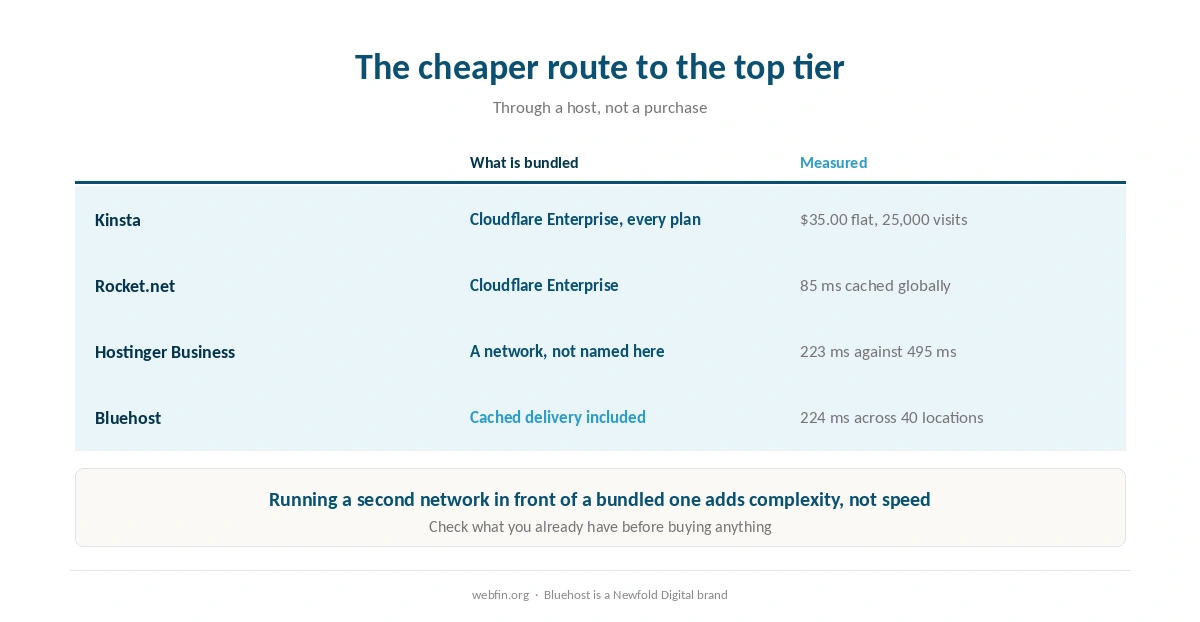
Kinsta. Cloudflare Enterprise in front of every plan at $35.00 a month flat, with 25,000 monthly visits included.
Rocket.net. The same arrangement, with cached delivery measured at 85 ms globally over a twelve-month test. Our comparison of Kinsta against Rocket.net covers both.
Hostinger Business. Not Cloudflare specifically, but a bundled network, and the clearest measured evidence we have: 223 ms globally against 495 ms on Premium without one.
Bluehost. Cached delivery at 224 ms across 40 locations with nothing extra to buy. A Newfold Digital brand.
When the Free Tier Is Enough
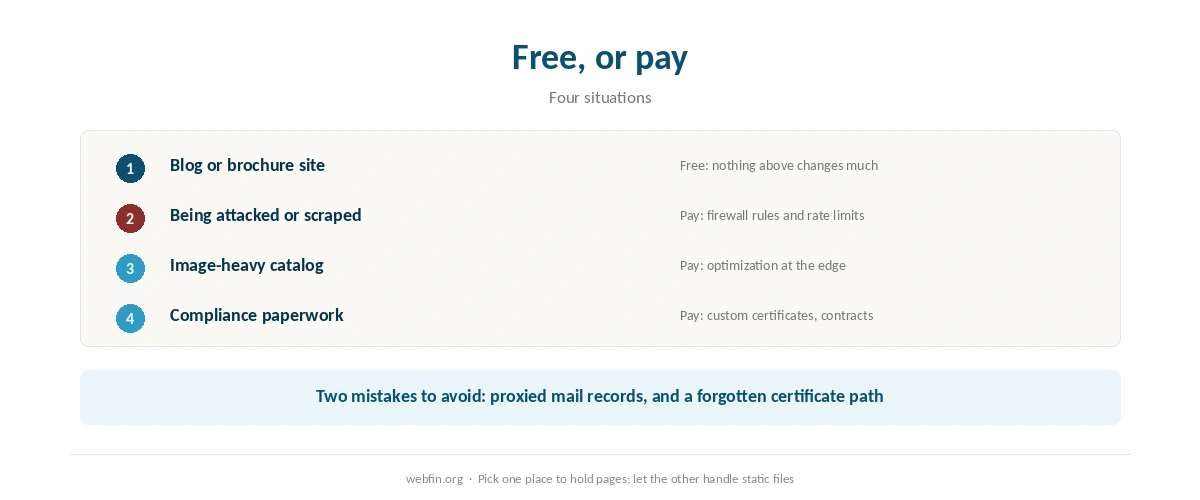
A blog or brochure site. Static files cached, TLS handled, DNS in one place. Nothing on a paid tier changes the reader’s experience much.
A site read mostly in one country. The network helps least here, and our guide to testing your site speed properly covers measuring that honestly.
A site whose host already has a network. Running two in series adds complexity rather than speed.
A small site with no attack history. Free-tier protection is the baseline, and a quiet site rarely needs more than the baseline.
When Paying Earns Its Place
You are being attacked or scraped. Firewall rules and rate limiting are the reason to move up, and they are a real difference rather than a marketing one.
An image-heavy site. Automatic optimization at the edge saves bandwidth and time on catalogs and galleries.
A store that needs precise bypass rules. Cart and checkout must never be cached, which our guide to configuring caching covers. Our list of hosting for ecommerce covers the server side.
Compliance requirements. Custom certificates and contractual commitments live on the higher tiers.
Two Mistakes Worth Avoiding
Proxying mail records. Mail must reach your mail host directly, so records for mail stay unproxied when you move DNS to a network. This is the commonest way a site owner breaks their own email, and our guide to setting up email on your domain covers the records.
Forgetting the certificate path. When the network terminates TLS, validation and renewal move there too. A change at either end can leave visitors facing a browser warning, which our page on SSL certificates explains is the failure that actually costs traffic.
If You Run Both a Network and a Host Cache
Two caches in series is a common accident. The host caches a page, the network caches the host’s copy, and a change you publish disappears behind whichever layer you forgot to purge.
Pick one place to hold pages and let the other handle static files, then test a publish end to end once. Our guide to fixing a website that is down covers the same habit of testing after a change.
And our guide to setting up a CDN covers the bypass rules that keep carts and admin screens out of both.
How We Research
We run no tests and we do not rate network plans. Tier contents here come from Cloudflare’s own published pages, read on 20 September 2026. We describe categories rather than a feature matrix, because those change between releases.
The hosting figures come from Hostingstep. Global rankings across 40 locations are from its 2026 benchmarks, and the Rocket.net cached and origin figures from a twelve-month test to March 2026. The Bluehost delivery figure is from its July 2026 review. Named networks appear only where a host bundles them. The criteria behind our scores are on our about page.
Cloudflare Tiers FAQ
For a blog, brochure or small business site, yes. It caches static files at the edge, terminates TLS and runs your DNS. It also absorbs ordinary attack traffic, which is the strongest argument for using it.
Rules, reporting and contracts rather than raw speed: firewall rulesets, image optimization, deeper analytics, more configuration rules, and at the top tier account management and custom certificates.
Through a host, yes. Kinsta and Rocket.net include Cloudflare Enterprise in plans at $35.00 and less, which is a cheaper route to those features than buying the tier directly.
No. Carts, checkouts and admin screens reach your server whatever sits in front. Rocket.net’s own figures make the point: 85 ms cached against 310 ms at the origin.
Email, usually, because mail records must stay unproxied. The other common failure is the certificate path, since the network terminates TLS and renewal moves with it.
The Verdict
Start free, and start by checking your host. If you are on Kinsta or Rocket.net the top tier is already in front of your site. On Hostinger the Business tier adds a network worth a measured 272 milliseconds against Premium.
Pay when you need rules rather than delivery: firewall policies, image handling, precise bypasses, or contracts. And whatever tier you land on, keep mail records unproxied and watch the certificate path after any change. Our guide to reducing TTFB covers the parts a network cannot reach.