
Disclosure: WebFin is reader-supported. If you buy hosting through links on this page, we may earn a commission at no extra cost to you. Commissions vary between providers and our ratings do not — here’s our full disclosure.
Bluehost vs GoDaddy compares the two most advertised names in hosting, and both earn a large share of their money after the checkout button. Bluehost Starter opens at $3.99 and renews at $9.99 on a 36-month term, then sells security and SEO add-ons from its own parent company. GoDaddy Economy opens at $5.99, renews at $15.32, and charges $119.99 for an SSL certificate after year one. The measurements separate them further than the brands suggest. The same GoDaddy figures against Kinsta are in our Kinsta and GoDaddy comparison.
Bluehost vs GoDaddy: The Short Answer
Bluehost, by a wide margin, at 4.0 against 2.7 in our reviews. It costs $143.64 across 36 months against $215.64, and its hardware scores 9.6 of 10. GoDaddy’s shared plan records 751 ms to first byte and did not complete the load test in the same benchmarks.
Head to Head
| Criterion | Bluehost Starter | GoDaddy Economy |
|---|---|---|
| Intro rate | $3.99/mo | $5.99/mo |
| Renewal, 36-month term | $9.99/mo | $15.32/mo |
| Renewal, 12-month term | $11.99/mo | Not in our table |
| 36 months on a 36-month term | $143.64 | $215.64 |
| SSL after year one | Free with Let’s Encrypt | $119.99 on Economy |
| Time to first byte | Not a weak point | 751 ms |
| Load test | Completed | Did not complete |
| Server hardware score | 9.6 of 10 | Not recorded for shared |
| Uptime in the window | Not quoted here | 99.76% |
| Owner | Newfold Digital, since 2021 | Publicly listed |
| Our score | 4.0 | 2.7 |
What Three Years Cost, Before the Extras
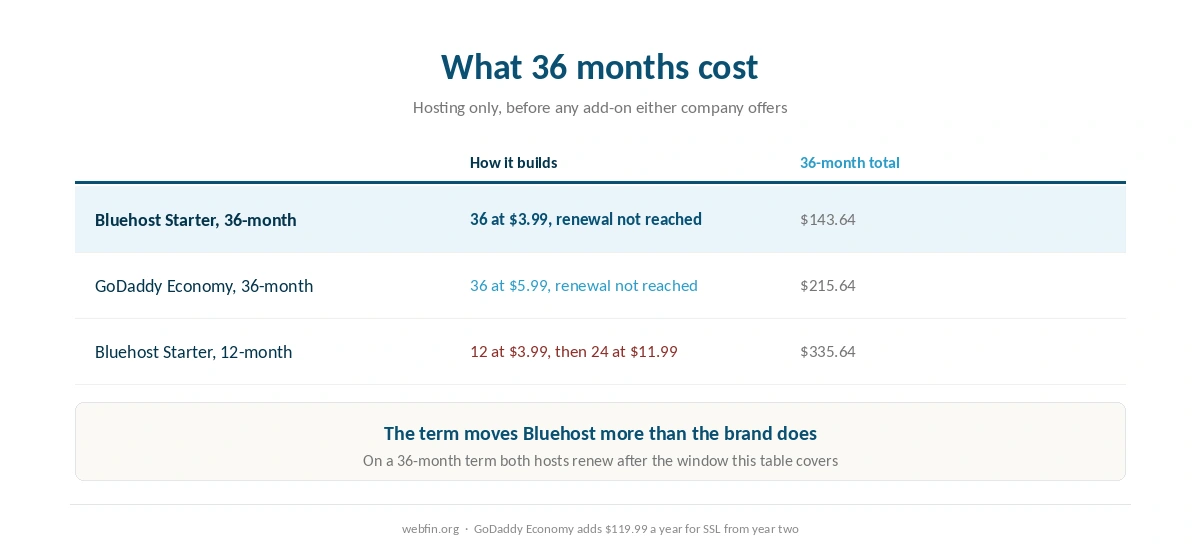
Bluehost Starter bills 36 months at $3.99, so three years come to $143.64 and the renewal of $9.99 arrives after that. On a 12-month term it renews at $11.99 instead, which pushes the same three years to $335.64. So Bluehost has the familiar two-rate shape, at 2.5× over 36 months or 3.0× over 12 months.
GoDaddy Economy bills 36 months at $5.99, which is $215.64, and renews at $15.32. That is 2.6× over 36 months, a gentler step than Bluehost on the short term and a higher price at every stage. Our page on hosting renewal prices puts both beside the field.
| Host and plan | Intro → Renewal | Multiplier |
|---|---|---|
| IONOS Plus | $1.00 → $14.00 | 14.0× over 12 months |
| SiteGround StartUp | $2.99 → $17.99 | 6.0× over 12 months |
| SiteGround GrowBig | $4.99 → $29.99 | 6.0× over 12 months |
| SiteGround GoGeek | $7.99 → $44.99 | 5.6× over 12 months |
| ChemiCloud Starter | $2.49 → not published | Renewal shown at checkout only |
| Scala Hosting Mini | $2.95 → $11.95 | 4.1× over 12 months |
| DreamHost Launch, annual | $2.89 → $10.99 | 3.8× over 12 months |
| Hostinger Premium | $2.99 → $10.99 | 3.7× over 48 months |
| Bluehost Starter | $3.99 → $11.99 | 3.0× over 12 months |
| A2 Hosting Turbo Boost | $6.99 → $20.99 | 3.0× over 12 months |
| HostGator Hatchling | $3.75 → $10.99 | 2.9× over 36 months |
| GoDaddy Economy | $5.99 → $15.32 | 2.6× over 36 months |
| Bluehost Starter | $3.99 → $9.99 | 2.5× over 36 months |
| Namecheap Stellar | $1.98 → $4.88 | 2.5× over 12 or 24 months |
| Namecheap Stellar Plus | $2.98 → $6.88 | 2.3× over 12 or 24 months |
| Namecheap Stellar Business | $4.98 → $9.88 | 2.0× over 12 or 24 months |
| DreamHost Launch, 4-year | $2.89 → $7.99 | 2.8× over 48 months |
| DreamHost, eligible US nonprofits | One shared plan free for the account's life | 501(c)(3) or (c)(19); help article, checked 10 Jun 2026 by a nonprofit directory |
| Bluehost Business | $6.99 → $13.99 | 2.0× over 36 months |
| Bluehost Starter, second reading | $1.99 → $8.99 | Hostingstep, July 2026; conflicts with Bluehost's help page |
| Hostwinds Basic | $4.54 → $6.99 | 1.5× over 12 months |
| WP Engine Startup | $27.00 → $35.00 | 1.3× over 12 months |
| Rocket.net Starter | $25.00 → $30.00 | 1.2× over 12 months |
| InterServer Standard | $2.50 flat | 1.0×, price lock |
| Cloudways, from | $14.00 flat | no promotional term |
| Kinsta Starter | $35.00 flat | no promotional term |
| Liquid Web managed VPS, annual billing | $33.00, no promotional term | No increase described on annual billing |
| Liquid Web managed VPS, monthly billing | $36.00 → $72.00 reported | 2.0× over one month; one pricing guide, disputed |
| GreenGeeks Lite | $2.95 → $13.95 | 4.7× after one term; renewal was $12.95 before 2026 |
| ChemiCloud Starter, third-party figures | $9.95, $11.95 or $12.95 quoted | Sources disagree; 4.0× to 5.2× over 36 months |
| SiteGround StartUp, by term | $2.99 → $14.99, $17.99 or $24.99 | 5.0× over 24 months, 6.0× over 12, 8.4× month to month |
| ChemiCloud Kickstart, reseller | $8.99 → $29.95 | Term not stated in the source we read |
| InterServer reseller | $19.95, price locked | No increase described in sources |
| GreenGeeks reseller | $19.95 with WHMCS included | Promotional rate; renewal not published |
| Hostwinds white-label reseller | $10.00 with WHMCS included | Plain reseller plan excludes WHMCS |
| InMotion Core, 36-month term | $3.19 → $10.99 | 3.4× over 36 months; TechRadar, 2026 |
| InMotion Launch, 36-month term | $4.99 → $13.99 | 2.8× over 36 months; TechRadar and plan cards, 2026 |
| InMotion Core, by term | Renews at $10.99, $11.99 or $14.49 | Longest term lowest; one review, May 2026 |
The Extras Are Where Both Make Money
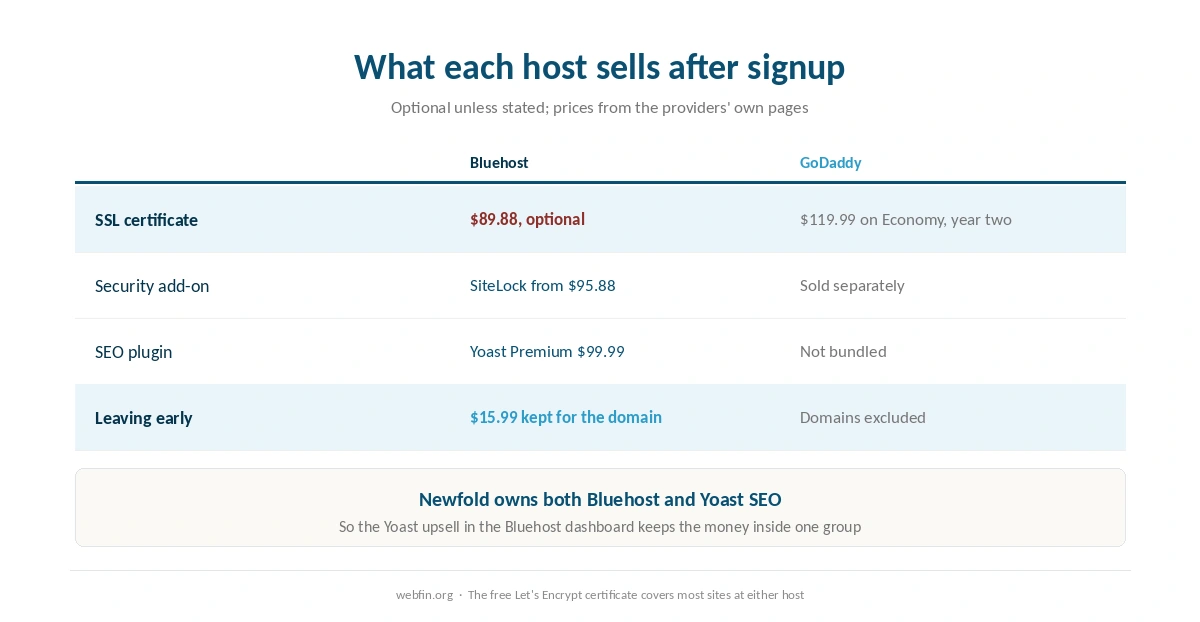
Bluehost sells a menu after signup. Premium SSL runs $89.88, which is optional because Let’s Encrypt is free. SiteLock Essentials is $95.88 and SiteLock Prevent $239.88. Yoast SEO Premium is $99.99, and Newfold Digital owns both Bluehost and Yoast, so that upsell keeps the money inside one group.
GoDaddy makes the SSL question unavoidable. On the Economy tier the certificate costs $119.99 after the first year, while higher tiers include it for the life of the plan. One review counted pre-checked extras at checkout worth a large sum, though we could not verify the total, so treat the checkout page as something to read line by line.
⚠️ The practical rule is the same for both. Untick everything you did not choose, and price the SSL for year two before you compare plans. Our page on hidden hosting fees collects these charges across the field.
Speed and Load: The Clearest Difference
We run no tests, so these figures belong to Hostingstep. GoDaddy’s shared hosting records 751 ms to first byte and 99.76% uptime over its November 2025 to June 2026 window, and its load test did not complete. A load test that does not finish means a share of requests went unanswered, which is the failure a visitor actually sees.
Bluehost scores 9.6 of 10 on the same project’s server benchmark, which that project places at the top of its shared results. GoDaddy’s managed WordPress line tells a different story from its shared plan, at 344 ms to first byte, though with a hardware score of 3.8. So the brand is not the product: the same company sells one tier that answers quickly and another that does not finish a load test.
⚠️ GoDaddy’s shared monitoring also stopped reporting after 30 June 2026, the same pause that affects Namecheap in that project. Its figures therefore rest on a shortened window. Our guide to reading an uptime report explains why the window matters as much as the number.
The Limits Bluehost Publishes Three Ways
Bluehost sells its shared plans as unlimited, and its own help pages describe the ceiling in three different numbers. One article calls 50,000 inodes a soft limit. Another puts the acceptable use threshold at 200,000. A third calls 1,000,000 a terms of service violation. Databases are capped at 5,000 tables or 10 GB in total, and 5 GB for any single one.
That is more than most hosts publish, and it is still confusing. A small blog never reaches any of those figures. A photographer’s portfolio with thousands of image variants might reach the first. Our piece on what unlimited hosting means is built around exactly this finding.
Compare the Tier Above, Too
The entry plans are not where either company wants you to stay. Bluehost Business opens at $6.99 and renews at $13.99 on a 36-month term, which is 2.0× over 36 months and the gentlest step in its range. It also adds domain privacy free for the first year, which Starter charges $15.00 for.
GoDaddy’s higher tiers solve its biggest problem on Economy. The SSL certificate is included for the life of the plan above the entry tier, so the $119.99 charge in year two disappears. For a buyer set on GoDaddy, the step up often costs less than the certificate it removes.
⚠️ This is the general pattern in shared hosting. The entry tier is priced to be quoted, and the tier above is priced to be bought. Our guide to choosing a hosting plan works through when the upgrade pays for itself.
Dashboards, Domains and Everyday Use
Bluehost wraps cPanel in its own dashboard, which handles WordPress installs, staging on higher tiers and the add-on menu. Beginners find it approachable, and anyone who wants the raw panel can still reach it. The dashboard is also where the upsells live, which is worth remembering when a button offers to secure your site.
GoDaddy’s advantage is the ecosystem. Many buyers already hold a domain there, and keeping domain, email and hosting under one login is a genuine convenience. The cost is that convenience makes the extras easier to accept, since every one of them is a single click from an account you already trust.
Support and Refunds
Both hosts publish phone support around the clock. GoDaddy answers the phone in more countries than most hosts, which matters for a buyer outside the United States. Neither publishes a measured response time, and no controlled test of hosting support exists in the sources we found.
Both refund within 30 days. Bluehost deducts $15.99 for the free domain if you cancel early and excludes add-ons and professional services. GoDaddy excludes domains and some services. The Bluehost deduction is small, and it is still a fee for leaving.
What the Free Domain Actually Costs
Both hosts bundle a domain for the first year, and both treat it as a hook rather than a gift. At Bluehost, canceling inside the refund window costs $15.99 for the domain, deducted from the refund, and the domain stays registered to you. Domain privacy on Starter is a further $15.00 a year after the free period on higher tiers.
GoDaddy is primarily a registrar, so the domain side is its home ground and its renewal pricing follows its own list. The practical advice is the same at both: note the domain renewal date separately from the hosting one, because the two rarely line up and the second invoice arrives without warning.
⚠️ If you plan to move hosts later, consider registering the domain somewhere neutral from the start. A domain held by the host makes leaving one step harder, and that friction is part of what the free year buys the host. Our page on what web hosting costs runs the hosting side of that arithmetic.
Who Owns Them
Bluehost has belonged to Newfold Digital since 2021. Newfold also runs HostGator and Yoast SEO, which is why a Bluehost dashboard can sell you a Yoast license. The full picture is in who owns Bluehost.
GoDaddy is publicly listed, so its accounts are filed in public and its strategy answers to shareholders. Neither ownership is a verdict on service. Both explain why each company leans so hard on revenue after the first invoice.
Winners by Category
Three-year price: Bluehost, at $143.64 against $215.64. Renewal: Bluehost, at $9.99 against $15.32 on 36-month terms. SSL: Bluehost, where the free certificate is enough. Hardware: Bluehost, at 9.6 of 10. Load handling: Bluehost, which completed the test. International phone support: GoDaddy. Published limits: Bluehost, even if confusingly.
When to Choose GoDaddy Instead
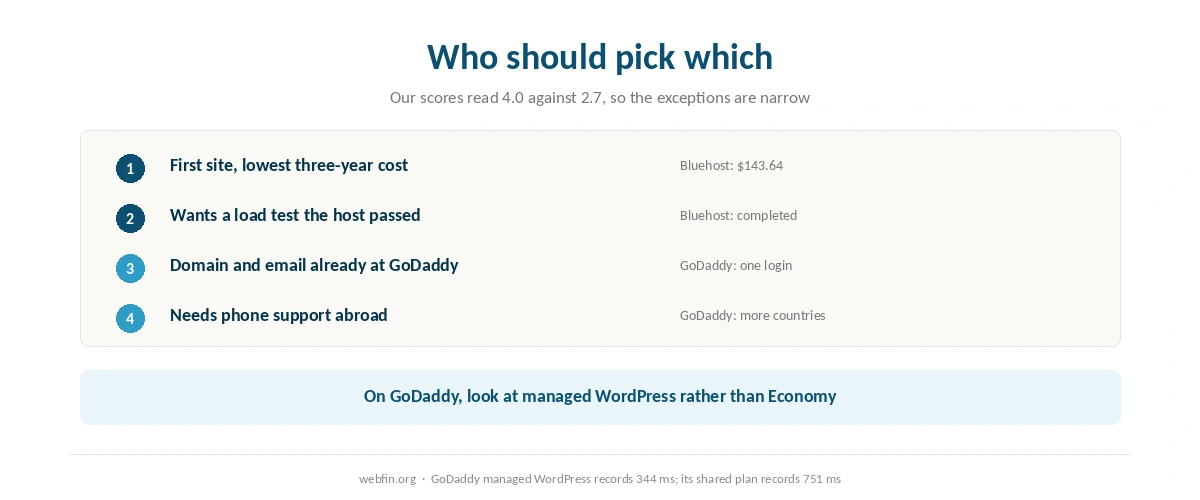
Take GoDaddy if the domain, email and website all need to live with one company you already use, or if phone support in your own country matters more than performance. Consider its managed WordPress line rather than shared, since the 344 ms first byte there is a different product from the Economy plan measured above.
Take Bluehost for almost everything else. It is cheaper across three years, stronger on hardware, and its extras can all be declined. For a first site, our roundup of cheap web hosting shows where both sit, and our comparison of Hostinger against Bluehost covers the obvious next question.
How We Research
We run no speed or uptime tests. Measurements come from Hostingstep’s 2026 benchmarks with their windows, and we note where GoDaddy’s monitoring paused. Prices, add-ons and limits come from the providers’ own pages and help articles, read on 20 September 2026.
Where a figure comes from a single review we could not verify, as with GoDaddy’s pre-checked extras, we say so and leave the number out. The criteria behind our scores are on our about page, and the full workings are in our Bluehost review.
Bluehost vs GoDaddy FAQ
Bluehost, at $143.64 on a 36-month term against $215.64 at GoDaddy. On a 12-month term Bluehost reaches $335.64, because its renewal is $11.99 on that term against $9.99 on the long one. Add GoDaddy’s $119.99 SSL on Economy and the gap widens.
On the Economy tier, yes: $119.99 after the first year. Higher tiers include a certificate for the life of the plan. Bluehost sells a premium certificate at $89.88 but it is optional, because the free Let’s Encrypt certificate covers most sites.
Bluehost, on the published figures. Its hardware scores 9.6 of 10, while GoDaddy’s shared plan records 751 ms to first byte and did not complete the load test. GoDaddy’s managed WordPress line is much faster at 344 ms, so the tier matters.
Bluehost belongs to Newfold Digital, which also owns HostGator and Yoast SEO. GoDaddy is a publicly listed company. That is why Bluehost can sell a Yoast license from its dashboard and keep the revenue inside one group.
No shared plan is. Bluehost’s own help pages give three inode figures: 50,000 as a soft limit, 200,000 as the acceptable use threshold and 1,000,000 as a violation. Databases are capped at 5,000 tables or 10 GB in total.
The Verdict
Bluehost takes this comfortably, and our scores reflect it at 4.0 against 2.7. It is cheaper across three years, its SSL is free, its hardware scores 9.6 of 10, and it completed a load test that GoDaddy’s shared plan did not. The extras it sells after checkout can all be declined.
GoDaddy is a stronger company than its shared plan suggests, and its managed WordPress line measures well. For a buyer on Economy, though, the SSL charge, the first-byte figure and the incomplete load test add up to a weak shared offer at a price above Bluehost. If you are moving from it, our guide to migrating web hosting covers the order of operations.