
Disclosure: WebFin is reader-supported. If you buy hosting through links on this page, we may earn a commission at no extra cost to you. Commissions vary between providers and our ratings do not — here’s our full disclosure.
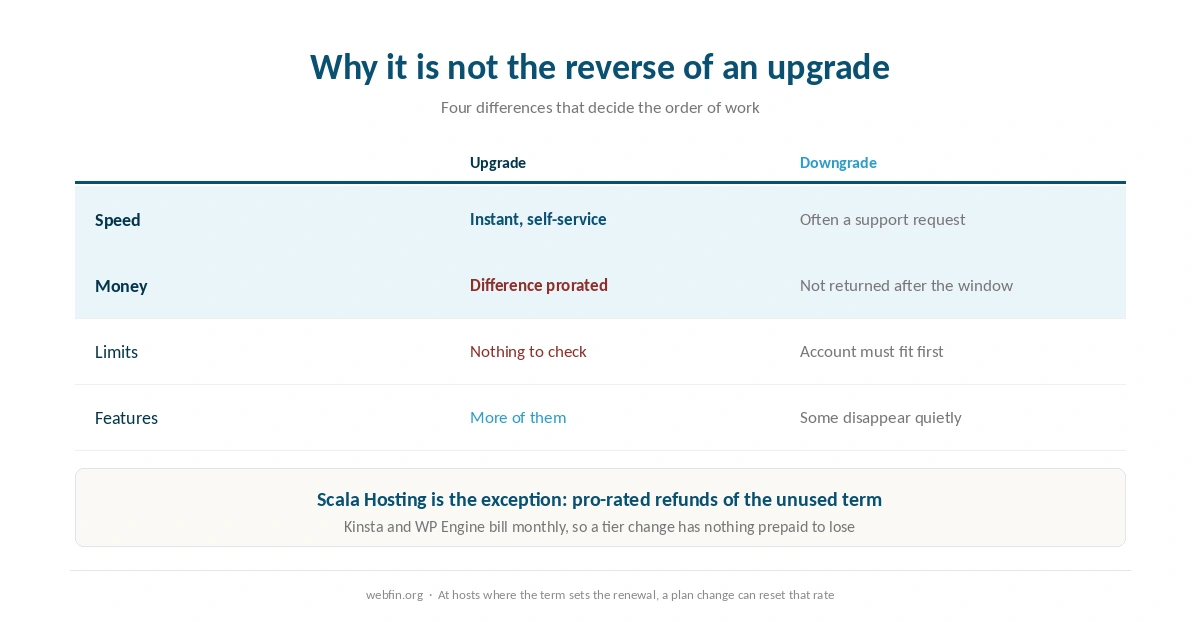
Downgrading a hosting plan is not the reverse of upgrading. An upgrade happens at once, with the difference prorated, because the host collects more. A downgrade often means a support request. The prepaid difference is not returned outside the refund window at any host in our table, apart from Scala Hosting. And it only works once the site fits inside the smaller plan’s limits. So the order matters: shrink the site first, time the change for the renewal date, and check that the features you rely on exist on the tier below.
How to Downgrade a Hosting Plan: The Short Answer
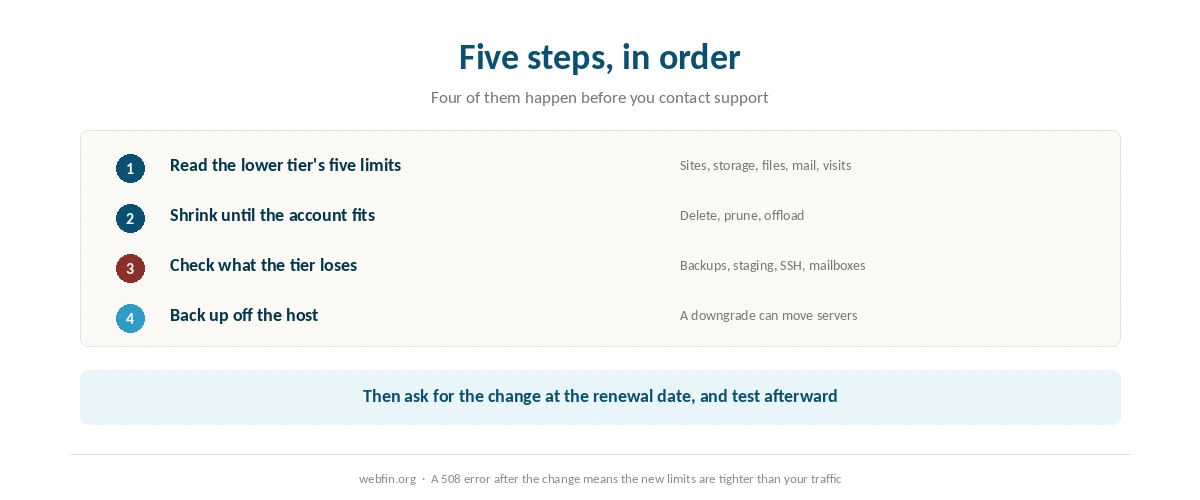
Read the lower plan’s limits on sites, storage, files, mailboxes and visits. Delete what you no longer use and move large media off the host so the site fits. Back everything up. Then ask support to make the change at the renewal date rather than mid-term, and test the site afterward for resource errors.
Why Downgrading Is Harder Than Upgrading
The money rarely comes back. A prepaid term is refunded only inside the refund window, which is 30 days at most hosts in our table. After that the change takes effect without returning the difference. Scala Hosting is the exception, refunding the unused part of a term pro-rated. Our guide to canceling hosting and getting a refund covers the terms.
The limits must fit first. A plan with one site cannot accept an account with three, and a plan with 10 GB will not take 30 GB of uploads. The host checks this, not you.
Some features disappear. Daily backups, staging, extra mailboxes and dedicated resources sit on higher tiers at several hosts. Losing one quietly is worse than paying for it.
The renewal price can change. At hosts where the term sets the renewal, a change of plan can reset the rate you had locked in, which our page on hosting renewal prices records across the field.
Step 1: Read the Lower Plan’s Limits
Write down five numbers for the tier below: sites, storage, files, mailboxes and visits. Then compare each against what you use now. The table below holds the limits we have recorded for the plans we price.
Two of those five catch people out. Files, counted as inodes, include every resized image and every retained backup archive. Bluehost, a Newfold Digital brand, publishes 50,000 as a soft limit. Visits are counted rather than estimated at hosts like Kinsta and WP Engine, where entry tiers include 25,000 a month. Our piece on what unlimited hosting means covers the ceilings behind the marketing.
| Host and plan | Limit | Where it's stated |
|---|---|---|
| Bluehost shared | 50,000 inodes — soft limit | Hosting Inode Limit article |
| Bluehost shared | 200,000 inodes — AUP threshold | Server Resource Limitations |
| Bluehost shared | 1,000,000 inodes — TOS violation | Hosting Inode Limit article |
| Bluehost shared | 5,000 tables or 10 GB, all databases | Server Resource Limitations |
| Bluehost shared | 5 GB per single database | Server Resource Limitations |
| Bluehost Starter | 100 MB per mailbox | Shared hosting prices page |
| WP Engine Startup | 25,000 monthly visits, then overage handling | Plan pages |
| WP Engine, by tier | 25,000 to 400,000 monthly visits | Plan pages |
| Rocket.net Starter | 25,000 monthly visits, 1 site, 10 GB storage | Plan pages |
| Namecheap EasyWP | 50,000 / 200,000 / 500,000 monthly visits by tier | Plan pages |
| Kinsta Starter | 25,000 monthly visits | Plan pages |
| Scala Hosting VPS | Priced per unit: $3 per core, $1 per gigabyte | Plan pages; adjustable anytime |
| HostGator shared | Weekly backups described as a courtesy, not guaranteed | Hosting terms |
| Liquid Web | Dedicated resources at every tier; no shared plan | Plan pages |
| InterServer Standard | Unlimited storage, bandwidth, email and websites | One plan, no tiers |
| GreenGeeks Lite | One website only | Plan pages |
| IONOS Plus | One email account bundled per plan | Plan pages |
| Hostinger, all plans | Not published | Hostinger support article, 28 Aug 2026 |
| Bluehost Starter | 10 GB NVMe storage | Plan pages, as listed in a 2026 audit |
| InMotion Core | One site, 10 email accounts, SSD storage; NVMe from Launch | TechRadar and a 2026 review |
| SiteGround shared | Shell access by tier — not recorded | Not stated on the plan pages we read, 20 Sep 2026 |
| Bluehost shared | Shell access by tier — not recorded | Not stated on the plan pages we read, 20 Sep 2026 |
| Hostinger, all plans | Shell access by tier — not recorded | Not stated on the plan pages we read, 20 Sep 2026 |
| Cloudways servers | Search service (OpenSearch, Elasticsearch) — not recorded | Not stated on the plan pages we read, 20 Sep 2026 |
Step 2: Shrink the Site Before You Ask
Delete sites you no longer run. An abandoned staging copy or an old client site still counts against the plan.
Prune retained backups. Archives kept inside the account fill both the disk and the inode allowance. They belong off the host anyway, as our guide to backing up a WordPress site explains.
Move large media out. Video belongs on a video platform and client downloads on a delivery service. That single change often makes a smaller plan viable.
Clear caches and logs. They regenerate, and they can occupy a surprising share of a small plan.
Step 3: Check What the Tier Below Includes
Compare features rather than prices. HostGator describes its weekly backups as a courtesy and sells daily copies separately. Bluehost Starter caps each mailbox at 100 MB, and managed platforms tie visit allowances to tiers. A downgrade that removes daily backups changes your recovery plan, not just your bill.
Also check the panel and the tools you use. Staging, SSH and Git are not on every tier. A site you deploy with Git does not belong on a plan without it. Our list of hosting for developers records which hosts keep those tools low in the range.
Step 4: Time It for the Renewal
A downgrade mid-term forfeits the balance unless the host pro-rates, as Scala does. So the cheapest moment to shrink is the day the term renews. Put the date in your calendar a month ahead and raise the request then, referencing the renewal date explicitly.
If your term has ten months left and the smaller plan saves a few dollars a month, the arithmetic often says wait. Our guide to choosing between annual and three-year terms works through the same trade in the other direction.
Step 5: Back Up, Change, Then Test
Take a full backup off the host before anything changes. A downgrade moves an account between servers at some hosts, and a copy in your own hands is outside anyone else’s reach.
Afterward, visit the site and an uncached page, send an email, and watch for resource faults over the following week. A 508 error or a slow admin area means tighter limits than your traffic. Our guide to checking whether your host is throttling you explains how to confirm.
Sometimes Moving Beats Downgrading
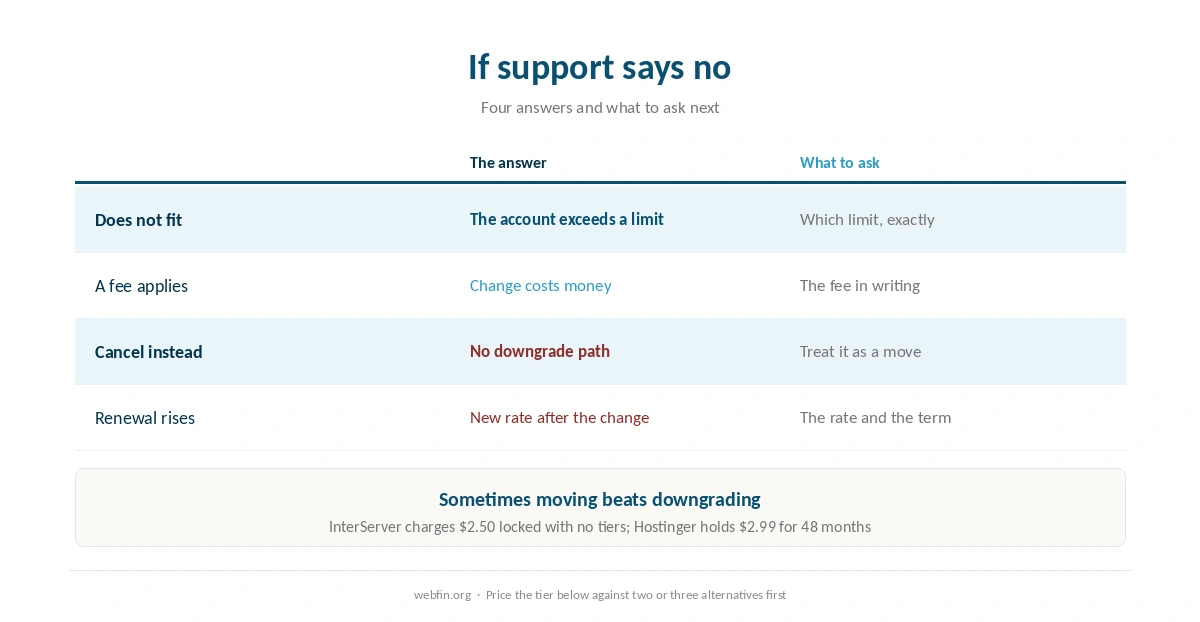
A lower tier at an expensive host can still cost more than a good cheap host. InterServer charges $2.50 a month with the price locked and no tiers to move between, and Hostinger Premium holds $2.99 for 48 months before renewing at $10.99.
So price the tier below against two or three alternatives before you ask for it. If the saving is small and the host has disappointed you, the move is the better use of the same effort. Our roundup of cheap web hosting lists the options, and our guide to migrating web hosting covers the order.
A Downgrade Is Also a Tidy-Up
The work that makes a smaller plan fit is worth doing anyway. Deleting dead sites, pruning archives and moving media off the host all reduce what can break. They also reduce what an attacker can reach, as our guide to recovering a hacked website makes clear.
It also makes the account easier to hand over. One site with a short plugin list and copies kept off the host is a handover; a tangle of old projects is a problem. Our list of hosting for multiple sites covers what several sites share in one account.
The Easy Cases
A cloud server. Cloudways resizes down as readily as up and bills by the hour, so shrinking after a launch costs nothing but the hours you stop using.
A per-unit VPS. Scala prices a processor core at $36.00 a year and a gigabyte of memory at $12.00, so you remove units rather than change product.
A one-plan host. InterServer has nothing to downgrade to, which is the simplest version of this problem.
A monthly managed plan. Kinsta and WP Engine bill monthly, so a tier change takes effect at the next cycle with nothing prepaid to lose.
If Support Says No
The account does not fit. Shrink further: delete sites, prune archives, move media. Ask which specific limit is blocking the change.
A fee applies. Ask for it in writing, then compare it with the saving over the next twelve months.
Only cancellation is offered. That is effectively a move, so plan it as one rather than letting the account lapse.
The renewal price rises after the change. Ask for the new rate before agreeing, and read the term it applies to. Our guide to reading a hosting agreement covers the clause that allows it.
How We Research
This guide describes procedures rather than measurements, and it runs no tests. Plan limits, backup terms, mailbox caps and refund windows come from the providers’ own pages and from our reviews, read on 20 September 2026, and they sit in our tables.
Downgrade mechanics differ by host and change without notice, so the steps describe what to check rather than one company’s menus. The criteria behind our scores are on our about page.
Downgrading FAQ
You can usually change the plan, but the prepaid difference is not returned outside the refund window, which is 30 days at most hosts in our table. Scala Hosting is the exception, refunding the unused part of a term pro-rated.
The account probably does not fit the smaller plan yet. Sites, storage, files and mailboxes all have limits, and the host checks them. Ask which specific limit is blocking the change, then shrink that one.
Check before you ask. Daily backups, staging, SSH, extra mailboxes and visit allowances sit on higher tiers at several hosts, and losing one quietly changes your recovery plan rather than just your bill.
The renewal date. A change mid-term forfeits the balance unless the host pro-rates, so put the renewal in your calendar a month ahead and raise the request then.
Sometimes. A lower tier at an expensive host can cost more than a good cheap one: InterServer charges $2.50 a month locked, and Hostinger Premium holds $2.99 for 48 months. Price the tier below against alternatives first.
The Verdict
Treat a downgrade as a small migration rather than a settings change. Read the lower plan’s limits, shrink the site until it fits, confirm which features you are giving up, and make the change at the renewal date with a backup in your own hands.
And price the alternative while you are there. If the saving is a dollar or two and the host has annoyed you all year, the same afternoon spent moving buys a better outcome. Our page on what web hosting costs compares three-year totals across the plans we price.